

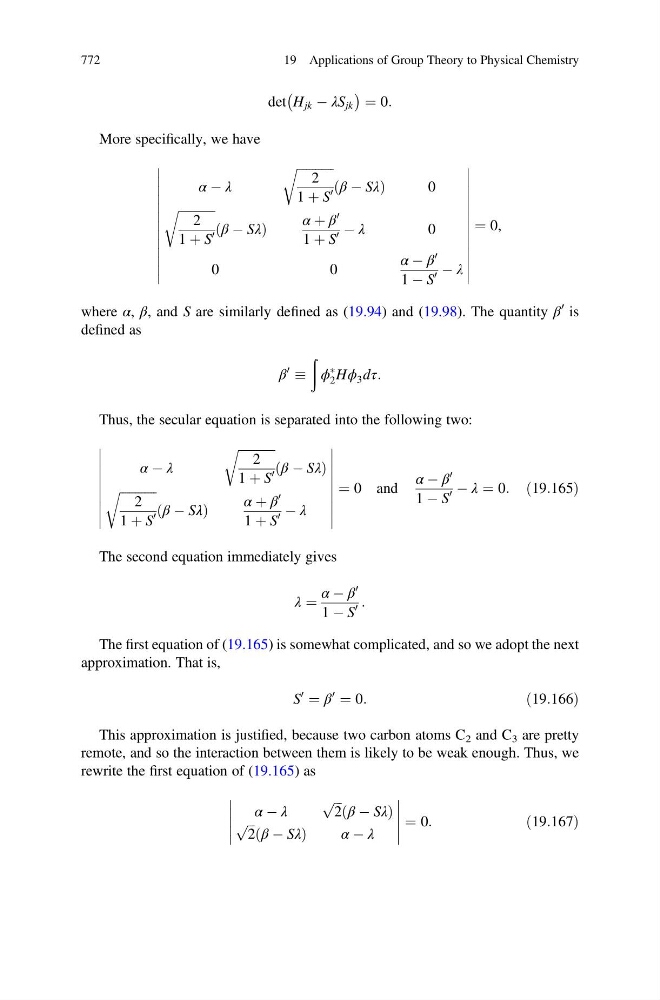
det H jk À λS jk
À
Á ¼ 0:
More specifically, we have
α À λ
ffiffiffiffiffiffiffiffiffiffiffiffi
2
1 þ S
0
r
β À Sλ
ð
Þ
0
ffiffiffiffiffiffiffiffiffiffiffiffi
2
1 þ S
0
r
β À Sλ
ð
Þ
α þ β
0
1 þ S
0 À λ
0
0
0
α À β
0
1 À S
0 À λ
¼ 0,
where α, β, and S are similarly defined as (19.94) and (19.98). The quantity β
0 is
defined as
β
0
ð
ϕ
Ã
2 Hϕ 3 dτ:
Thus, the secular equation is separated into the following two:
α À λ
ffiffiffiffiffiffiffiffiffiffiffiffi
2
1 þ S
0
r
β À Sλ
ð
Þ
ffiffiffiffiffiffiffiffiffiffiffiffi
2
1 þ S
0
r
β À Sλ
ð
Þ
α þ β
0
1 þ S
0 À λ
¼ 0 and
α À β
0
1 À S
0 À λ ¼ 0: ð19:165Þ
The second equation immediately gives
λ ¼
α À β
0
1 À S
0 :
The first equation of (19.165) is somewhat complicated, and so we adopt the next
approximation. That is,
S
0
¼ β
0
¼ 0:
ð19:166Þ
This approximation is justified, because two carbon atoms C 2 and C 3 are pretty
remote, and so the interaction between them is likely to be weak enough. Thus, we
rewrite the first equation of (19.165) as
α À λ
ffiffi ffi
2
p β À Sλ
ð
Þ
ffiffi ffi
2
p β À Sλ
ð
Þ
α À λ
¼ 0:
ð19:167Þ
772
19 Applications of Group Theory to Physical Chemistry