

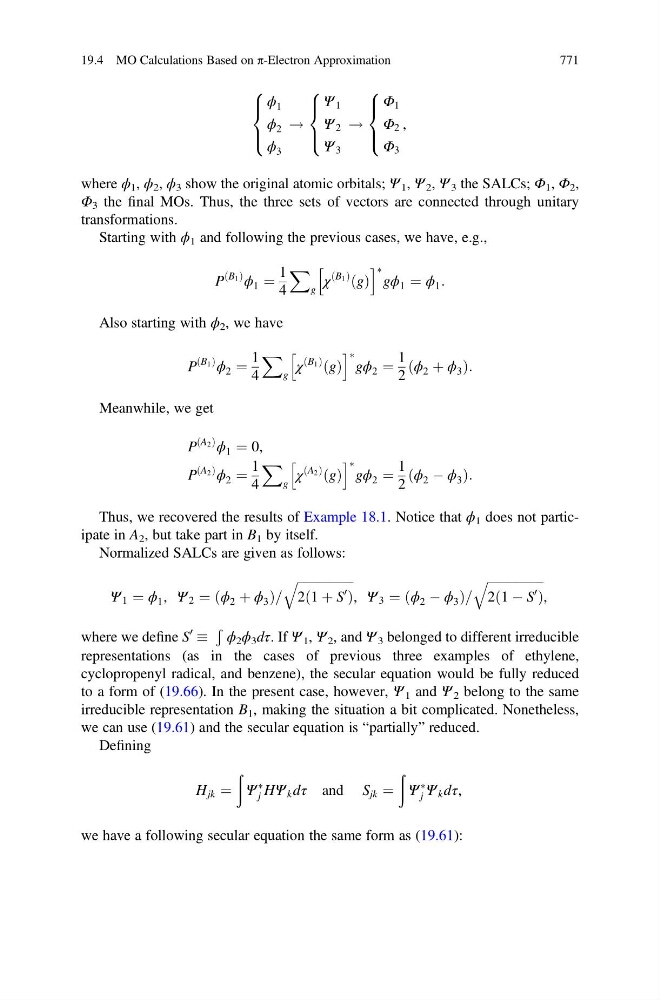
ϕ 1
ϕ 2
ϕ 3
8
> <
> :
!
Ψ 1
Ψ 2
Ψ 3
8
> <
> :
!
Φ 1
Φ 2
Φ 3
8
> <
> :
,
where ϕ 1 , ϕ 2 , ϕ 3 show the original atomic orbitals; Ψ 1 , Ψ 2 , Ψ 3 the SALCs; Φ 1 , Φ 2 ,
Φ 3 the final MOs. Thus, the three sets of vectors are connected through unitary
transformations.
Starting with ϕ 1 and following the previous cases, we have, e.g.,
P
B 1
ð Þ
ϕ 1 ¼
1
4
X
g
χ
B 1
ð Þ g
ð Þ
h
i Ã
gϕ 1 ¼ ϕ 1 :
Also starting with ϕ 2 , we have
P
B 1
ð Þ
ϕ 2 ¼
1
4
X
g
χ
B 1
ð Þ g
ð Þ
h
i Ã
gϕ 2 ¼
1
2
ϕ 2 þ ϕ 3
ð
Þ :
Meanwhile, we get
P
A 2
ð Þ
ϕ 1 ¼ 0,
P
A 2
ð Þ
ϕ 2 ¼
1
4
X
g
χ
A 2
ð Þ g
ð Þ
h
i Ã
gϕ 2 ¼
1
2
ϕ 2 À ϕ 3
ð
Þ :
Thus, we recovered the results of Example 18.1. Notice that ϕ 1 does not participate in A 2 , but take part in B 1 by itself.
Normalized SALCs are given as follows:
Ψ 1 ¼ ϕ 1 , Ψ 2 ¼ ϕ 2 þ ϕ 3
ð
Þ =
ffiffiffiffiffiffiffiffiffiffiffiffiffiffiffiffiffiffi
2 1 þ S
0
ð
Þ
q
, Ψ 3 ¼ ϕ 2 À ϕ 3
ð
Þ =
ffiffiffiffiffiffiffiffiffiffiffiffiffiffiffiffiffiffi
2 1 À S
0
ð
Þ
q
,
where we define S
0
Ð ϕ 2 ϕ 3 dτ. If Ψ 1 , Ψ 2 , and Ψ 3 belonged to different irreducible
representations (as in the cases of previous three examples of ethylene,
cyclopropenyl radical, and benzene), the secular equation would be fully reduced
to a form of (19.66). In the present case, however, Ψ 1 and Ψ 2 belong to the same
irreducible representation B 1 , making the situation a bit complicated. Nonetheless,
we can use (19.61) and the secular equation is “partially” reduced.
Defining
H jk ¼
ð
Ψ
Ã
j HΨ k dτ and S jk ¼
ð
Ψ
Ã
j Ψ k dτ,
we have a following secular equation the same form as (19.61):
19.4 MO Calculations Based on π-Electron Approximation
771