

Γ ¼ B 1u þ B 2u þ E 1u :
ð19:163Þ
Notice that unlike ethylene a direct-product representation associated with the
final state is reducible.
To examine whether (19.162) is nonvanishing, as in the case of (19.109) we
estimate whether a direct-product representation A 1g  E 1g  E 2u ¼ E 1g  E 2u ¼
B 1u + B 2u + E 1u contains an irreducible representation which ε e Á P belongs
to. Consulting a character table of D 6h , we find that x and y belong to an irreducible
representation E 1u and that z belongs to A 2u . Since the direct sum Γ in (19.163)
contains E 1u , benzene is expected to be polarized along both x- and y-axes (see
Fig. 19.10). Since (19.163) does not contain A 2u , the transition along the z-axis is
forbidden. Accordingly, the transition takes place when the light is polarized parallel
to the molecular plane (i.e., the xy-plane). This is a common feature among planar
aromatic molecules including benzene and cyclopropenyl radical. On the other hand,
A 2u is not contained in Γ, and so we do not expect the optical transition to occur in
the direction of the z-axis.
19.4.4 Allyl Radical [1]
We revisit the allyl radical and perform its MO calculations. As already noted,
Tables 18.1 and 18.2 of Example 18.1 collected representation matrices of individual
symmetry operations in reference to the basis vectors comprising three atomic
orbitals of allyl radical. As usual, we examine traces (or characters) of those
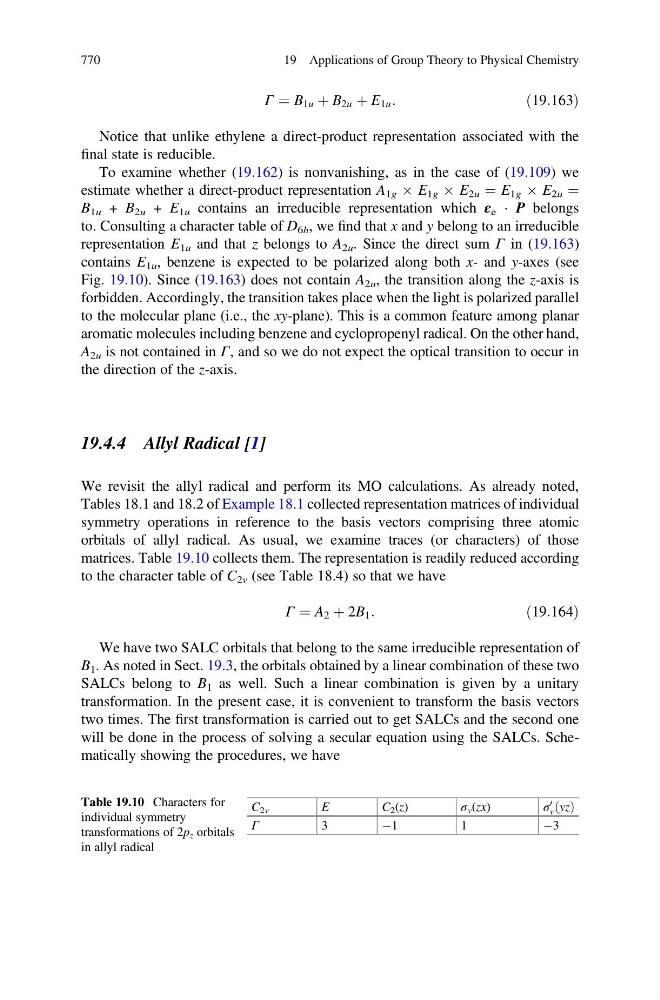
matrices. Table 19.10 collects them. The representation is readily reduced according
to the character table of C 2v (see Table 18.4) so that we have
Γ ¼ A 2 þ 2B 1 :
ð19:164Þ
We have two SALC orbitals that belong to the same irreducible representation of
B 1 . As noted in Sect. 19.3, the orbitals obtained by a linear combination of these two
SALCs belong to B 1 as well. Such a linear combination is given by a unitary
transformation. In the present case, it is convenient to transform the basis vectors
two times. The first transformation is carried out to get SALCs and the second one
will be done in the process of solving a secular equation using the SALCs. Schematically showing the procedures, we have
Table 19.10 Characters for
individual symmetry
transformations of 2p z orbitals
in allyl radical
C 2v
E
C 2 (z)
σ v (zx)
σ
0
v yz
ð Þ
Γ
3
À1
1
À3
770
19 Applications of Group Theory to Physical Chemistry