

f
Ψ 3 ¼
2ϕ 1 þ ϕ 2 À ϕ 3 À 2ϕ 4 À ϕ 5 þ ϕ 6
ffiffiffiffiffiffiffiffiffiffiffiffiffiffiffiffiffiffiffiffiffiffiffiffiffiffiffiffiffiffiffiffiffiffiffiffiffiffiffi
12 1 þ S À S
0
À S
00
ð
Þ
p
,
f
Ψ 4 ¼
ϕ 2 þ ϕ 3 À ϕ 5 À ϕ 6
2
ffiffiffiffiffiffiffiffiffiffiffiffiffiffiffiffiffiffiffiffiffiffiffiffiffiffiffiffiffiffi ffi
1 þ S À S
0
À S
00
p
:
ð19:160Þ
Similarly, transforming Ψ 5 and Ψ 6 to f
Ψ 5 and f
Ψ 6 , respectively, we have
f
Ψ 5 ¼
2ϕ 1 À ϕ 2 À ϕ 3 þ 2ϕ 4 À ϕ 5 À ϕ 6
ffiffiffiffiffiffiffiffiffiffiffiffiffiffiffiffiffiffiffiffiffiffiffiffiffiffiffiffiffiffiffiffiffiffiffiffiffiffiffi
12 1 À S À S
0
þ S
00
ð
Þ
p
,
f
Ψ 6 ¼
ϕ 2 À ϕ 3 þ ϕ 5 À ϕ 6
2
ffiffiffiffiffiffiffiffiffiffiffiffiffiffiffiffiffiffiffiffiffiffiffiffiffiffiffiffiffiffi ffi
1 À S À S
0
þ S
00
p
:
ð19:161Þ
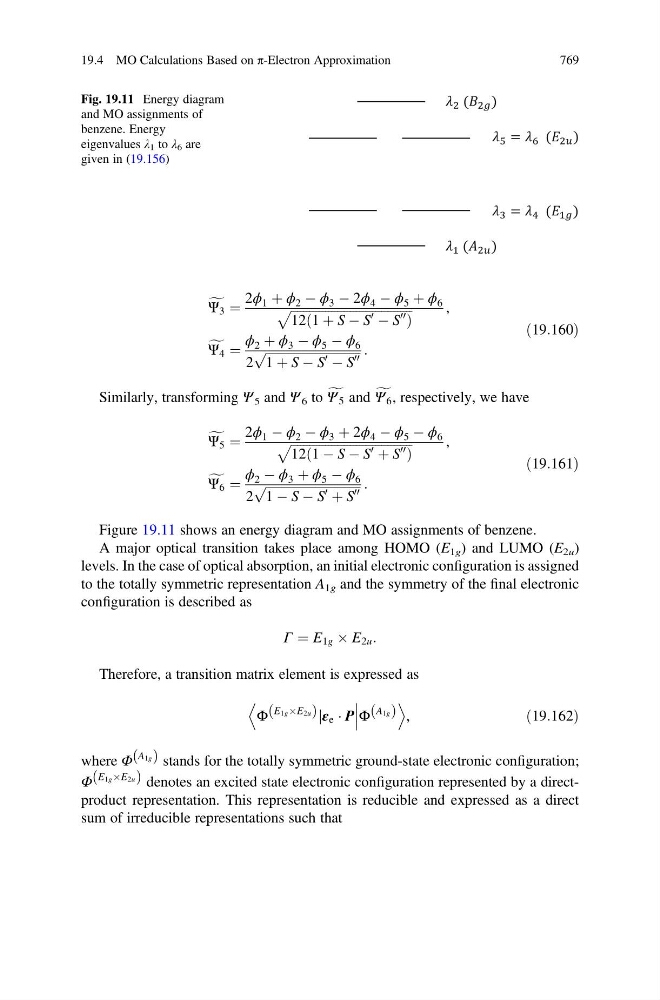
Figure 19.11 shows an energy diagram and MO assignments of benzene.
A major optical transition takes place among HOMO (E 1g ) and LUMO (E 2u )
levels. In the case of optical absorption, an initial electronic configuration is assigned
to the totally symmetric representation A 1g and the symmetry of the final electronic
configuration is described as
Γ ¼ E 1g  E 2u :
Therefore, a transition matrix element is expressed as
Φ
E 1g ÂE 2u
ð
Þ
D
ε e Á P
j
Φ
A 1g
ð Þ
E
,
ð19:162Þ
where Φ
A 1g
ð Þ stands for the totally symmetric ground-state electronic configuration;
Φ
E 1g ÂE 2u
ð
Þ denotes an excited state electronic configuration represented by a directproduct representation. This representation is reducible and expressed as a direct
sum of irreducible representations such that
=
(
)
=
(
)
(
)
Fig. 19.11 Energy diagram
and MO assignments of
benzene. Energy
eigenvalues λ 1 to λ 6 are
given in (19.156)
19.4 MO Calculations Based on π-Electron Approximation
769