

C 6 z
ð Þ ¼
0 1 0 0 0 0
0 0 1 0 0 0
0 0 0 1 0 0
0 0 0 0 1 0
0 0 0 0 0 1
1 0 0 0 0 0
0
B
B
B
B
B
B
B
B
@
1
C
C
C
C
C
C
C
C
A
:
ð19:148Þ
Once again, we can determine the trace for individual symmetry transformations
belonging to D 6h . We collect the results in Table 19.7. The representation is
reducible and this is reduced as follows using a character table of D 6h
(Table 19.8). As a result, we get
Γ ¼ A 2u þ B 2g þ E 1g þ E 2u :
ð19:149Þ
As a subduced representation of D of D 6h to C 6 , we have
A 2u # C 6 ¼ A, B 2g # C 6 ¼ B, E 1g # C 6 ¼ 2E 1 , E 2u # C 6 ¼ 2E 2 :
ð19:150Þ
Here, we used Table 19.9 that shows a character table of irreducible representations of C 6 . Following the previous procedures, as SALCs we have
x
O
z
y
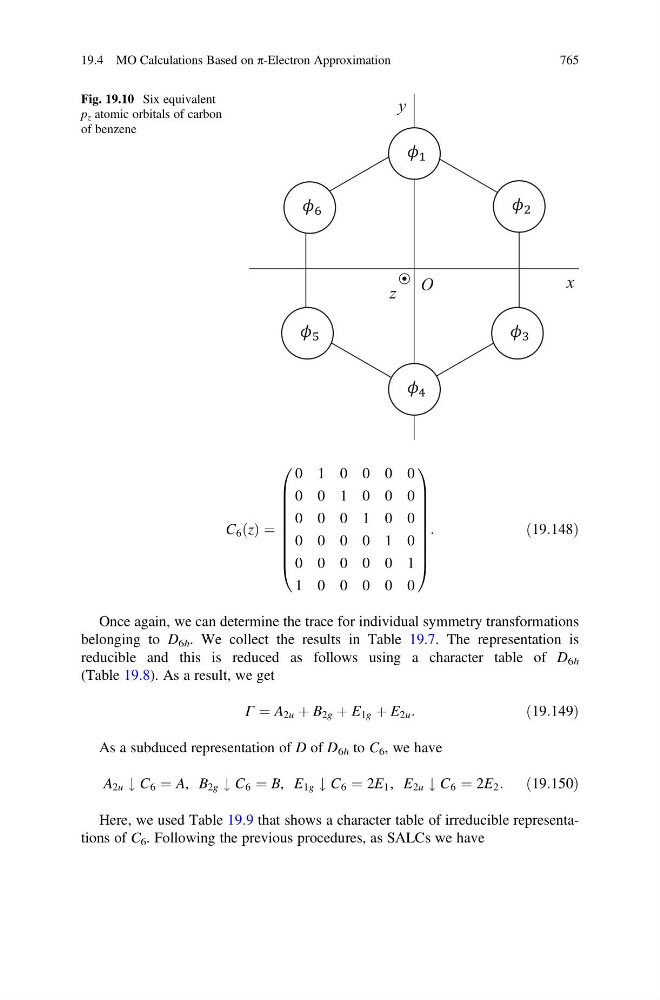
Fig. 19.10 Six equivalent
p z atomic orbitals of carbon
of benzene
19.4 MO Calculations Based on π-Electron Approximation
765