

Thus, we have successfully converted complex functions to real functions. In the
above unitary transformation, notice that a norm of the vectors remains unchanged
before and after the unitary transformation.
As cyclopropenyl radical has three π electrons, two occupy the lowest energy
level of A
00
. Another electron occupies a level E
00 . Since this level possesses an
energy higher than α, the electron occupying this level is anticipated to be unstable.
Under such a circumstance, a molecule tends to lose the said electron so as to be a
cation. Following the argument given in the previous case of ethylene, it is easy to
make sure that the allowed transition of the cyclopropenyl radical takes place when
the light is polarized parallel to the molecular plane (i.e., the xy-plane in Fig. 19.8).
The proof is left for readers as an exercise. This polarizing feature is typical of planar
molecules with high molecular symmetry.
19.4.3 Benzene
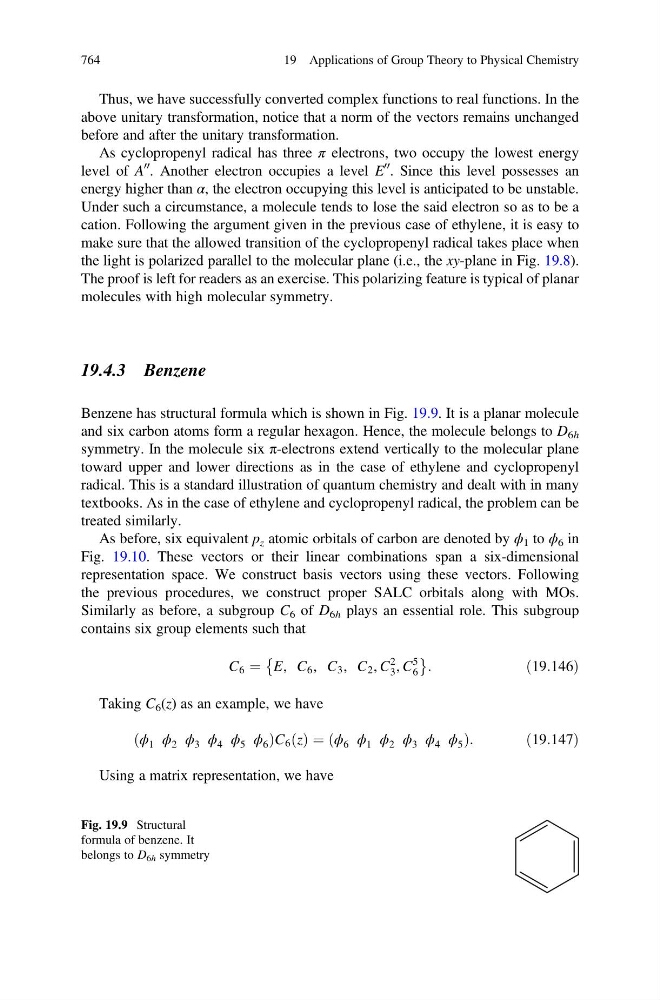
Benzene has structural formula which is shown in Fig. 19.9. It is a planar molecule
and six carbon atoms form a regular hexagon. Hence, the molecule belongs to D 6h
symmetry. In the molecule six π-electrons extend vertically to the molecular plane
toward upper and lower directions as in the case of ethylene and cyclopropenyl
radical. This is a standard illustration of quantum chemistry and dealt with in many
textbooks. As in the case of ethylene and cyclopropenyl radical, the problem can be
treated similarly.
As before, six equivalent p z atomic orbitals of carbon are denoted by ϕ 1 to ϕ 6 in
Fig. 19.10. These vectors or their linear combinations span a six-dimensional
representation space. We construct basis vectors using these vectors. Following
the previous procedures, we construct proper SALC orbitals along with MOs.
Similarly as before, a subgroup C 6 of D 6h plays an essential role. This subgroup
contains six group elements such that
C 6 ¼ E, C 6 , C 3 , C 2 , C
2
3 , C
5
6
È
É :
ð19:146Þ
Taking C 6 (z) as an example, we have
ϕ 1 ϕ 2 ϕ 3 ϕ 4 ϕ 5 ϕ 6
ð
Þ C 6 z
ð Þ ¼ ϕ 6 ϕ 1 ϕ 2 ϕ 3 ϕ 4 ϕ 5
ð
Þ :
ð19:147Þ
Using a matrix representation, we have
Fig. 19.9 Structural
formula of benzene. It
belongs to D 6h symmetry
764
19 Applications of Group Theory to Physical Chemistry