

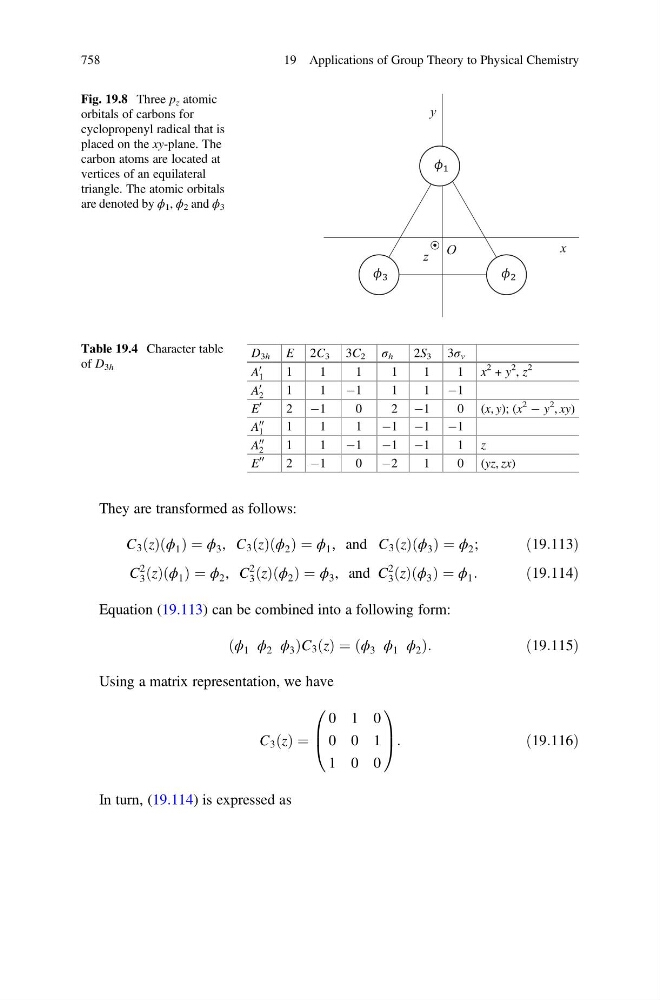
They are transformed as follows:
C 3 z
ð Þ ϕ 1
ð Þ ¼ ϕ 3 , C 3 z
ð Þ ϕ 2
ð Þ ¼ ϕ 1 , and C 3 z
ð Þ ϕ 3
ð Þ ¼ ϕ 2 ;
ð19:113Þ
C
2
3 z
ð Þ ϕ 1
ð Þ ¼ ϕ 2 , C
2
3 z
ð Þ ϕ 2
ð Þ ¼ ϕ 3 , and C
2
3 z
ð Þ ϕ 3
ð Þ ¼ ϕ 1 :
ð19:114Þ
Equation (19.113) can be combined into a following form:
ϕ 1 ϕ 2 ϕ 3
ð
Þ C 3 z
ð Þ ¼ ϕ 3 ϕ 1 ϕ 2
ð
Þ :
ð19:115Þ
Using a matrix representation, we have
C 3 z
ð Þ ¼
0 1 0
0 0 1
1 0 0
0
B
@
1
C
A:
ð19:116Þ
In turn, (19.114) is expressed as
x
O
z
y
Fig. 19.8 Three p z atomic
orbitals of carbons for
cyclopropenyl radical that is
placed on the xy-plane. The
carbon atoms are located at
vertices of an equilateral
triangle. The atomic orbitals
are denoted by ϕ 1 , ϕ 2 and ϕ 3
Table 19.4 Character table
of D 3h
D 3h E 2C 3 3C 2 σ h
2S 3 3σ v
A
0
1
1
1
1
1
1
1 x
2 + y
2
, z
2
A
0
2
1
1
À1
1
1 À1
E
0
2 À1
0
2 À1
0 (x, y); (x
2 À y
2
, xy)
A
00
1
1
1
1
À1 À1 À1
A
00
2
1
1
À1
À1 À1
1 z
E
00
2 À1
0
À2
1
0 (yz, zx)
758
19 Applications of Group Theory to Physical Chemistry
C 3 z
ð Þ ϕ 1
ð Þ ¼ ϕ 3 , C 3 z
ð Þ ϕ 2
ð Þ ¼ ϕ 1 , and C 3 z
ð Þ ϕ 3
ð Þ ¼ ϕ 2 ;
ð19:113Þ
C
2
3 z
ð Þ ϕ 1
ð Þ ¼ ϕ 2 , C
2
3 z
ð Þ ϕ 2
ð Þ ¼ ϕ 3 , and C
2
3 z
ð Þ ϕ 3
ð Þ ¼ ϕ 1 :
ð19:114Þ
Equation (19.113) can be combined into a following form:
ϕ 1 ϕ 2 ϕ 3
ð
Þ C 3 z
ð Þ ¼ ϕ 3 ϕ 1 ϕ 2
ð
Þ :
ð19:115Þ
Using a matrix representation, we have
C 3 z
ð Þ ¼
0 1 0
0 0 1
1 0 0
0
B
@
1
C
A:
ð19:116Þ
In turn, (19.114) is expressed as
x
O
z
y
Fig. 19.8 Three p z atomic
orbitals of carbons for
cyclopropenyl radical that is
placed on the xy-plane. The
carbon atoms are located at
vertices of an equilateral
triangle. The atomic orbitals
are denoted by ϕ 1 , ϕ 2 and ϕ 3
Table 19.4 Character table
of D 3h
D 3h E 2C 3 3C 2 σ h
2S 3 3σ v
A
0
1
1
1
1
1
1
1 x
2 + y
2
, z
2
A
0
2
1
1
À1
1
1 À1
E
0
2 À1
0
2 À1
0 (x, y); (x
2 À y
2
, xy)
A
00
1
1
1
1
À1 À1 À1
A
00
2
1
1
À1
À1 À1
1 z
E
00
2 À1
0
À2
1
0 (yz, zx)
758
19 Applications of Group Theory to Physical Chemistry