

q B 3u ¼
1
8
1 Â 1 þ À1
ð ÞÂ À1
ð Þþ1 Â À1
ð Þþ À1
ð ÞÂ1
½
þ À1
ð ÞÂ À1
ð Þþ1 Â 1 þ À1
ð ÞÂ1 þ 1 Â À1
ð Þ ¼ 0:
This implies that B 3u is not contained in B 1u  B 3g (¼B 2u ).
The above results on the optical transitions are quite obvious. Once we get used to
using a character table, quick estimation will be done.
19.4.2 Cyclopropenyl Radical [1]
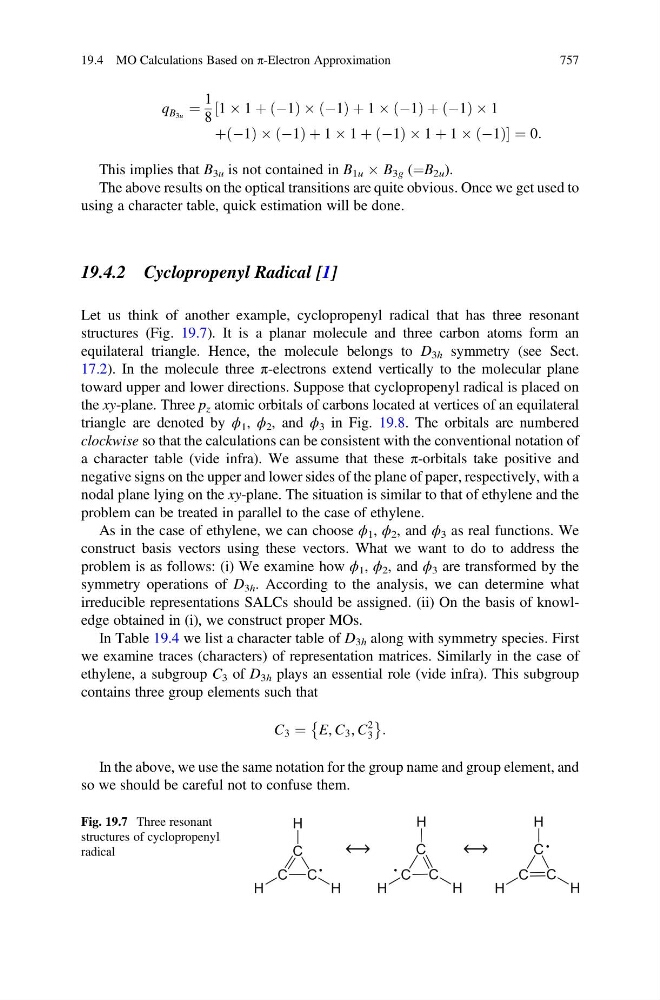
Let us think of another example, cyclopropenyl radical that has three resonant
structures (Fig. 19.7). It is a planar molecule and three carbon atoms form an
equilateral triangle. Hence, the molecule belongs to D 3h symmetry (see Sect.
17.2). In the molecule three π-electrons extend vertically to the molecular plane
toward upper and lower directions. Suppose that cyclopropenyl radical is placed on
the xy-plane. Three p z atomic orbitals of carbons located at vertices of an equilateral
triangle are denoted by ϕ 1 , ϕ 2 , and ϕ 3 in Fig. 19.8. The orbitals are numbered
clockwise so that the calculations can be consistent with the conventional notation of
a character table (vide infra). We assume that these π-orbitals take positive and
negative signs on the upper and lower sides of the plane of paper, respectively, with a
nodal plane lying on the xy-plane. The situation is similar to that of ethylene and the
problem can be treated in parallel to the case of ethylene.
As in the case of ethylene, we can choose ϕ 1 , ϕ 2 , and ϕ 3 as real functions. We
construct basis vectors using these vectors. What we want to do to address the
problem is as follows: (i) We examine how ϕ 1 , ϕ 2 , and ϕ 3 are transformed by the
symmetry operations of D 3h . According to the analysis, we can determine what
irreducible representations SALCs should be assigned. (ii) On the basis of knowledge obtained in (i), we construct proper MOs.
In Table 19.4 we list a character table of D 3h along with symmetry species. First
we examine traces (characters) of representation matrices. Similarly in the case of
ethylene, a subgroup C 3 of D 3h plays an essential role (vide infra). This subgroup
contains three group elements such that
C 3 ¼ E, C 3 , C
2
3
È
É :
In the above, we use the same notation for the group name and group element, and
so we should be careful not to confuse them.
⋅
⋅
⟷
⟷
⋅
Fig. 19.7 Three resonant
structures of cyclopropenyl
radical
19.4 MO Calculations Based on π-Electron Approximation
757