

M fi ¼ Φ
β
ð Þ
f jO
γ
ð Þ
jΦ
α
ð Þ
i
D
E
,
ð19:110Þ
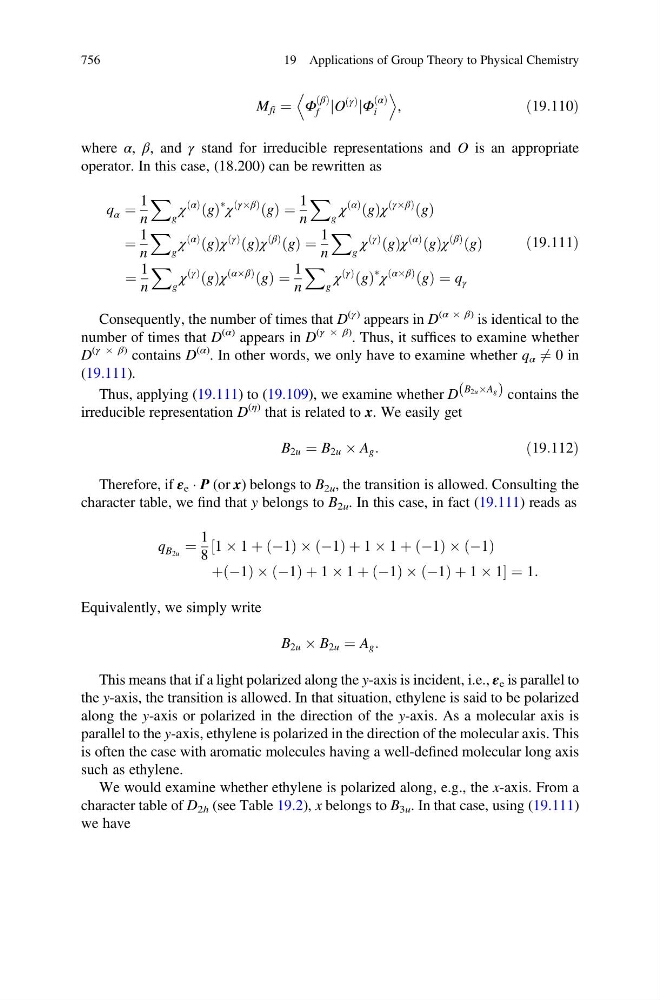
where α, β, and γ stand for irreducible representations and O is an appropriate
operator. In this case, (18.200) can be rewritten as
q α ¼
1
n
X
g
χ
α
ð Þ g
ð Þ
à χ
γÂβ
ð
Þ g
ð Þ ¼
1
n
X
g
χ
α
ð Þ g
ð Þχ
γÂβ
ð
Þ g
ð Þ
¼
1
n
X
g
χ
α
ð Þ g
ð Þχ
γ
ð Þ g
ð Þχ
β
ð Þ g
ð Þ ¼
1
n
X
g
χ
γ
ð Þ g
ð Þχ
α
ð Þ g
ð Þχ
β
ð Þ g
ð Þ
¼
1
n
X
g
χ
γ
ð Þ g
ð Þχ
αÂβ
ð
Þ g
ð Þ ¼
1
n
X
g
χ
γ
ð Þ g
ð Þ
à χ
αÂβ
ð
Þ g
ð Þ ¼ q γ
ð19:111Þ
Consequently, the number of times that D
(γ) appears in D
(α Â β) is identical to the
number of times that D
(α) appears in D
(γ Â β) . Thus, it suffices to examine whether
D
(γ Â β) contains D
(α)
. In other words, we only have to examine whether q α 6 ¼ 0 in
(19.111).
Thus, applying (19.111) to (19.109), we examine whether D
B 2u ÂA g
ð
Þ contains the
irreducible representation D
(η) that is related to x. We easily get
B 2u ¼ B 2u  A g :
ð19:112Þ
Therefore, if ε e Á P (or x) belongs to B 2u , the transition is allowed. Consulting the
character table, we find that y belongs to B 2u . In this case, in fact (19.111) reads as
q B 2u ¼
1
8
1 Â 1 þ À1
ð ÞÂ À1
ð Þþ1 Â 1 þ À1
ð ÞÂ À1
ð Þ
½
þ À1
ð ÞÂ À1
ð Þþ1 Â 1 þ À1
ð ÞÂ À1
ð Þþ1 Â 1 ¼ 1:
Equivalently, we simply write
B 2u  B 2u ¼ A g :
This means that if a light polarized along the y-axis is incident, i.e., ε e is parallel to
the y-axis, the transition is allowed. In that situation, ethylene is said to be polarized
along the y-axis or polarized in the direction of the y-axis. As a molecular axis is
parallel to the y-axis, ethylene is polarized in the direction of the molecular axis. This
is often the case with aromatic molecules having a well-defined molecular long axis
such as ethylene.
We would examine whether ethylene is polarized along, e.g., the x-axis. From a
character table of D 2h (see Table 19.2), x belongs to B 3u . In that case, using (19.111)
we have
756
19 Applications of Group Theory to Physical Chemistry
β
ð Þ
f jO
γ
ð Þ
jΦ
α
ð Þ
i
D
E
,
ð19:110Þ
where α, β, and γ stand for irreducible representations and O is an appropriate
operator. In this case, (18.200) can be rewritten as
q α ¼
1
n
X
g
χ
α
ð Þ g
ð Þ
à χ
γÂβ
ð
Þ g
ð Þ ¼
1
n
X
g
χ
α
ð Þ g
ð Þχ
γÂβ
ð
Þ g
ð Þ
¼
1
n
X
g
χ
α
ð Þ g
ð Þχ
γ
ð Þ g
ð Þχ
β
ð Þ g
ð Þ ¼
1
n
X
g
χ
γ
ð Þ g
ð Þχ
α
ð Þ g
ð Þχ
β
ð Þ g
ð Þ
¼
1
n
X
g
χ
γ
ð Þ g
ð Þχ
αÂβ
ð
Þ g
ð Þ ¼
1
n
X
g
χ
γ
ð Þ g
ð Þ
à χ
αÂβ
ð
Þ g
ð Þ ¼ q γ
ð19:111Þ
Consequently, the number of times that D
(γ) appears in D
(α Â β) is identical to the
number of times that D
(α) appears in D
(γ Â β) . Thus, it suffices to examine whether
D
(γ Â β) contains D
(α)
. In other words, we only have to examine whether q α 6 ¼ 0 in
(19.111).
Thus, applying (19.111) to (19.109), we examine whether D
B 2u ÂA g
ð
Þ contains the
irreducible representation D
(η) that is related to x. We easily get
B 2u ¼ B 2u  A g :
ð19:112Þ
Therefore, if ε e Á P (or x) belongs to B 2u , the transition is allowed. Consulting the
character table, we find that y belongs to B 2u . In this case, in fact (19.111) reads as
q B 2u ¼
1
8
1 Â 1 þ À1
ð ÞÂ À1
ð Þþ1 Â 1 þ À1
ð ÞÂ À1
ð Þ
½
þ À1
ð ÞÂ À1
ð Þþ1 Â 1 þ À1
ð ÞÂ À1
ð Þþ1 Â 1 ¼ 1:
Equivalently, we simply write
B 2u  B 2u ¼ A g :
This means that if a light polarized along the y-axis is incident, i.e., ε e is parallel to
the y-axis, the transition is allowed. In that situation, ethylene is said to be polarized
along the y-axis or polarized in the direction of the y-axis. As a molecular axis is
parallel to the y-axis, ethylene is polarized in the direction of the molecular axis. This
is often the case with aromatic molecules having a well-defined molecular long axis
such as ethylene.
We would examine whether ethylene is polarized along, e.g., the x-axis. From a
character table of D 2h (see Table 19.2), x belongs to B 3u . In that case, using (19.111)
we have
756
19 Applications of Group Theory to Physical Chemistry