

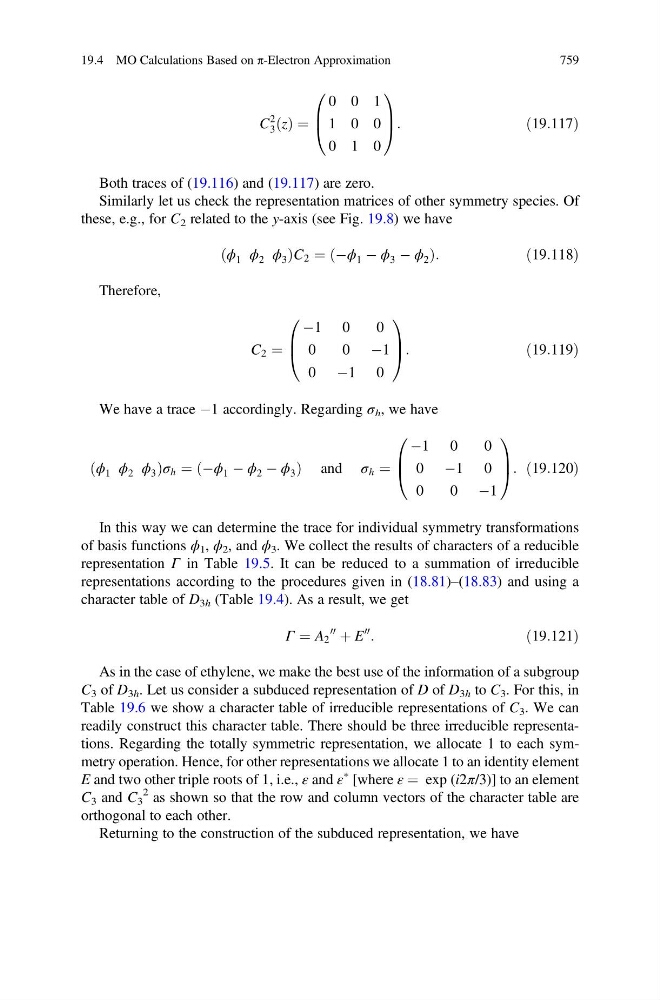
C
2
3 z
ð Þ ¼
0 0 1
1 0 0
0 1 0
0
B
@
1
C
A:
ð19:117Þ
Both traces of (19.116) and (19.117) are zero.
Similarly let us check the representation matrices of other symmetry species. Of
these, e.g., for C 2 related to the y-axis (see Fig. 19.8) we have
ϕ 1 ϕ 2 ϕ 3
ð
Þ C 2 ¼ Àϕ 1 À ϕ 3 À ϕ 2
ð
Þ :
ð19:118Þ
Therefore,
C 2 ¼
À1 0
0
0
0 À1
0 À1 0
0
B
@
1
C
A:
ð19:119Þ
We have a trace À1 accordingly. Regarding σ h , we have
ϕ 1 ϕ 2 ϕ 3
ð
Þ σ h ¼ Àϕ 1 À ϕ 2 À ϕ 3
ð
Þ and σ h ¼
À1 0
0
0 À1 0
0
0 À1
0
B
@
1
C
A: ð19:120Þ
In this way we can determine the trace for individual symmetry transformations
of basis functions ϕ 1 , ϕ 2 , and ϕ 3 . We collect the results of characters of a reducible
representation Γ in Table 19.5. It can be reduced to a summation of irreducible
representations according to the procedures given in (18.81)–(18.83) and using a
character table of D 3h (Table 19.4). As a result, we get
Γ ¼ A 2
00
þ E
00
:
ð19:121Þ
As in the case of ethylene, we make the best use of the information of a subgroup
C 3 of D 3h . Let us consider a subduced representation of D of D 3h to C 3 . For this, in
Table 19.6 we show a character table of irreducible representations of C 3 . We can
readily construct this character table. There should be three irreducible representations. Regarding the totally symmetric representation, we allocate 1 to each symmetry operation. Hence, for other representations we allocate 1 to an identity element
E and two other triple roots of 1, i.e., ε and ε
à [where ε ¼ exp (i2π/3)] to an element
C 3 and C 3
2 as shown so that the row and column vectors of the character table are
orthogonal to each other.
Returning to the construction of the subduced representation, we have
19.4 MO Calculations Based on π-Electron Approximation
759