

P
B
ð Þ
ϕ 1 ¼
1
2
X
g
χ
B
ð Þ g
ð Þ
h
i Ã
gϕ 1 ¼
1
2
1 Á ϕ 1 þ À1
ð Þϕ 2
½
¼
1
2
ϕ 1 À ϕ 2
ð
Þ : ð19:86Þ
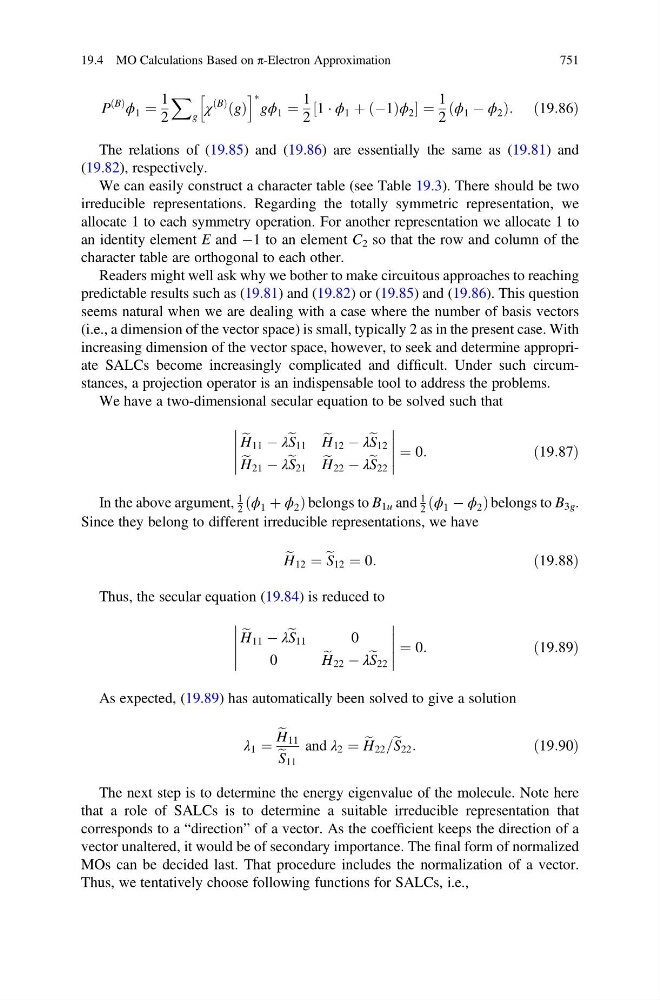
The relations of (19.85) and (19.86) are essentially the same as (19.81) and
(19.82), respectively.
We can easily construct a character table (see Table 19.3). There should be two
irreducible representations. Regarding the totally symmetric representation, we
allocate 1 to each symmetry operation. For another representation we allocate 1 to
an identity element E and À1 to an element C 2 so that the row and column of the
character table are orthogonal to each other.
Readers might well ask why we bother to make circuitous approaches to reaching
predictable results such as (19.81) and (19.82) or (19.85) and (19.86). This question
seems natural when we are dealing with a case where the number of basis vectors
(i.e., a dimension of the vector space) is small, typically 2 as in the present case. With
increasing dimension of the vector space, however, to seek and determine appropriate SALCs become increasingly complicated and difficult. Under such circumstances, a projection operator is an indispensable tool to address the problems.
We have a two-dimensional secular equation to be solved such that
e
H 11 À λ e S 11 e
H 12 À λ e S 12
e
H 21 À λ e S 21 e
H 22 À λ e S 22
¼ 0:
ð19:87Þ
In the above argument,
1
2 ϕ 1 þ ϕ 2
ð
Þbelongs to B 1u and
1
2 ϕ 1 À ϕ 2
ð
Þbelongs to B 3g .
Since they belong to different irreducible representations, we have
e
H 12 ¼ e S 12 ¼ 0:
ð19:88Þ
Thus, the secular equation (19.84) is reduced to
e
H 11 À λ e S 11
0
0
e
H 22 À λ e S 22
¼ 0:
ð19:89Þ
As expected, (19.89) has automatically been solved to give a solution
λ 1 ¼
e
H 11
e S 11
and λ 2 ¼ e
H 22 = e S 22 :
ð19:90Þ
The next step is to determine the energy eigenvalue of the molecule. Note here
that a role of SALCs is to determine a suitable irreducible representation that
corresponds to a “direction” of a vector. As the coefficient keeps the direction of a
vector unaltered, it would be of secondary importance. The final form of normalized
MOs can be decided last. That procedure includes the normalization of a vector.
Thus, we tentatively choose following functions for SALCs, i.e.,
19.4 MO Calculations Based on π-Electron Approximation
751
B
ð Þ
ϕ 1 ¼
1
2
X
g
χ
B
ð Þ g
ð Þ
h
i Ã
gϕ 1 ¼
1
2
1 Á ϕ 1 þ À1
ð Þϕ 2
½
¼
1
2
ϕ 1 À ϕ 2
ð
Þ : ð19:86Þ
The relations of (19.85) and (19.86) are essentially the same as (19.81) and
(19.82), respectively.
We can easily construct a character table (see Table 19.3). There should be two
irreducible representations. Regarding the totally symmetric representation, we
allocate 1 to each symmetry operation. For another representation we allocate 1 to
an identity element E and À1 to an element C 2 so that the row and column of the
character table are orthogonal to each other.
Readers might well ask why we bother to make circuitous approaches to reaching
predictable results such as (19.81) and (19.82) or (19.85) and (19.86). This question
seems natural when we are dealing with a case where the number of basis vectors
(i.e., a dimension of the vector space) is small, typically 2 as in the present case. With
increasing dimension of the vector space, however, to seek and determine appropriate SALCs become increasingly complicated and difficult. Under such circumstances, a projection operator is an indispensable tool to address the problems.
We have a two-dimensional secular equation to be solved such that
e
H 11 À λ e S 11 e
H 12 À λ e S 12
e
H 21 À λ e S 21 e
H 22 À λ e S 22
¼ 0:
ð19:87Þ
In the above argument,
1
2 ϕ 1 þ ϕ 2
ð
Þbelongs to B 1u and
1
2 ϕ 1 À ϕ 2
ð
Þbelongs to B 3g .
Since they belong to different irreducible representations, we have
e
H 12 ¼ e S 12 ¼ 0:
ð19:88Þ
Thus, the secular equation (19.84) is reduced to
e
H 11 À λ e S 11
0
0
e
H 22 À λ e S 22
¼ 0:
ð19:89Þ
As expected, (19.89) has automatically been solved to give a solution
λ 1 ¼
e
H 11
e S 11
and λ 2 ¼ e
H 22 = e S 22 :
ð19:90Þ
The next step is to determine the energy eigenvalue of the molecule. Note here
that a role of SALCs is to determine a suitable irreducible representation that
corresponds to a “direction” of a vector. As the coefficient keeps the direction of a
vector unaltered, it would be of secondary importance. The final form of normalized
MOs can be decided last. That procedure includes the normalization of a vector.
Thus, we tentatively choose following functions for SALCs, i.e.,
19.4 MO Calculations Based on π-Electron Approximation
751