

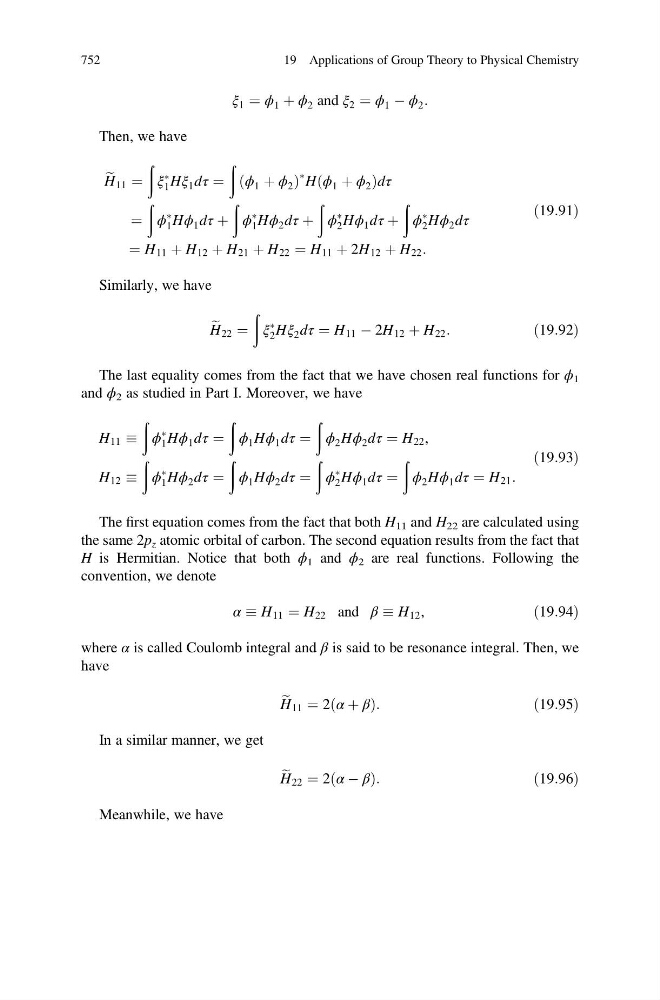
ξ 1 ¼ ϕ 1 þ ϕ 2 and ξ 2 ¼ ϕ 1 À ϕ 2 :
Then, we have
e
H 11 ¼
ð
ξ
Ã
1 Hξ 1 dτ ¼
ð
ϕ 1 þ ϕ 2
ð
Þ
à H ϕ 1 þ ϕ 2
ð
Þ dτ
¼
ð
ϕ
Ã
1 Hϕ 1 dτ þ
ð
ϕ
Ã
1 Hϕ 2 dτ þ
ð
ϕ
Ã
2 Hϕ 1 dτ þ
ð
ϕ
Ã
2 Hϕ 2 dτ
¼ H 11 þ H 12 þ H 21 þ H 22 ¼ H 11 þ 2H 12 þ H 22 :
ð19:91Þ
Similarly, we have
e
H 22 ¼
ð
ξ
Ã
2 Hξ 2 dτ ¼ H 11 À 2H 12 þ H 22 :
ð19:92Þ
The last equality comes from the fact that we have chosen real functions for ϕ 1
and ϕ 2 as studied in Part I. Moreover, we have
H 11
ð
ϕ
Ã
1 Hϕ 1 dτ ¼
ð
ϕ 1 Hϕ 1 dτ ¼
ð
ϕ 2 Hϕ 2 dτ ¼ H 22 ,
H 12
ð
ϕ
Ã
1 Hϕ 2 dτ ¼
ð
ϕ 1 Hϕ 2 dτ ¼
ð
ϕ
Ã
2 Hϕ 1 dτ ¼
ð
ϕ 2 Hϕ 1 dτ ¼ H 21 :
ð19:93Þ
The first equation comes from the fact that both H 11 and H 22 are calculated using
the same 2p z atomic orbital of carbon. The second equation results from the fact that
H is Hermitian. Notice that both ϕ 1 and ϕ 2 are real functions. Following the
convention, we denote
α H 11 ¼ H 22 and β H 12 ,
ð19:94Þ
where α is called Coulomb integral and β is said to be resonance integral. Then, we
have
e
H 11 ¼ 2 α þ β
ð
Þ:
ð19:95Þ
In a similar manner, we get
e
H 22 ¼ 2 α À β
ð
Þ:
ð19:96Þ
Meanwhile, we have
752
19 Applications of Group Theory to Physical Chemistry