

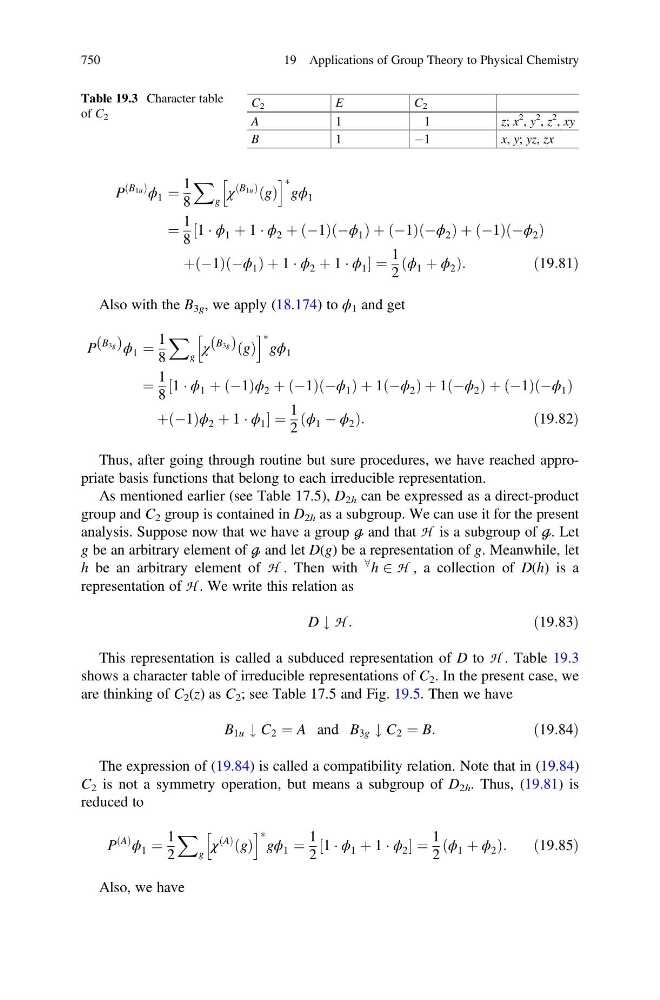
P
B 1u
ð Þ
ϕ 1 ¼
1
8
X
g
χ
B 1u
ð Þ g
ð Þ
h
i Ã
gϕ 1
¼
1
8
1 Á ϕ 1 þ 1 Á ϕ 2 þ À1
ð Þ Àϕ 1
ð
Þþ À1
ð Þ Àϕ 2
ð
Þþ À1
ð Þ Àϕ 2
ð
Þ
½
þ À1
ð Þ Àϕ 1
ð
Þþ1 Á ϕ 2 þ 1 Á ϕ 1 ¼
1
2
ϕ 1 þ ϕ 2
ð
Þ :
ð19:81Þ
Also with the B 3g , we apply (18.174) to ϕ 1 and get
P
B 3g
ð Þ ϕ 1 ¼
1
8
X
g
χ
B 3g
ð Þ g
ð Þ
h
i Ã
gϕ 1
¼
1
8
1 Á ϕ 1 þ À1
ð Þϕ 2 þ À1
ð Þ Àϕ 1
ð
Þþ1 Àϕ 2
ð
Þþ1 Àϕ 2
ð
Þþ À1
ð Þ Àϕ 1
ð
Þ
½
þ À1
ð Þϕ 2 þ 1 Á ϕ 1 ¼
1
2
ϕ 1 À ϕ 2
ð
Þ :
ð19:82Þ
Thus, after going through routine but sure procedures, we have reached appropriate basis functions that belong to each irreducible representation.
As mentioned earlier (see Table 17.5), D 2h can be expressed as a direct-product
group and C 2 group is contained in D 2h as a subgroup. We can use it for the present
analysis. Suppose now that we have a group ℊ and that H is a subgroup of ℊ. Let
g be an arbitrary element of ℊ and let D(g) be a representation of g. Meanwhile, let
h be an arbitrary element of H . Then with
8 h 2 H , a collection of D(h) is a
representation of H . We write this relation as
D # H :
ð19:83Þ
This representation is called a subduced representation of D to H . Table 19.3
shows a character table of irreducible representations of C 2 . In the present case, we
are thinking of C 2 (z) as C 2 ; see Table 17.5 and Fig. 19.5. Then we have
B 1u # C 2 ¼ A and B 3g # C 2 ¼ B:
ð19:84Þ
The expression of (19.84) is called a compatibility relation. Note that in (19.84)
C 2 is not a symmetry operation, but means a subgroup of D 2h . Thus, (19.81) is
reduced to
P
A
ð Þ
ϕ 1 ¼
1
2
X
g
χ
A
ð Þ g
ð Þ
h
i Ã
gϕ 1 ¼
1
2
1 Á ϕ 1 þ 1 Á ϕ 2
½
¼
1
2
ϕ 1 þ ϕ 2
ð
Þ :
ð19:85Þ
Also, we have
Table 19.3 Character table
of C 2
C 2
E
C 2
A
1
1
z; x
2
, y
2
, z
2
, xy
B
1
À1
x, y; yz, zx
750
19 Applications of Group Theory to Physical Chemistry
B 1u
ð Þ
ϕ 1 ¼
1
8
X
g
χ
B 1u
ð Þ g
ð Þ
h
i Ã
gϕ 1
¼
1
8
1 Á ϕ 1 þ 1 Á ϕ 2 þ À1
ð Þ Àϕ 1
ð
Þþ À1
ð Þ Àϕ 2
ð
Þþ À1
ð Þ Àϕ 2
ð
Þ
½
þ À1
ð Þ Àϕ 1
ð
Þþ1 Á ϕ 2 þ 1 Á ϕ 1 ¼
1
2
ϕ 1 þ ϕ 2
ð
Þ :
ð19:81Þ
Also with the B 3g , we apply (18.174) to ϕ 1 and get
P
B 3g
ð Þ ϕ 1 ¼
1
8
X
g
χ
B 3g
ð Þ g
ð Þ
h
i Ã
gϕ 1
¼
1
8
1 Á ϕ 1 þ À1
ð Þϕ 2 þ À1
ð Þ Àϕ 1
ð
Þþ1 Àϕ 2
ð
Þþ1 Àϕ 2
ð
Þþ À1
ð Þ Àϕ 1
ð
Þ
½
þ À1
ð Þϕ 2 þ 1 Á ϕ 1 ¼
1
2
ϕ 1 À ϕ 2
ð
Þ :
ð19:82Þ
Thus, after going through routine but sure procedures, we have reached appropriate basis functions that belong to each irreducible representation.
As mentioned earlier (see Table 17.5), D 2h can be expressed as a direct-product
group and C 2 group is contained in D 2h as a subgroup. We can use it for the present
analysis. Suppose now that we have a group ℊ and that H is a subgroup of ℊ. Let
g be an arbitrary element of ℊ and let D(g) be a representation of g. Meanwhile, let
h be an arbitrary element of H . Then with
8 h 2 H , a collection of D(h) is a
representation of H . We write this relation as
D # H :
ð19:83Þ
This representation is called a subduced representation of D to H . Table 19.3
shows a character table of irreducible representations of C 2 . In the present case, we
are thinking of C 2 (z) as C 2 ; see Table 17.5 and Fig. 19.5. Then we have
B 1u # C 2 ¼ A and B 3g # C 2 ¼ B:
ð19:84Þ
The expression of (19.84) is called a compatibility relation. Note that in (19.84)
C 2 is not a symmetry operation, but means a subgroup of D 2h . Thus, (19.81) is
reduced to
P
A
ð Þ
ϕ 1 ¼
1
2
X
g
χ
A
ð Þ g
ð Þ
h
i Ã
gϕ 1 ¼
1
2
1 Á ϕ 1 þ 1 Á ϕ 2
½
¼
1
2
ϕ 1 þ ϕ 2
ð
Þ :
ð19:85Þ
Also, we have
Table 19.3 Character table
of C 2
C 2
E
C 2
A
1
1
z; x
2
, y
2
, z
2
, xy
B
1
À1
x, y; yz, zx
750
19 Applications of Group Theory to Physical Chemistry