

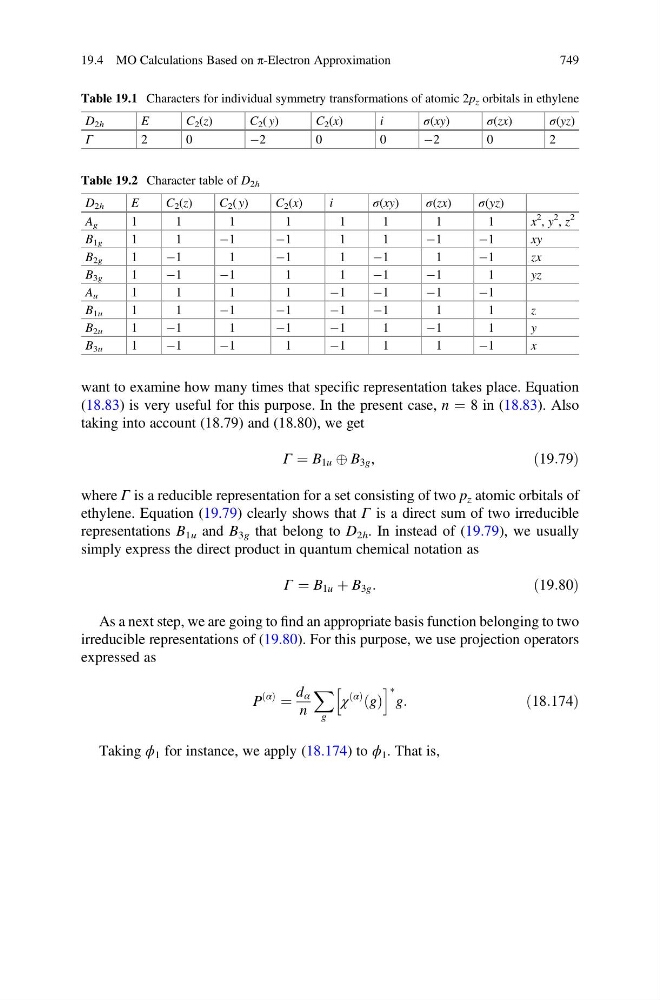
want to examine how many times that specific representation takes place. Equation
(18.83) is very useful for this purpose. In the present case, n ¼ 8 in (18.83). Also
taking into account (18.79) and (18.80), we get
Γ ¼ B 1u È B 3g ,
ð19:79Þ
where Γ is a reducible representation for a set consisting of two p z atomic orbitals of
ethylene. Equation (19.79) clearly shows that Γ is a direct sum of two irreducible
representations B 1u and B 3g that belong to D 2h . In instead of (19.79), we usually
simply express the direct product in quantum chemical notation as
Γ ¼ B 1u þ B 3g :
ð19:80Þ
As a next step, we are going to find an appropriate basis function belonging to two
irreducible representations of (19.80). For this purpose, we use projection operators
expressed as
P
α
ð Þ
¼
d α
n
X
g
χ
α
ð Þ g
ð Þ
h
i Ã
g:
ð18:174Þ
Taking ϕ 1 for instance, we apply (18.174) to ϕ 1 . That is,
Table 19.1 Characters for individual symmetry transformations of atomic 2p z orbitals in ethylene
D 2h
E
C 2 (z)
C 2 ( y)
C 2 (x)
i
σ(xy)
σ(zx)
σ(yz)
Γ
2
0
À2
0
0
À2
0
2
Table 19.2 Character table of D 2h
D 2h
E
C 2 (z)
C 2 ( y)
C 2 (x)
i
σ(xy)
σ(zx)
σ(yz)
A g
1
1
1
1
1
1
1
1
x
2
, y
2
, z
2
B 1g
1
1
À1
À1
1
1
À1
À1
xy
B 2g
1
À1
1
À1
1
À1
1
À1
zx
B 3g
1
À1
À1
1
1
À1
À1
1
yz
A u
1
1
1
1
À1
À1
À1
À1
B 1u
1
1
À1
À1
À1
À1
1
1
z
B 2u
1
À1
1
À1
À1
1
À1
1
y
B 3u
1
À1
À1
1
À1
1
1
À1
x
19.4 MO Calculations Based on π-Electron Approximation
749