

C 2 z
ð Þ ϕ 2
ð Þ ¼ ϕ 1 :
ð19:73Þ
Equation (19.73) can be combined into a following equation:
ϕ 1 ϕ 2
ð
ÞC 2 z
ð Þ ¼ ϕ 2 ϕ 1
ð
Þ:
ð19:74Þ
Thus, using a matrix representation, we have
C 2 z
ð Þ ¼
0 1
1 0
:
ð19:75Þ
In Sect. 17.2, we had
R zθ ¼
cos θ À sin θ 0
sin θ
cos θ 0
0
0
1
0
B
@
1
C
A or
ð19:76Þ
C 2 z
ð Þ ¼
À1 0 0
0 À1 0
0
0 1
0
B
@
1
C
A:
ð19:77Þ
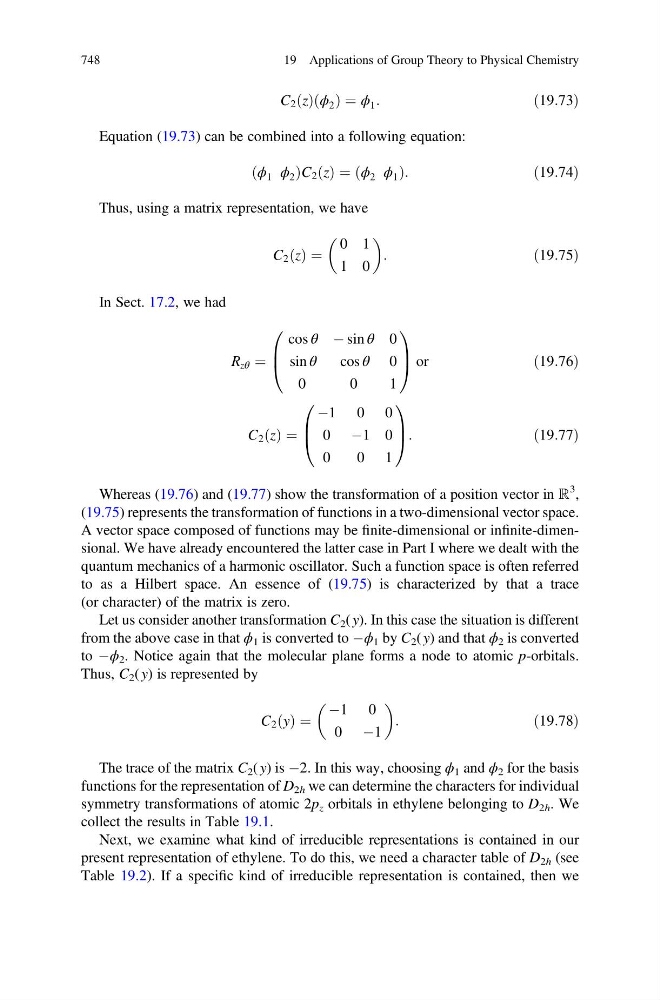
Whereas (19.76) and (19.77) show the transformation of a position vector in ℝ
3 ,
(19.75) represents the transformation of functions in a two-dimensional vector space.
A vector space composed of functions may be finite-dimensional or infinite-dimensional. We have already encountered the latter case in Part I where we dealt with the
quantum mechanics of a harmonic oscillator. Such a function space is often referred
to as a Hilbert space. An essence of (19.75) is characterized by that a trace
(or character) of the matrix is zero.
Let us consider another transformation C 2 ( y). In this case the situation is different
from the above case in that ϕ 1 is converted to Àϕ 1 by C 2 ( y) and that ϕ 2 is converted
to Àϕ 2 . Notice again that the molecular plane forms a node to atomic p-orbitals.
Thus, C 2 ( y) is represented by
C 2 y
ð Þ ¼
À1 0
0 À1
:
ð19:78Þ
The trace of the matrix C 2 ( y) is À2. In this way, choosing ϕ 1 and ϕ 2 for the basis
functions for the representation of D 2h we can determine the characters for individual
symmetry transformations of atomic 2p z orbitals in ethylene belonging to D 2h . We
collect the results in Table 19.1.
Next, we examine what kind of irreducible representations is contained in our
present representation of ethylene. To do this, we need a character table of D 2h (see
Table 19.2). If a specific kind of irreducible representation is contained, then we
748
19 Applications of Group Theory to Physical Chemistry