

19.4 MO Calculations Based on π-Electron Approximation
On the basis of the general argument developed in Sects. 19.2 and 19.3, we preform
molecular orbital calculations of individual molecules. First, we apply group theory
to the molecular orbital calculations about aromatic hydrocarbons such as ethylene,
cyclopropenyl radical and cation as well as benzene and allyl radical. In these cases,
in addition to adoption of the molecular orbital theory, we adopt so-called
“π-electron approximation.” With the first three molecules, we will not have to
“solve” a secular equation. But, for allyl radical we deal with two SALC orbitals
belonging to the same irreducible representations and, hence, the final molecular
orbitals must be obtained by solving the secular equation.
19.4.1 Ethylene
We start with one of the simplest examples, ethylene. Ethylene is a planar molecule
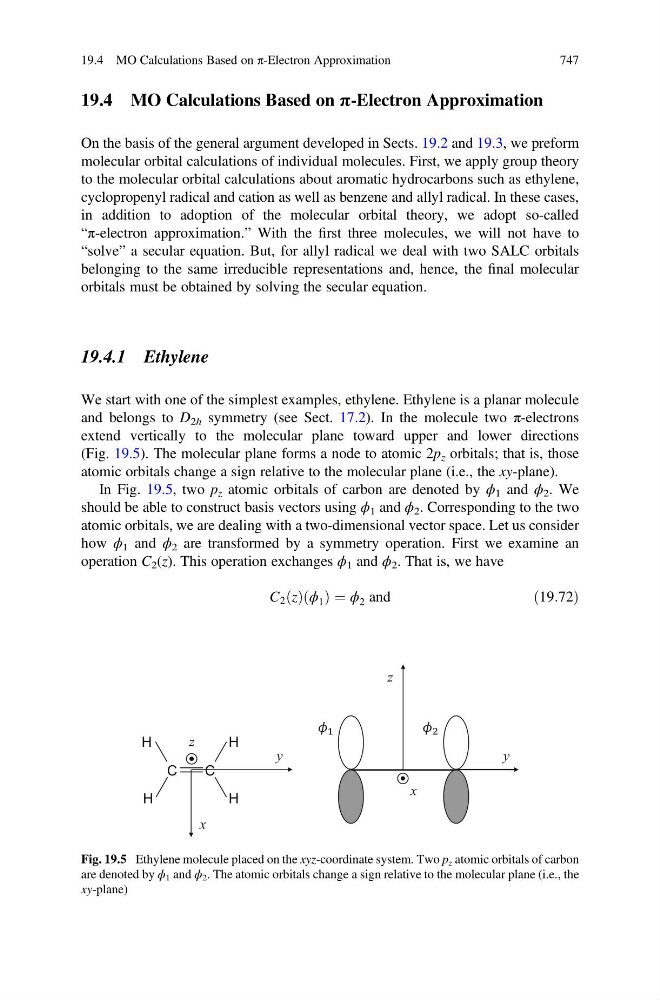
and belongs to D 2h symmetry (see Sect. 17.2). In the molecule two π-electrons
extend vertically to the molecular plane toward upper and lower directions
(Fig. 19.5). The molecular plane forms a node to atomic 2p z orbitals; that is, those
atomic orbitals change a sign relative to the molecular plane (i.e., the xy-plane).
In Fig. 19.5, two p z atomic orbitals of carbon are denoted by ϕ 1 and ϕ 2 . We
should be able to construct basis vectors using ϕ 1 and ϕ 2 . Corresponding to the two
atomic orbitals, we are dealing with a two-dimensional vector space. Let us consider
how ϕ 1 and ϕ 2 are transformed by a symmetry operation. First we examine an
operation C 2 (z). This operation exchanges ϕ 1 and ϕ 2 . That is, we have
C 2 z
ð Þ ϕ 1
ð Þ ¼ ϕ 2 and
ð19:72Þ
&
&
+
+
+
+
x
y
z
z
y
x
Fig. 19.5 Ethylene molecule placed on the xyz-coordinate system. Two p z atomic orbitals of carbon
are denoted by ϕ 1 and ϕ 2 . The atomic orbitals change a sign relative to the molecular plane (i.e., the
xy-plane)
19.4 MO Calculations Based on π-Electron Approximation
747