

atomic orbitals contained in a molecule and examine how those orbitals are
transformed by symmetry operations. (iii) We examine how those atomic orbitals
are transformed according to symmetry operations. Since the symmetry operations
are represented by a (n, n) unitary matrix, we can readily decide a trace of the matrix.
Generally, that matrix representation is reducible, and so we reduce the representation according to the procedures of (18.81)–(18.83). Thus, we are able to determine
how many irreducible representations are contained in the original reducible representation. (iv) After having determined the irreducible representations, we construct
SALCs and constitute a secular equation using them. (v) Solving the secular
equation, we determine molecular orbital energies and decide functional forms of
the corresponding MOs. (vi) We examine physicochemical properties such as optical
transition within a molecule.
In the procedure (iii) of the above, if the same irreducible representations appear
more than once, we have to solve a secular equation of an order of two or more. Even
in that case, we can render a set of resulting eigenvectors orthogonal to one another
during the process of solving a problem.
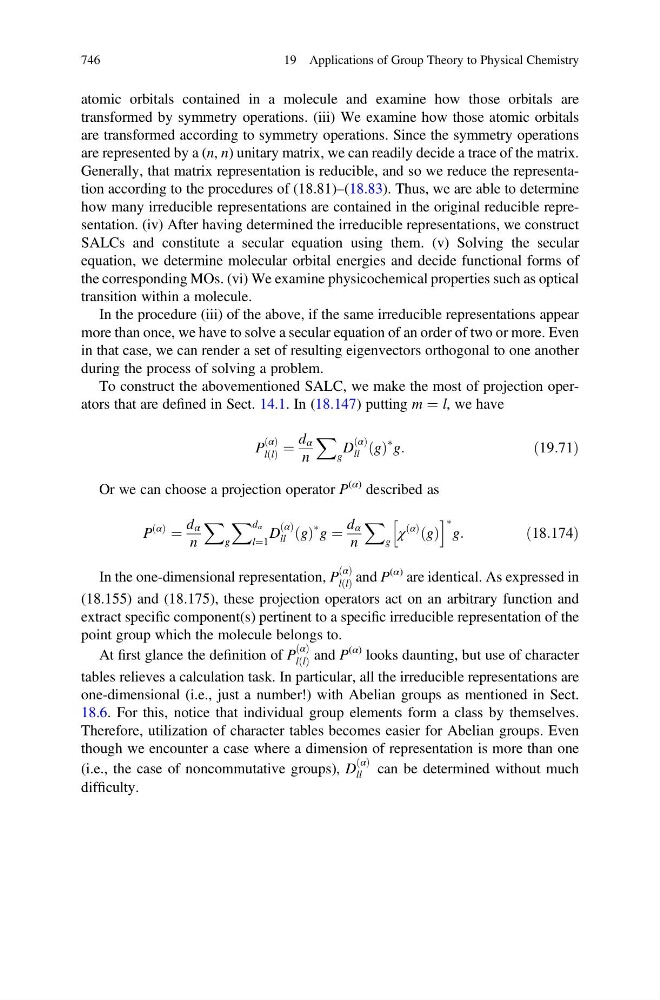
To construct the abovementioned SALC, we make the most of projection operators that are defined in Sect. 14.1. In (18.147) putting m ¼ l, we have
P
α
ð Þ
l l
ð Þ ¼
d α
n
X
g
D
α
ð Þ
ll g
ð Þ
à g:
ð19:71Þ
Or we can choose a projection operator P
(α) described as
P
α
ð Þ
¼
d α
n
X
g
X d α
l¼1
D
α
ð Þ
ll g
ð Þ
à g ¼
d α
n
X
g
χ
α
ð Þ g
ð Þ
h
i Ã
g:
ð18:174Þ
In the one-dimensional representation, P
α
ð Þ
l l
ð Þ and P
(α) are identical. As expressed in
(18.155) and (18.175), these projection operators act on an arbitrary function and
extract specific component(s) pertinent to a specific irreducible representation of the
point group which the molecule belongs to.
At first glance the definition of P
α
ð Þ
l l
ð Þ and P
(α) looks daunting, but use of character
tables relieves a calculation task. In particular, all the irreducible representations are
one-dimensional (i.e., just a number!) with Abelian groups as mentioned in Sect.
18.6. For this, notice that individual group elements form a class by themselves.
Therefore, utilization of character tables becomes easier for Abelian groups. Even
though we encounter a case where a dimension of representation is more than one
(i.e., the case of noncommutative groups), D
α
ð Þ
ll can be determined without much
difficulty.
746
19 Applications of Group Theory to Physical Chemistry