

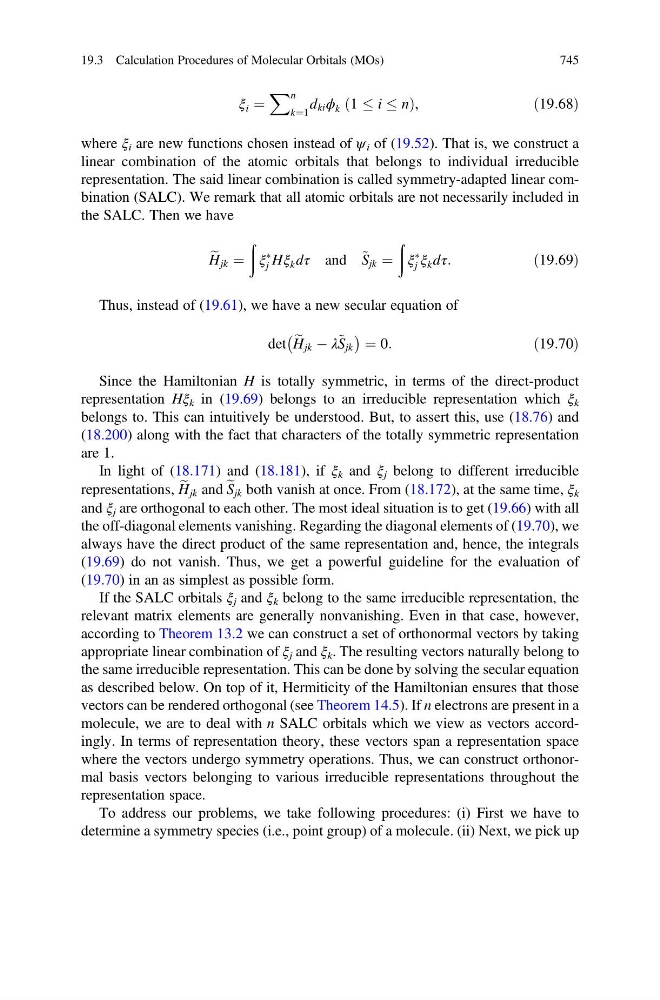
ξ i ¼
X n
k¼1
d ki ϕ k 1 i n
ð
Þ ,
ð19:68Þ
where ξ i are new functions chosen instead of ψ i of (19.52). That is, we construct a
linear combination of the atomic orbitals that belongs to individual irreducible
representation. The said linear combination is called symmetry-adapted linear combination (SALC). We remark that all atomic orbitals are not necessarily included in
the SALC. Then we have
e
H jk ¼
ð
ξ
Ã
j Hξ k dτ and ~ S jk ¼
ð
ξ
Ã
j ξ k dτ:
ð19:69Þ
Thus, instead of (19.61), we have a new secular equation of
det e
H jk À λ ~ S jk
À
Á ¼ 0:
ð19:70Þ
Since the Hamiltonian H is totally symmetric, in terms of the direct-product
representation Hξ k in (19.69) belongs to an irreducible representation which ξ k
belongs to. This can intuitively be understood. But, to assert this, use (18.76) and
(18.200) along with the fact that characters of the totally symmetric representation
are 1.
In light of (18.171) and (18.181), if ξ k and ξ j belong to different irreducible
representations, e
H jk and e S jk both vanish at once. From (18.172), at the same time, ξ k
and ξ j are orthogonal to each other. The most ideal situation is to get (19.66) with all
the off-diagonal elements vanishing. Regarding the diagonal elements of (19.70), we
always have the direct product of the same representation and, hence, the integrals
(19.69) do not vanish. Thus, we get a powerful guideline for the evaluation of
(19.70) in an as simplest as possible form.
If the SALC orbitals ξ j and ξ k belong to the same irreducible representation, the
relevant matrix elements are generally nonvanishing. Even in that case, however,
according to Theorem 13.2 we can construct a set of orthonormal vectors by taking
appropriate linear combination of ξ j and ξ k . The resulting vectors naturally belong to
the same irreducible representation. This can be done by solving the secular equation
as described below. On top of it, Hermiticity of the Hamiltonian ensures that those
vectors can be rendered orthogonal (see Theorem 14.5). If n electrons are present in a
molecule, we are to deal with n SALC orbitals which we view as vectors accordingly. In terms of representation theory, these vectors span a representation space
where the vectors undergo symmetry operations. Thus, we can construct orthonormal basis vectors belonging to various irreducible representations throughout the
representation space.
To address our problems, we take following procedures: (i) First we have to
determine a symmetry species (i.e., point group) of a molecule. (ii) Next, we pick up
19.3 Calculation Procedures of Molecular Orbitals (MOs)
745