

Equation (19.61) is called a secular equation. This equation is pertinent to a
determinant of an order n, and so we are expected to get n roots for this, some of
which are identical (i.e., a degenerate case).
In the above discussion, it is useful to introduce the following notation:
ϕ j jHϕ k
H jk ¼
ð
ϕ
Ã
j Hϕ k dτ and ϕ j jϕ k
S jk ¼
ð
ϕ
Ã
j ϕ k dτ:
ð19:62Þ
The above notation has already been introduced in Sect. 1.4. Equation (19.62)
certainly satisfies the definition of the inner product described in (13.2)–(13.4);
readers, please check it. On the basis of (13.64), we have
yjHx
h
i
à ¼ xH
{
jy
:
ð19:63Þ
Since H is Hermitian, H
{ = H. That is,
yjHx
h
i
à ¼ xHjy
h
i:
ð19:64Þ
To solve (19.61) with an enough large number n is usually formidable. However,
if we can find appropriate conditions, (19.61) can pretty easily be solved. An
essential point rests upon how we deal with off-diagonal elements H jk and S jk . If
we are able to appropriately choose basis vectors so that we can get
H jk ¼ 0 and S jk ¼ 0 for j 6 ¼ k,
ð19:65Þ
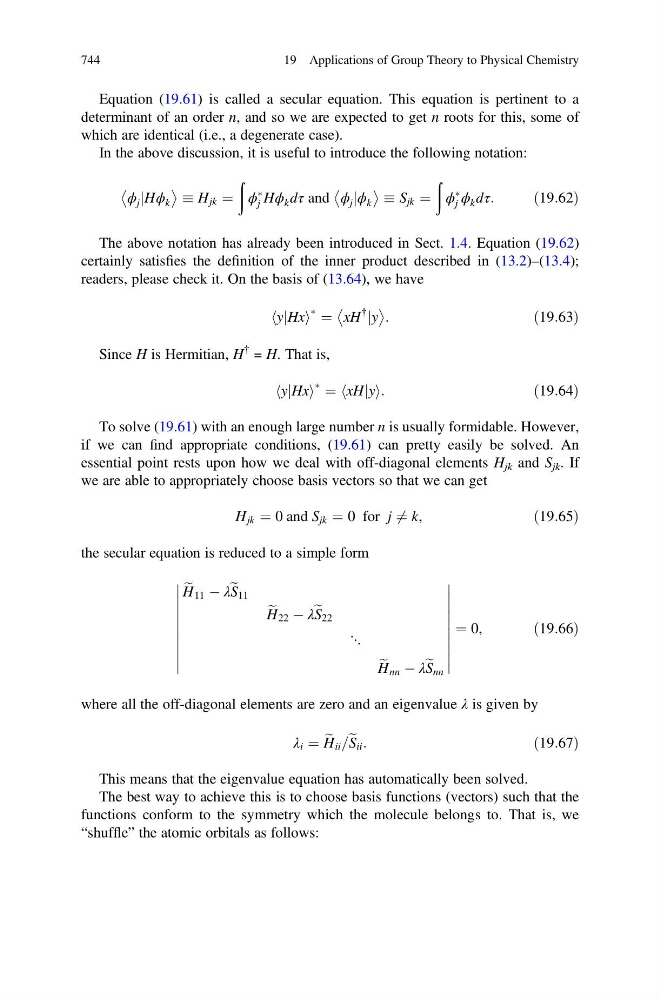
the secular equation is reduced to a simple form
e
H 11 À λ e S 11
e
H 22 À λ e S 22
⋱
e
H nn À λ e S nn
¼ 0,
ð19:66Þ
where all the off-diagonal elements are zero and an eigenvalue λ is given by
λ i ¼ e
H ii = e S ii :
ð19:67Þ
This means that the eigenvalue equation has automatically been solved.
The best way to achieve this is to choose basis functions (vectors) such that the
functions conform to the symmetry which the molecule belongs to. That is, we
“shuffle” the atomic orbitals as follows:
744
19 Applications of Group Theory to Physical Chemistry