

X n
k¼1
c k H À λ
ð
Þϕ k ¼ 0 1 k n
ð
Þ ,
ð19:55Þ
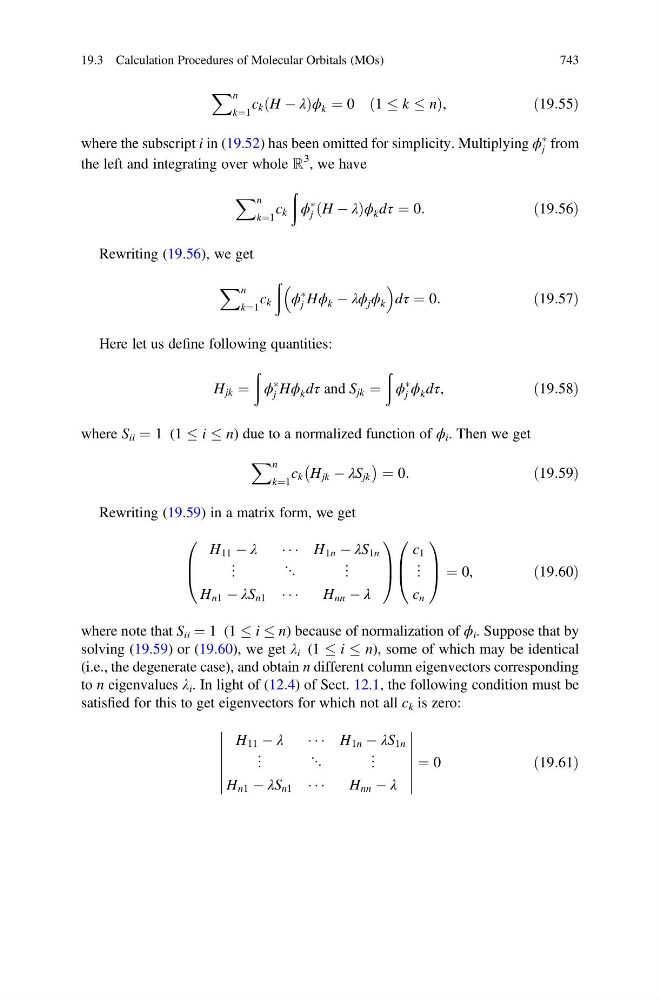
where the subscript i in (19.52) has been omitted for simplicity. Multiplying ϕ
Ã
j from
the left and integrating over whole ℝ
3 , we have
X n
k¼1
c k
ð
ϕ
Ã
j H À λ
ð
Þϕ k dτ ¼ 0:
ð19:56Þ
Rewriting (19.56), we get
X n
k¼1
c k
ð
ϕ
Ã
j Hϕ k À λϕ j ϕ k
dτ ¼ 0:
ð19:57Þ
Here let us define following quantities:
H jk ¼
ð
ϕ
Ã
j Hϕ k dτ and S jk ¼
ð
ϕ
Ã
j ϕ k dτ,
ð19:58Þ
where S ii ¼ 1 (1 i n) due to a normalized function of ϕ i . Then we get
X n
k¼1
c k H jk À λS jk
À
Á ¼ 0:
ð19:59Þ
Rewriting (19.59) in a matrix form, we get
H 11 À λ
Á Á Á H 1n À λS 1n
⋮
⋱
⋮
H n1 À λS n1 Á Á Á
H nn À λ
0
B
@
1
C
A
c 1
⋮
c n
0
B
@
1
C
A ¼ 0,
ð19:60Þ
where note that S ii ¼ 1 (1 i n) because of normalization of ϕ i . Suppose that by
solving (19.59) or (19.60), we get λ i (1 i n), some of which may be identical
(i.e., the degenerate case), and obtain n different column eigenvectors corresponding
to n eigenvalues λ i . In light of (12.4) of Sect. 12.1, the following condition must be
satisfied for this to get eigenvectors for which not all c k is zero:
H 11 À λ
Á Á Á H 1n À λS 1n
⋮
⋱
⋮
H n1 À λS n1 Á Á Á
H nn À λ
¼ 0
ð19:61Þ
19.3 Calculation Procedures of Molecular Orbitals (MOs)
743
k¼1
c k H À λ
ð
Þϕ k ¼ 0 1 k n
ð
Þ ,
ð19:55Þ
where the subscript i in (19.52) has been omitted for simplicity. Multiplying ϕ
Ã
j from
the left and integrating over whole ℝ
3 , we have
X n
k¼1
c k
ð
ϕ
Ã
j H À λ
ð
Þϕ k dτ ¼ 0:
ð19:56Þ
Rewriting (19.56), we get
X n
k¼1
c k
ð
ϕ
Ã
j Hϕ k À λϕ j ϕ k
dτ ¼ 0:
ð19:57Þ
Here let us define following quantities:
H jk ¼
ð
ϕ
Ã
j Hϕ k dτ and S jk ¼
ð
ϕ
Ã
j ϕ k dτ,
ð19:58Þ
where S ii ¼ 1 (1 i n) due to a normalized function of ϕ i . Then we get
X n
k¼1
c k H jk À λS jk
À
Á ¼ 0:
ð19:59Þ
Rewriting (19.59) in a matrix form, we get
H 11 À λ
Á Á Á H 1n À λS 1n
⋮
⋱
⋮
H n1 À λS n1 Á Á Á
H nn À λ
0
B
@
1
C
A
c 1
⋮
c n
0
B
@
1
C
A ¼ 0,
ð19:60Þ
where note that S ii ¼ 1 (1 i n) because of normalization of ϕ i . Suppose that by
solving (19.59) or (19.60), we get λ i (1 i n), some of which may be identical
(i.e., the degenerate case), and obtain n different column eigenvectors corresponding
to n eigenvalues λ i . In light of (12.4) of Sect. 12.1, the following condition must be
satisfied for this to get eigenvectors for which not all c k is zero:
H 11 À λ
Á Á Á H 1n À λS 1n
⋮
⋱
⋮
H n1 À λS n1 Á Á Á
H nn À λ
¼ 0
ð19:61Þ
19.3 Calculation Procedures of Molecular Orbitals (MOs)
743