

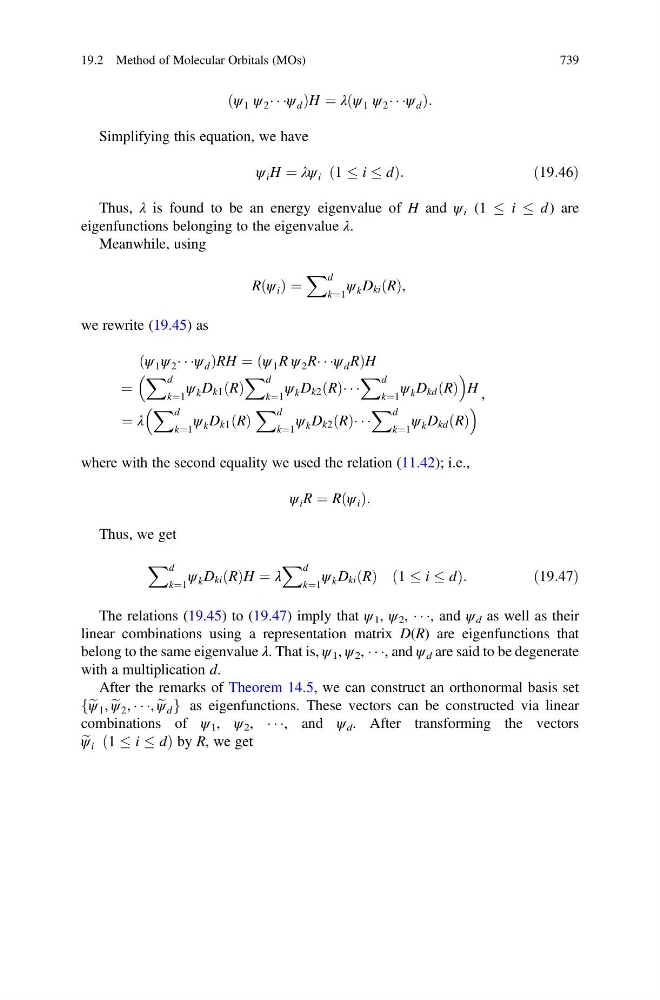
ψ 1 ψ 2 Á Á Áψ d
ð
Þ H ¼ λ ψ 1 ψ 2 Á Á Áψ d
ð
Þ :
Simplifying this equation, we have
ψ i H ¼ λψ i 1 i d
ð
Þ :
ð19:46Þ
Thus, λ is found to be an energy eigenvalue of H and ψ i (1
i
d ) are
eigenfunctions belonging to the eigenvalue λ.
Meanwhile, using
R ψ i
ð Þ ¼
X d
k¼1
ψ k D ki R
ð Þ,
we rewrite (19.45) as
ψ 1 ψ 2 Á Á Áψ d
ð
Þ RH ¼ ψ 1 R ψ 2 RÁ Á Áψ d R
ð
Þ H
¼
X d
k¼1
ψ k D k1 R
ð Þ
X d
k¼1
ψ k D k2 R
ð ÞÁ Á Á
X d
k¼1
ψ k D kd R
ð Þ
H
¼ λ
X d
k¼1
ψ k D k1 R
ð Þ
X d
k¼1
ψ k D k2 R
ð ÞÁ Á Á
X d
k¼1
ψ k D kd R
ð Þ
,
where with the second equality we used the relation (11.42); i.e.,
ψ i R ¼ R ψ i
ð Þ:
Thus, we get
X d
k¼1
ψ k D ki R
ð ÞH ¼ λ
X d
k¼1
ψ k D ki R
ð Þ 1 i d
ð
Þ :
ð19:47Þ
The relations (19.45) to (19.47) imply that ψ 1 , ψ 2 , Á Á Á, and ψ d as well as their
linear combinations using a representation matrix D(R) are eigenfunctions that
belong to the same eigenvalue λ. That is, ψ 1 , ψ 2 , Á Á Á, and ψ d are said to be degenerate
with a multiplication d.
After the remarks of Theorem 14.5, we can construct an orthonormal basis set
e
ψ 1 , e
ψ 2 , Á Á Á, e
ψ d
f
gas eigenfunctions. These vectors can be constructed via linear
combinations of ψ 1 , ψ 2 , Á Á Á, and ψ d . After transforming the vectors
e
ψ i 1 i d
ð
Þby R, we get
19.2 Method of Molecular Orbitals (MOs)
739
ð
Þ H ¼ λ ψ 1 ψ 2 Á Á Áψ d
ð
Þ :
Simplifying this equation, we have
ψ i H ¼ λψ i 1 i d
ð
Þ :
ð19:46Þ
Thus, λ is found to be an energy eigenvalue of H and ψ i (1
i
d ) are
eigenfunctions belonging to the eigenvalue λ.
Meanwhile, using
R ψ i
ð Þ ¼
X d
k¼1
ψ k D ki R
ð Þ,
we rewrite (19.45) as
ψ 1 ψ 2 Á Á Áψ d
ð
Þ RH ¼ ψ 1 R ψ 2 RÁ Á Áψ d R
ð
Þ H
¼
X d
k¼1
ψ k D k1 R
ð Þ
X d
k¼1
ψ k D k2 R
ð ÞÁ Á Á
X d
k¼1
ψ k D kd R
ð Þ
H
¼ λ
X d
k¼1
ψ k D k1 R
ð Þ
X d
k¼1
ψ k D k2 R
ð ÞÁ Á Á
X d
k¼1
ψ k D kd R
ð Þ
,
where with the second equality we used the relation (11.42); i.e.,
ψ i R ¼ R ψ i
ð Þ:
Thus, we get
X d
k¼1
ψ k D ki R
ð ÞH ¼ λ
X d
k¼1
ψ k D ki R
ð Þ 1 i d
ð
Þ :
ð19:47Þ
The relations (19.45) to (19.47) imply that ψ 1 , ψ 2 , Á Á Á, and ψ d as well as their
linear combinations using a representation matrix D(R) are eigenfunctions that
belong to the same eigenvalue λ. That is, ψ 1 , ψ 2 , Á Á Á, and ψ d are said to be degenerate
with a multiplication d.
After the remarks of Theorem 14.5, we can construct an orthonormal basis set
e
ψ 1 , e
ψ 2 , Á Á Á, e
ψ d
f
gas eigenfunctions. These vectors can be constructed via linear
combinations of ψ 1 , ψ 2 , Á Á Á, and ψ d . After transforming the vectors
e
ψ i 1 i d
ð
Þby R, we get
19.2 Method of Molecular Orbitals (MOs)
739