

Thus, we confirm that the Hamiltonian H commutes with any symmetry operation
R. In other words, H is invariant with the coordinate transformation relevant to the
symmetry operation.
Now we consider matrix representation of (19.42). Also let D be an irreducible
representation of the symmetry group ℊ. Then, we have
D g
ð ÞH ¼ HD g
ð Þ g 2 ℊ
ð
Þ:
Let {ψ 1 , ψ 2 , Á Á Á, ψ d } be a set of basis vectors that span a representation space L S
associated with D. Then, on the basis of Schur’s Second Lemma of Sect. 18.3,
(19.42) immediately leads to an important conclusion that if H is represented by a
matrix, we must have
H ¼ λE,
ð19:43Þ
where λ is an arbitrary complex constant. That is, H is represented such that
H ¼
λ Á Á Á 0
⋮ ⋱ ⋮
0 Á Á Á λ
0
B
@
1
C
A,
ð19:44Þ
where the above matrix is (d, d ) square diagonal matrix. This implies that H is
reduced to
H ¼ λD
0
ð Þ
È Á Á Á È λD
0
ð Þ ,
where D
(0) denotes the totally symmetric representation; notice that it is given by
1 for any symmetry operation. Thus, the commutability of an operator with all
symmetry operation is equivalent to that the operator belongs to the totally symmetric representation.
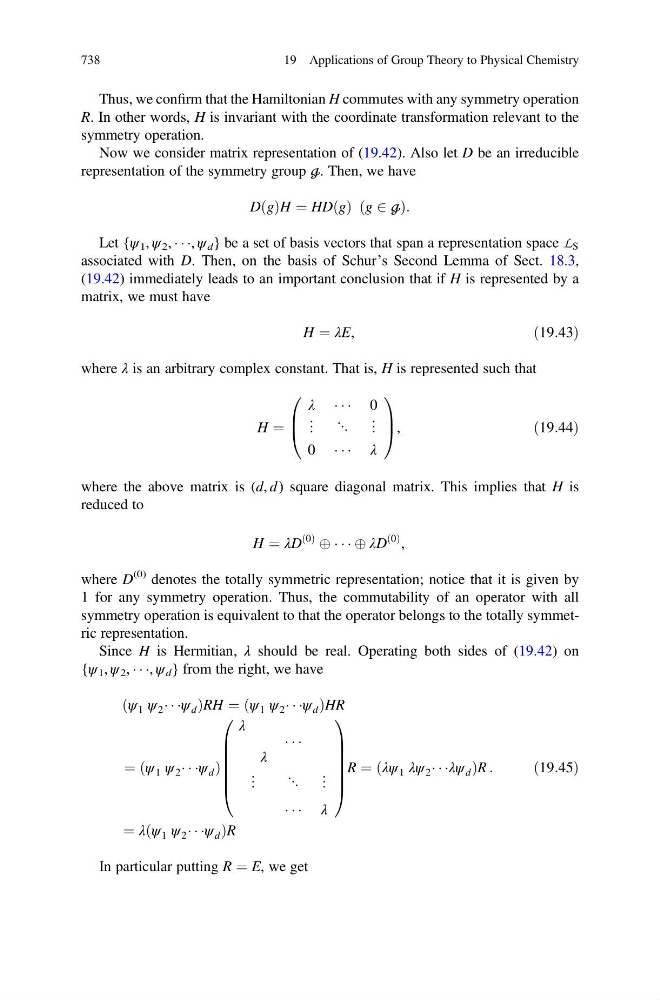
Since H is Hermitian, λ should be real. Operating both sides of (19.42) on
{ψ 1 , ψ 2 , Á Á Á, ψ d } from the right, we have
ψ 1 ψ 2 Á Á Áψ d
ð
Þ RH ¼ ψ 1 ψ 2 Á Á Áψ d
ð
Þ HR
¼ ψ 1 ψ 2 Á Á Áψ d
ð
Þ
λ
λ
Á Á Á
⋮
⋱ ⋮
Á Á Á λ
0
B
B
B
B
B
@
1
C
C
C
C
C
A
R ¼ λψ 1 λψ 2 Á Á Áλψ d
ð
Þ R
¼ λ ψ 1 ψ 2 Á Á Áψ d
ð
Þ R
:
ð19:45Þ
In particular putting R ¼ E, we get
738
19 Applications of Group Theory to Physical Chemistry