

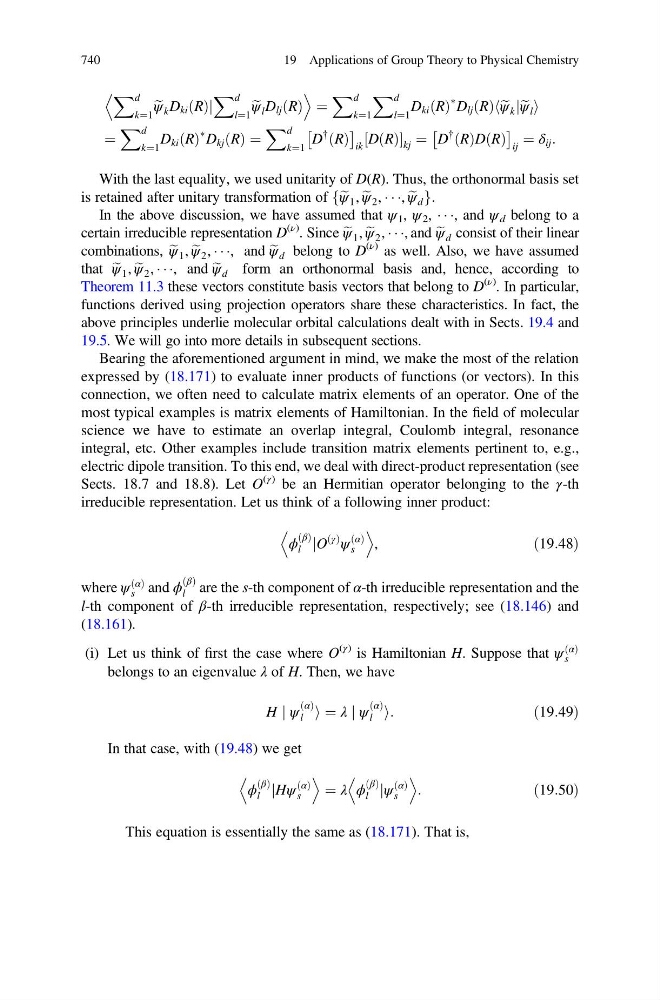
X d
k¼1
e
ψ k D ki R
ð Þj
X d
l¼1
e
ψ l D lj R
ð Þ
D
E
¼
X d
k¼1
X d
l¼1
D ki R
ð Þ
à D lj R
ð Þ e
ψ k je ψ l
h
i
¼
X d
k¼1
D ki R
ð Þ
à D kj R
ð Þ ¼
X d
k¼1
D
{ R
ð Þ
Â
Ã
ik
D R
ð Þ
½
kj ¼ D
{ R
ð ÞD R
ð Þ
Â
Ã
ij
¼ δ ij :
With the last equality, we used unitarity of D(R). Thus, the orthonormal basis set
is retained after unitary transformation of e
ψ 1 , e
ψ 2 , Á Á Á, e
ψ d
f
g .
In the above discussion, we have assumed that ψ 1 , ψ 2 , Á Á Á, and ψ d belong to a
certain irreducible representation D
(ν)
. Since e
ψ 1 , e
ψ 2 , Á Á Á, and e
ψ d consist of their linear
combinations, e
ψ 1 , e
ψ 2 , Á Á Á, and e
ψ d belong to D
(ν) as well. Also, we have assumed
that e
ψ 1 , e
ψ 2 , Á Á Á, and e
ψ d form an orthonormal basis and, hence, according to
Theorem 11.3 these vectors constitute basis vectors that belong to D
(ν)
. In particular,
functions derived using projection operators share these characteristics. In fact, the
above principles underlie molecular orbital calculations dealt with in Sects. 19.4 and
19.5. We will go into more details in subsequent sections.
Bearing the aforementioned argument in mind, we make the most of the relation
expressed by (18.171) to evaluate inner products of functions (or vectors). In this
connection, we often need to calculate matrix elements of an operator. One of the
most typical examples is matrix elements of Hamiltonian. In the field of molecular
science we have to estimate an overlap integral, Coulomb integral, resonance
integral, etc. Other examples include transition matrix elements pertinent to, e.g.,
electric dipole transition. To this end, we deal with direct-product representation (see
Sects. 18.7 and 18.8). Let O
(γ) be an Hermitian operator belonging to the γ-th
irreducible representation. Let us think of a following inner product:
ϕ
β
ð Þ
l jO
γ
ð Þ
ψ
α
ð Þ
s
D
E
,
ð19:48Þ
where ψ
α
ð Þ
s and ϕ
β
ð Þ
l are the s-th component of α-th irreducible representation and the
l-th component of β-th irreducible representation, respectively; see (18.146) and
(18.161).
(i) Let us think of first the case where O
(γ) is Hamiltonian H. Suppose that ψ
α
ð Þ
s
belongs to an eigenvalue λ of H. Then, we have
H j ψ
α
ð Þ
l i ¼ λ j ψ
α
ð Þ
l i:
ð19:49Þ
In that case, with (19.48) we get
ϕ
β
ð Þ
l jHψ
α
ð Þ
s
D
E
¼ λ ϕ
β
ð Þ
l jψ
α
ð Þ
s
D
E
:
ð19:50Þ
This equation is essentially the same as (18.171). That is,
740
19 Applications of Group Theory to Physical Chemistry
k¼1
e
ψ k D ki R
ð Þj
X d
l¼1
e
ψ l D lj R
ð Þ
D
E
¼
X d
k¼1
X d
l¼1
D ki R
ð Þ
à D lj R
ð Þ e
ψ k je ψ l
h
i
¼
X d
k¼1
D ki R
ð Þ
à D kj R
ð Þ ¼
X d
k¼1
D
{ R
ð Þ
Â
Ã
ik
D R
ð Þ
½
kj ¼ D
{ R
ð ÞD R
ð Þ
Â
Ã
ij
¼ δ ij :
With the last equality, we used unitarity of D(R). Thus, the orthonormal basis set
is retained after unitary transformation of e
ψ 1 , e
ψ 2 , Á Á Á, e
ψ d
f
g .
In the above discussion, we have assumed that ψ 1 , ψ 2 , Á Á Á, and ψ d belong to a
certain irreducible representation D
(ν)
. Since e
ψ 1 , e
ψ 2 , Á Á Á, and e
ψ d consist of their linear
combinations, e
ψ 1 , e
ψ 2 , Á Á Á, and e
ψ d belong to D
(ν) as well. Also, we have assumed
that e
ψ 1 , e
ψ 2 , Á Á Á, and e
ψ d form an orthonormal basis and, hence, according to
Theorem 11.3 these vectors constitute basis vectors that belong to D
(ν)
. In particular,
functions derived using projection operators share these characteristics. In fact, the
above principles underlie molecular orbital calculations dealt with in Sects. 19.4 and
19.5. We will go into more details in subsequent sections.
Bearing the aforementioned argument in mind, we make the most of the relation
expressed by (18.171) to evaluate inner products of functions (or vectors). In this
connection, we often need to calculate matrix elements of an operator. One of the
most typical examples is matrix elements of Hamiltonian. In the field of molecular
science we have to estimate an overlap integral, Coulomb integral, resonance
integral, etc. Other examples include transition matrix elements pertinent to, e.g.,
electric dipole transition. To this end, we deal with direct-product representation (see
Sects. 18.7 and 18.8). Let O
(γ) be an Hermitian operator belonging to the γ-th
irreducible representation. Let us think of a following inner product:
ϕ
β
ð Þ
l jO
γ
ð Þ
ψ
α
ð Þ
s
D
E
,
ð19:48Þ
where ψ
α
ð Þ
s and ϕ
β
ð Þ
l are the s-th component of α-th irreducible representation and the
l-th component of β-th irreducible representation, respectively; see (18.146) and
(18.161).
(i) Let us think of first the case where O
(γ) is Hamiltonian H. Suppose that ψ
α
ð Þ
s
belongs to an eigenvalue λ of H. Then, we have
H j ψ
α
ð Þ
l i ¼ λ j ψ
α
ð Þ
l i:
ð19:49Þ
In that case, with (19.48) we get
ϕ
β
ð Þ
l jHψ
α
ð Þ
s
D
E
¼ λ ϕ
β
ð Þ
l jψ
α
ð Þ
s
D
E
:
ð19:50Þ
This equation is essentially the same as (18.171). That is,
740
19 Applications of Group Theory to Physical Chemistry