

g R
À1 r
ð Þ
Â
à ¼ Rg r
ð Þ = 2 g r
ð Þ:
ð19:22Þ
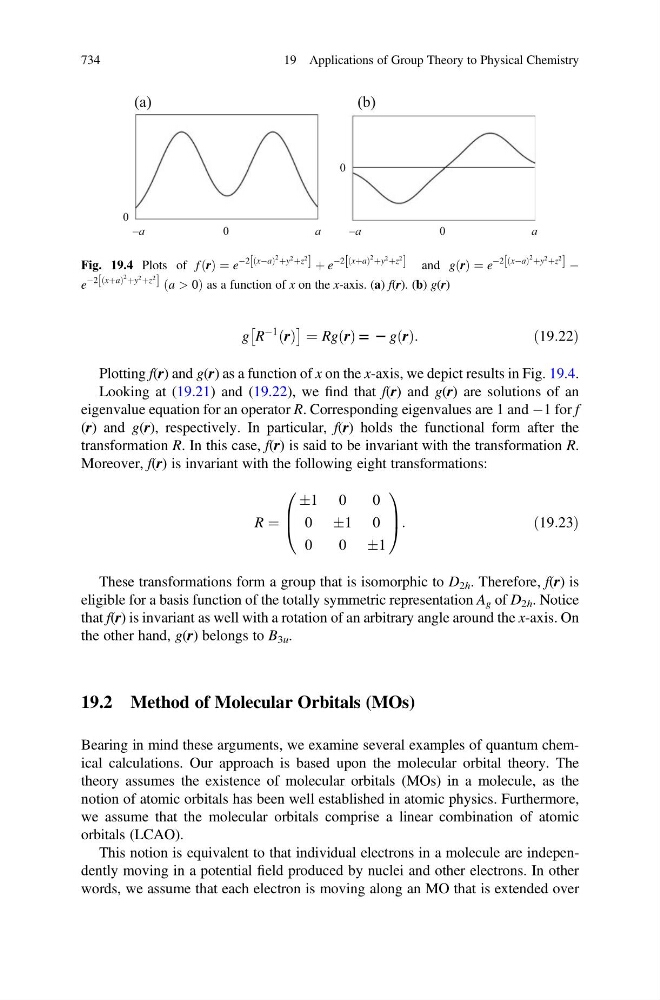
Plotting f(r) and g(r) as a function of x on the x-axis, we depict results in Fig. 19.4.
Looking at (19.21) and (19.22), we find that f(r) and g(r) are solutions of an
eigenvalue equation for an operator R. Corresponding eigenvalues are 1 and À1 for f
(r) and g(r), respectively. In particular, f(r) holds the functional form after the
transformation R. In this case, f(r) is said to be invariant with the transformation R.
Moreover, f(r) is invariant with the following eight transformations:
R ¼
Æ1 0
0
0 Æ1 0
0
0 Æ1
0
B
@
1
C
A:
ð19:23Þ
These transformations form a group that is isomorphic to D 2h . Therefore, f(r) is
eligible for a basis function of the totally symmetric representation A g of D 2h . Notice
that f(r) is invariant as well with a rotation of an arbitrary angle around the x-axis. On
the other hand, g(r) belongs to B 3u .
19.2 Method of Molecular Orbitals (MOs)
Bearing in mind these arguments, we examine several examples of quantum chemical calculations. Our approach is based upon the molecular orbital theory. The
theory assumes the existence of molecular orbitals (MOs) in a molecule, as the
notion of atomic orbitals has been well established in atomic physics. Furthermore,
we assume that the molecular orbitals comprise a linear combination of atomic
orbitals (LCAO).
This notion is equivalent to that individual electrons in a molecule are independently moving in a potential field produced by nuclei and other electrons. In other
words, we assume that each electron is moving along an MO that is extended over
0
‒a
a
0
‒a
a
0
0
(a)
(b)
Fig. 19.4 Plots of f r
ð Þ ¼ e
À2 xÀa
ð
Þ
2 þy
2 þz
2
½
þ e
À2 xþa
ð
Þ
2 þy
2 þz
2
½
and g r
ð Þ ¼ e
À2 xÀa
ð
Þ
2 þy
2 þz
2
½
À
e
À2 xþa
ð
Þ
2 þy
2 þz
2
½
a > 0
ð
Þas a function of x on the x-axis. (a) f(r). (b) g(r)
734
19 Applications of Group Theory to Physical Chemistry