

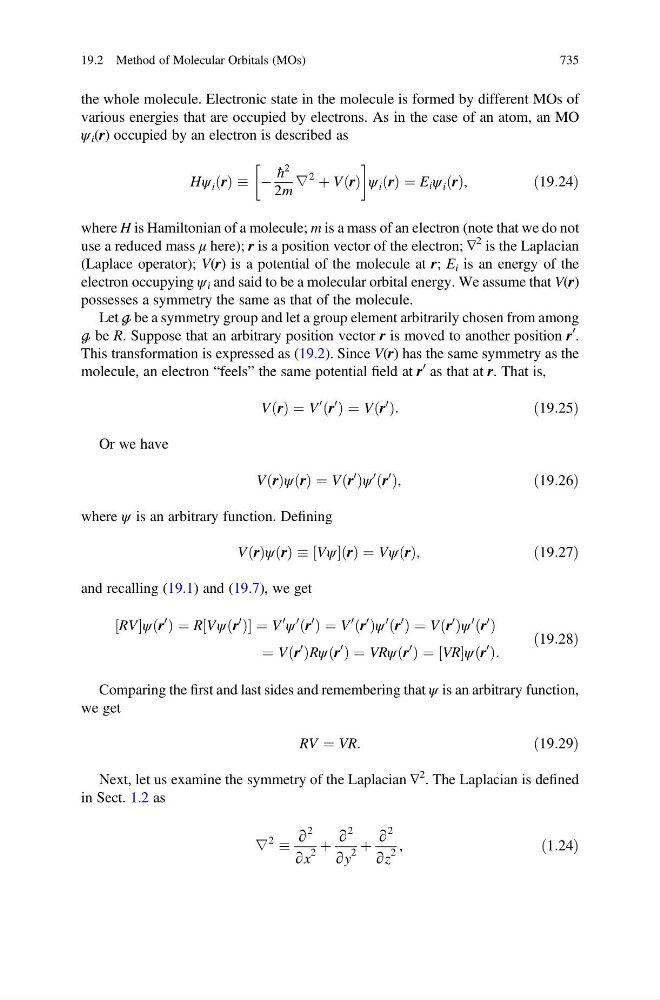
the whole molecule. Electronic state in the molecule is formed by different MOs of
various energies that are occupied by electrons. As in the case of an atom, an MO
ψ i (r) occupied by an electron is described as
Hψ i r
ð Þ À
ħ
2
2m
∇
2
þ V r
ð Þ
!
ψ i r
ð Þ ¼ E i ψ i r
ð Þ,
ð19:24Þ
where H is Hamiltonian of a molecule; m is a mass of an electron (note that we do not
use a reduced mass μ here); r is a position vector of the electron; ∇
2 is the Laplacian
(Laplace operator); V(r) is a potential of the molecule at r; E i is an energy of the
electron occupying ψ i and said to be a molecular orbital energy. We assume that V(r)
possesses a symmetry the same as that of the molecule.
Let ℊ be a symmetry group and let a group element arbitrarily chosen from among
ℊ be R. Suppose that an arbitrary position vector r is moved to another position r
0 .
This transformation is expressed as (19.2). Since V(r) has the same symmetry as the
molecule, an electron “feels” the same potential field at r
0 as that at r. That is,
V r
ð Þ ¼ V
0 r
0
ð Þ ¼ V r
0
ð Þ:
ð19:25Þ
Or we have
V r
ð Þψ r
ð Þ ¼ V r
0
ð Þψ
0 r
0
ð Þ,
ð19:26Þ
where ψ is an arbitrary function. Defining
V r
ð Þψ r
ð Þ Vψ
½ r
ð Þ ¼ Vψ r
ð Þ,
ð19:27Þ
and recalling (19.1) and (19.7), we get
RV
½ ψ r
0
ð Þ ¼ R Vψ r
0
ð Þ
½
¼V
0
ψ
0 r
0
ð Þ ¼ V
0 r
0
ð Þψ
0 r
0
ð Þ ¼ V r
0
ð Þψ
0 r
0
ð Þ
¼ V r
0
ð ÞRψ r
0
ð Þ ¼ VRψ r
0
ð Þ ¼ VR
½ ψ r
0
ð Þ:
ð19:28Þ
Comparing the first and last sides and remembering that ψ is an arbitrary function,
we get
RV ¼ VR:
ð19:29Þ
Next, let us examine the symmetry of the Laplacian ∇
2 . The Laplacian is defined
in Sect. 1.2 as
∇
2
∂
2
∂x
2
þ
∂
2
∂y
2
þ
∂
2
∂z
2
,
ð1:24Þ
19.2 Method of Molecular Orbitals (MOs)
735