

Rf x, y
ð Þ ¼ f
0 x, y
ð Þ= x þ b
ð
Þ
2 þ y À a
ð
Þ
2 :
ð19:15Þ
We also have
r 0 = e 1 e 2
ð
Þ
a
b
,
r
0
0 ¼ e 1 e 2
ð
Þ
0 À1
1 0
a
b
¼ e 1 e 2
ð
Þ
Àb
a
,
where we define R as
R ¼
0 À1
1 0
:
Similarly,
r = e 1 e 2
ð
Þ
x
y
and r
0
= e 1 e 2
ð
Þ
Ày
x
:
From (19.15), we have
f
0 x
0 , y
0
ð
Þ= x
0
þ b
ð
Þ
2 þ y
0
À a
ð
Þ
2 ¼ Ày þ b
ð
Þ
2 þ x À a
ð
Þ
2 ¼ f x, y
ð Þ:
ð19:16Þ
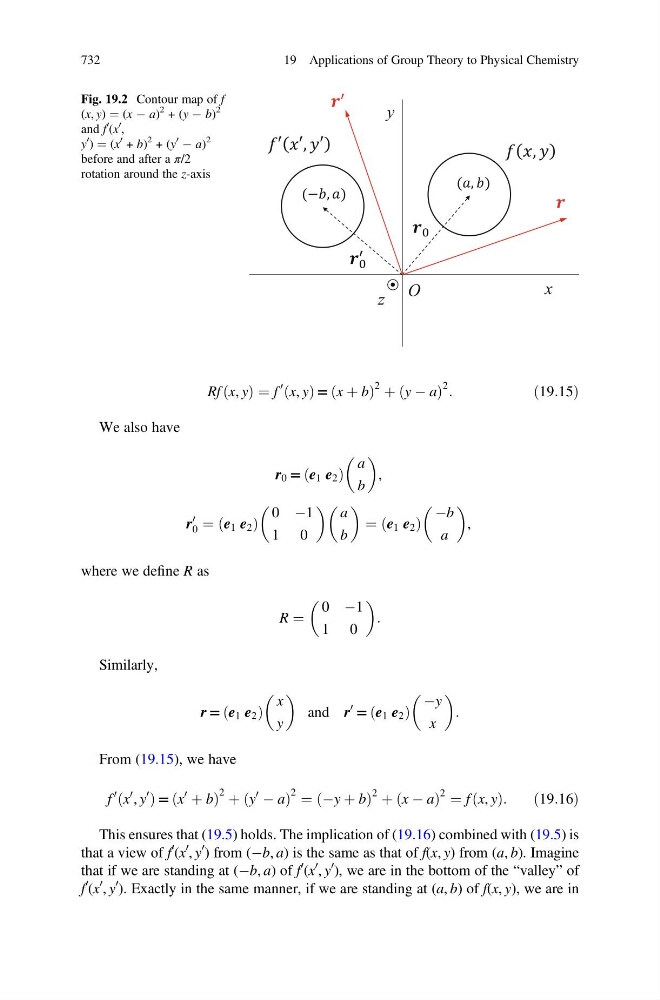
This ensures that (19.5) holds. The implication of (19.16) combined with (19.5) is
that a view of f
0 (x
0 , y
0 ) from (Àb, a) is the same as that of f(x, y) from (a, b). Imagine
that if we are standing at (Àb, a) of f
0 (x
0 , y
0 ), we are in the bottom of the “valley” of
f
0
(x
0 , y
0 ). Exactly in the same manner, if we are standing at (a, b) of f(x, y), we are in
y
x
,
′ ′, ′
( , )
(− , )
O
z
Fig. 19.2 Contour map of f
(x, y) ¼ (x À a)
2 + (y À b)
2
and f
0
(x
0
,
y
0 ) ¼ (x
0 + b)
2 + (y
0 À a)
2
before and after a π/2
rotation around the z-axis
732
19 Applications of Group Theory to Physical Chemistry