

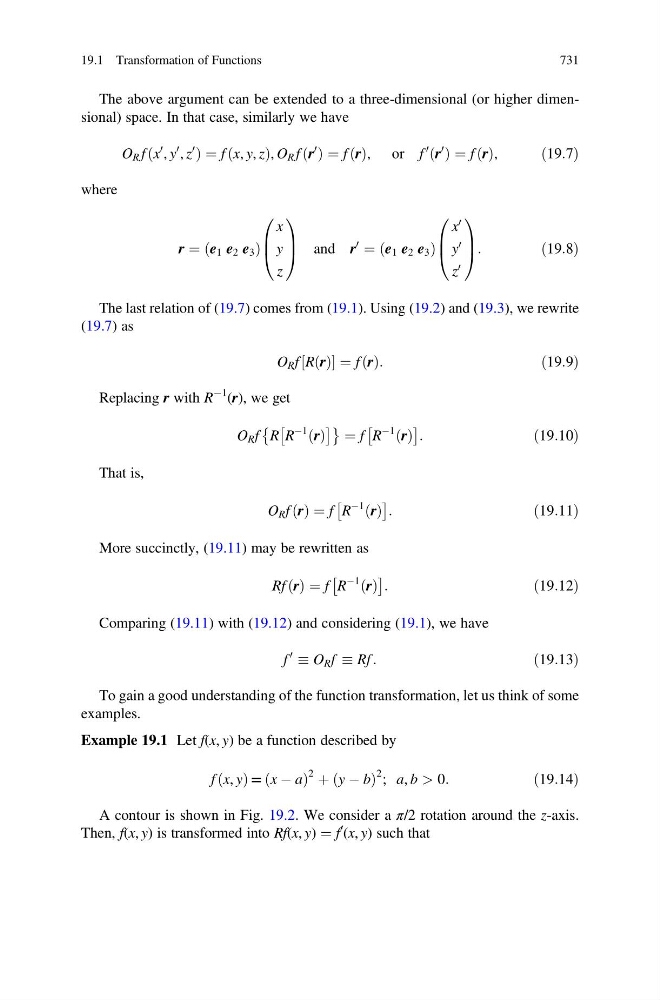
The above argument can be extended to a three-dimensional (or higher dimensional) space. In that case, similarly we have
O R f x
0 , y
0 , z
0
ð
Þ¼f x, y, z
ð
Þ, O R f r
0
ð Þ ¼ f r
ð Þ, or f
0 r
0
ð Þ ¼ f r
ð Þ,
ð19:7Þ
where
r ¼ e 1 e 2 e 3
ð
Þ
x
y
z
0
B
@
1
C
A and r
0
¼ e 1 e 2 e 3
ð
Þ
x
0
y
0
z
0
0
B
@
1
C
A:
ð19:8Þ
The last relation of (19.7) comes from (19.1). Using (19.2) and (19.3), we rewrite
(19.7) as
O R f R r
ð Þ
½
¼ f r
ð Þ:
ð19:9Þ
Replacing r with R
À1 (r), we get
O R f R R
À1 r
ð Þ
Â
Ã
È
É ¼ f R
À1 r
ð Þ
Â
Ã
:
ð19:10Þ
That is,
O R f r
ð Þ ¼ f R
À1 r
ð Þ
Â
à :
ð19:11Þ
More succinctly, (19.11) may be rewritten as
Rf r
ð Þ ¼ f R
À1 r
ð Þ
Â
Ã
:
ð19:12Þ
Comparing (19.11) with (19.12) and considering (19.1), we have
f
0
O R f Rf :
ð19:13Þ
To gain a good understanding of the function transformation, let us think of some
examples.
Example 19.1 Let f(x, y) be a function described by
f x, y
ð Þ= x À a
ð
Þ
2 þ y À b
ð
Þ
2 ; a, b > 0:
ð19:14Þ
A contour is shown in Fig. 19.2. We consider a π/2 rotation around the z-axis.
Then, f(x, y) is transformed into Rf(x, y) ¼ f
0 (x, y) such that
19.1 Transformation of Functions
731