

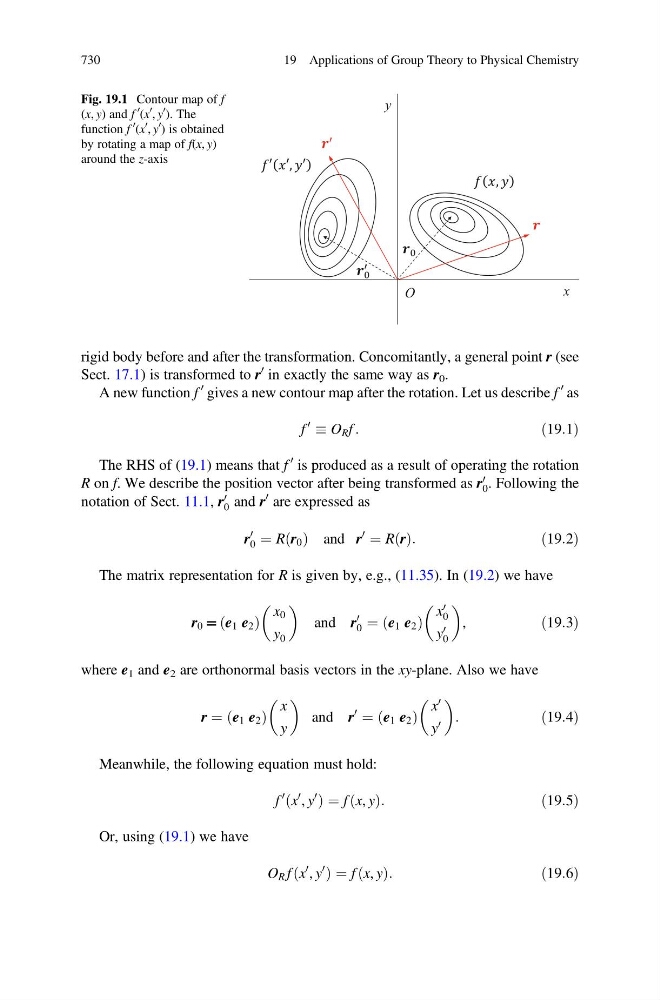
rigid body before and after the transformation. Concomitantly, a general point r (see
Sect. 17.1) is transformed to r
0 in exactly the same way as r 0 .
A new function f
0 gives a new contour map after the rotation. Let us describe f
0 as
f
0
O R f :
ð19:1Þ
The RHS of (19.1) means that f
0 is produced as a result of operating the rotation
R on f. We describe the position vector after being transformed as r
0
0 . Following the
notation of Sect. 11.1, r
0
0 and r
0 are expressed as
r
0
0 ¼ R r 0
ð Þ and r
0
¼ R r
ð Þ:
ð19:2Þ
The matrix representation for R is given by, e.g., (11.35). In (19.2) we have
r 0 = e 1 e 2
ð
Þ
x 0
y 0
and r
0
0 ¼ e 1 e 2
ð
Þ
x
0
0
y
0
0
,
ð19:3Þ
where e 1 and e 2 are orthonormal basis vectors in the xy-plane. Also we have
r ¼ e 1 e 2
ð
Þ
x
y
and r
0
¼ e 1 e 2
ð
Þ
x
0
y
0
:
ð19:4Þ
Meanwhile, the following equation must hold:
f
0 x
0 , y
0
ð
Þ ¼f x, y
ð Þ:
ð19:5Þ
Or, using (19.1) we have
O R f x
0 , y
0
ð
Þ ¼ f x, y
ð Þ:
ð19:6Þ
y
x
,
′ ′, ′
O
Fig. 19.1 Contour map of f
(x, y) and f
0
(x
0
, y
0
). The
function f
0 (x
0 , y
0
) is obtained
by rotating a map of f(x, y)
around the z-axis
730
19 Applications of Group Theory to Physical Chemistry