

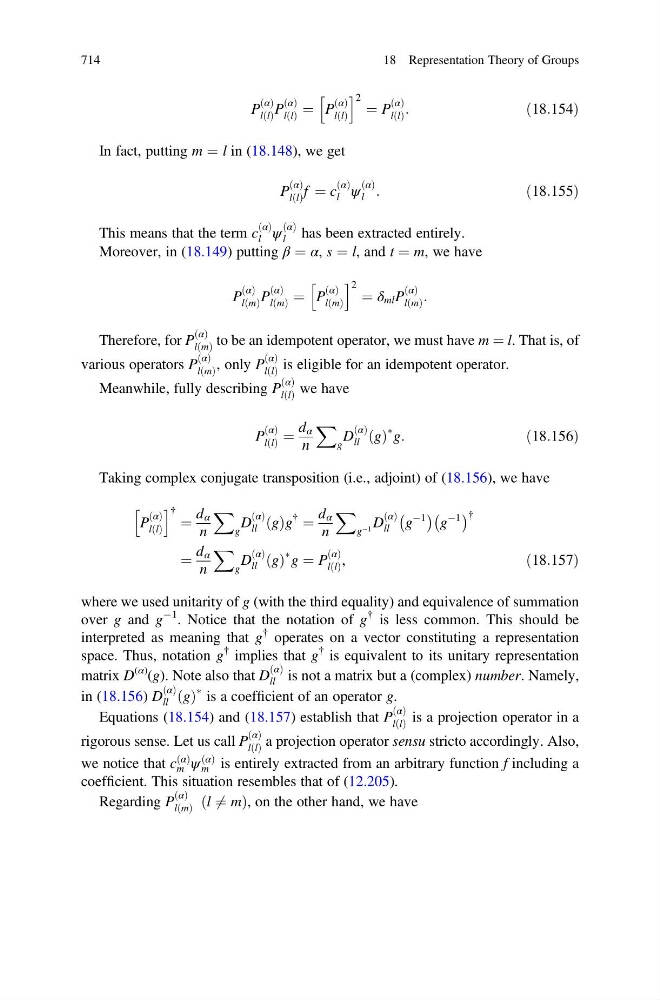
P
α
ð Þ
l l
ð Þ P
α
ð Þ
l l
ð Þ ¼ P
α
ð Þ
l l
ð Þ
h
i 2 ¼ P
α
ð Þ
l l
ð Þ :
ð18:154Þ
In fact, putting m ¼ l in (18.148), we get
P
α
ð Þ
l l
ð Þ f ¼ c
α
ð Þ
l ψ
α
ð Þ
l :
ð18:155Þ
This means that the term c
α
ð Þ
l ψ
α
ð Þ
l
has been extracted entirely.
Moreover, in (18.149) putting β ¼ α, s ¼ l, and t ¼ m, we have
P
α
ð Þ
l m
ð Þ P
α
ð Þ
l m
ð Þ ¼ P
α
ð Þ
l m
ð Þ
h
i 2 ¼ δ ml P
α
ð Þ
l m
ð Þ :
Therefore, for P
α
ð Þ
l m
ð Þ to be an idempotent operator, we must have m ¼ l. That is, of
various operators P
α
ð Þ
l m
ð Þ , only P
α
ð Þ
l l
ð Þ is eligible for an idempotent operator.
Meanwhile, fully describing P
α
ð Þ
l l
ð Þ we have
P
α
ð Þ
l l
ð Þ ¼
d α
n
X
g
D
α
ð Þ
ll g
ð Þ
à g:
ð18:156Þ
Taking complex conjugate transposition (i.e., adjoint) of (18.156), we have
P
α
ð Þ
l l
ð Þ
h
i { ¼
d α
n
X
g
D
α
ð Þ
ll g
ð Þg
{
¼
d α
n
X
g À1 D
α
ð Þ
ll g
À1
À Á
g
À1
À Á {
¼
d α
n
X
g
D
α
ð Þ
ll g
ð Þ
à g ¼ P
α
ð Þ
l l
ð Þ ,
ð18:157Þ
where we used unitarity of g (with the third equality) and equivalence of summation
over g and g
À1 . Notice that the notation of g
{ is less common. This should be
interpreted as meaning that g
{ operates on a vector constituting a representation
space. Thus, notation g
{ implies that g
{ is equivalent to its unitary representation
matrix D
(α)
(g). Note also that D
α
ð Þ
ll is not a matrix but a (complex) number. Namely,
in (18.156) D
α
ð Þ
ll g
ð Þ
à is a coefficient of an operator g.
Equations (18.154) and (18.157) establish that P
α
ð Þ
l l
ð Þ is a projection operator in a
rigorous sense. Let us call P
α
ð Þ
l l
ð Þ a projection operator sensu stricto accordingly. Also,
we notice that c
α
ð Þ
m ψ
α
ð Þ
m is entirely extracted from an arbitrary function f including a
coefficient. This situation resembles that of (12.205).
Regarding P
α
ð Þ
l m
ð Þ l 6 ¼ m
ð
Þ, on the other hand, we have
714
18 Representation Theory of Groups
α
ð Þ
l l
ð Þ P
α
ð Þ
l l
ð Þ ¼ P
α
ð Þ
l l
ð Þ
h
i 2 ¼ P
α
ð Þ
l l
ð Þ :
ð18:154Þ
In fact, putting m ¼ l in (18.148), we get
P
α
ð Þ
l l
ð Þ f ¼ c
α
ð Þ
l ψ
α
ð Þ
l :
ð18:155Þ
This means that the term c
α
ð Þ
l ψ
α
ð Þ
l
has been extracted entirely.
Moreover, in (18.149) putting β ¼ α, s ¼ l, and t ¼ m, we have
P
α
ð Þ
l m
ð Þ P
α
ð Þ
l m
ð Þ ¼ P
α
ð Þ
l m
ð Þ
h
i 2 ¼ δ ml P
α
ð Þ
l m
ð Þ :
Therefore, for P
α
ð Þ
l m
ð Þ to be an idempotent operator, we must have m ¼ l. That is, of
various operators P
α
ð Þ
l m
ð Þ , only P
α
ð Þ
l l
ð Þ is eligible for an idempotent operator.
Meanwhile, fully describing P
α
ð Þ
l l
ð Þ we have
P
α
ð Þ
l l
ð Þ ¼
d α
n
X
g
D
α
ð Þ
ll g
ð Þ
à g:
ð18:156Þ
Taking complex conjugate transposition (i.e., adjoint) of (18.156), we have
P
α
ð Þ
l l
ð Þ
h
i { ¼
d α
n
X
g
D
α
ð Þ
ll g
ð Þg
{
¼
d α
n
X
g À1 D
α
ð Þ
ll g
À1
À Á
g
À1
À Á {
¼
d α
n
X
g
D
α
ð Þ
ll g
ð Þ
à g ¼ P
α
ð Þ
l l
ð Þ ,
ð18:157Þ
where we used unitarity of g (with the third equality) and equivalence of summation
over g and g
À1 . Notice that the notation of g
{ is less common. This should be
interpreted as meaning that g
{ operates on a vector constituting a representation
space. Thus, notation g
{ implies that g
{ is equivalent to its unitary representation
matrix D
(α)
(g). Note also that D
α
ð Þ
ll is not a matrix but a (complex) number. Namely,
in (18.156) D
α
ð Þ
ll g
ð Þ
à is a coefficient of an operator g.
Equations (18.154) and (18.157) establish that P
α
ð Þ
l l
ð Þ is a projection operator in a
rigorous sense. Let us call P
α
ð Þ
l l
ð Þ a projection operator sensu stricto accordingly. Also,
we notice that c
α
ð Þ
m ψ
α
ð Þ
m is entirely extracted from an arbitrary function f including a
coefficient. This situation resembles that of (12.205).
Regarding P
α
ð Þ
l m
ð Þ l 6 ¼ m
ð
Þ, on the other hand, we have
714
18 Representation Theory of Groups