

P
α
ð Þ
l m
ð Þ
h
i { ¼
d α
n
X
g
D
α
ð Þ
lm g
ð Þg
{
¼
d α
n
X
g À1 D
α
ð Þ
lm g
À1
À Á
g
À1
À Á {
¼
d α
n
X
g
D
α
ð Þ
ml g
ð Þ
à g ¼ P
α
ð Þ
m l
ð Þ :
ð18:158Þ
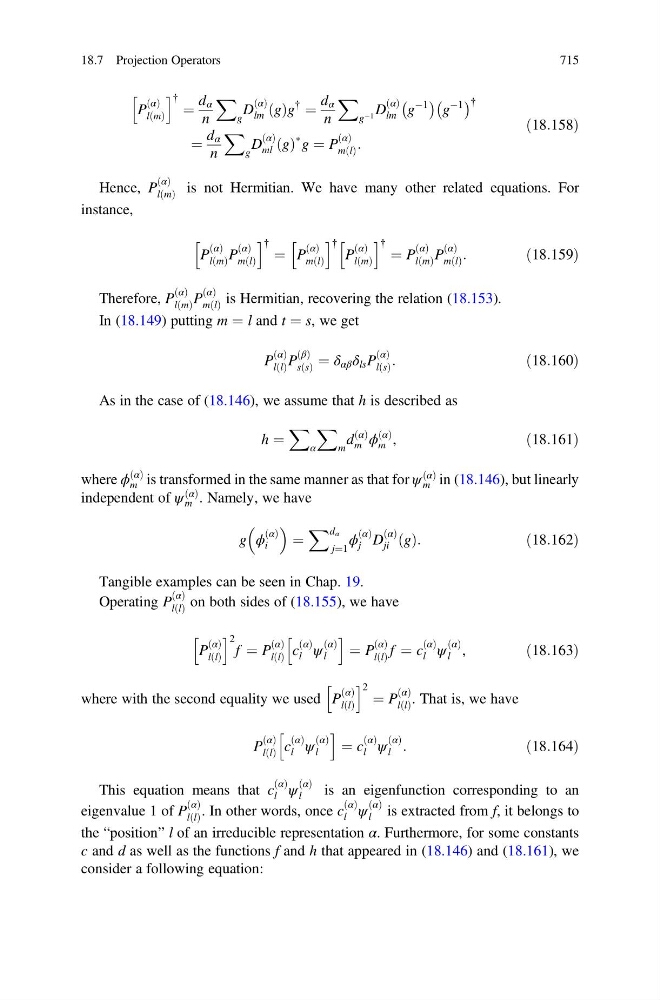
Hence, P
α
ð Þ
l m
ð Þ is not Hermitian. We have many other related equations. For
instance,
P
α
ð Þ
l m
ð Þ P
α
ð Þ
m l
ð Þ
h
i { ¼ P
α
ð Þ
m l
ð Þ
h
i {
P
α
ð Þ
l m
ð Þ
h
i { ¼ P
α
ð Þ
l m
ð Þ P
α
ð Þ
m l
ð Þ :
ð18:159Þ
Therefore, P
α
ð Þ
l m
ð Þ P
α
ð Þ
m l
ð Þ is Hermitian, recovering the relation (18.153).
In (18.149) putting m ¼ l and t ¼ s, we get
P
α
ð Þ
l l
ð Þ P
β
ð Þ
s s
ð Þ ¼ δ αβ δ ls P
α
ð Þ
l s
ð Þ :
ð18:160Þ
As in the case of (18.146), we assume that h is described as
h ¼
X
α
X
m
d
α
ð Þ
m ϕ
α
ð Þ
m ,
ð18:161Þ
where ϕ
α
ð Þ
m is transformed in the same manner as that for ψ
α
ð Þ
m in (18.146), but linearly
independent of ψ
α
ð Þ
m . Namely, we have
g ϕ
α
ð Þ
i
¼
X d α
j¼1
ϕ
α
ð Þ
j D
α
ð Þ
ji g
ð Þ:
ð18:162Þ
Tangible examples can be seen in Chap. 19.
Operating P
α
ð Þ
l l
ð Þ on both sides of (18.155), we have
P
α
ð Þ
l l
ð Þ
h
i 2
f ¼ P
α
ð Þ
l l
ð Þ c
α
ð Þ
l ψ
α
ð Þ
l
h
i
¼ P
α
ð Þ
l l
ð Þ f ¼ c
α
ð Þ
l ψ
α
ð Þ
l ,
ð18:163Þ
where with the second equality we used P
α
ð Þ
l l
ð Þ
h
i 2 ¼ P
α
ð Þ
l l
ð Þ . That is, we have
P
α
ð Þ
l l
ð Þ c
α
ð Þ
l ψ
α
ð Þ
l
h
i
¼ c
α
ð Þ
l ψ
α
ð Þ
l :
ð18:164Þ
This equation means that c
α
ð Þ
l ψ
α
ð Þ
l
is an eigenfunction corresponding to an
eigenvalue 1 of P
α
ð Þ
l l
ð Þ . In other words, once c
α
ð Þ
l ψ
α
ð Þ
l
is extracted from f, it belongs to
the “position” l of an irreducible representation α. Furthermore, for some constants
c and d as well as the functions f and h that appeared in (18.146) and (18.161), we
consider a following equation:
18.7 Projection Operators
715
α
ð Þ
l m
ð Þ
h
i { ¼
d α
n
X
g
D
α
ð Þ
lm g
ð Þg
{
¼
d α
n
X
g À1 D
α
ð Þ
lm g
À1
À Á
g
À1
À Á {
¼
d α
n
X
g
D
α
ð Þ
ml g
ð Þ
à g ¼ P
α
ð Þ
m l
ð Þ :
ð18:158Þ
Hence, P
α
ð Þ
l m
ð Þ is not Hermitian. We have many other related equations. For
instance,
P
α
ð Þ
l m
ð Þ P
α
ð Þ
m l
ð Þ
h
i { ¼ P
α
ð Þ
m l
ð Þ
h
i {
P
α
ð Þ
l m
ð Þ
h
i { ¼ P
α
ð Þ
l m
ð Þ P
α
ð Þ
m l
ð Þ :
ð18:159Þ
Therefore, P
α
ð Þ
l m
ð Þ P
α
ð Þ
m l
ð Þ is Hermitian, recovering the relation (18.153).
In (18.149) putting m ¼ l and t ¼ s, we get
P
α
ð Þ
l l
ð Þ P
β
ð Þ
s s
ð Þ ¼ δ αβ δ ls P
α
ð Þ
l s
ð Þ :
ð18:160Þ
As in the case of (18.146), we assume that h is described as
h ¼
X
α
X
m
d
α
ð Þ
m ϕ
α
ð Þ
m ,
ð18:161Þ
where ϕ
α
ð Þ
m is transformed in the same manner as that for ψ
α
ð Þ
m in (18.146), but linearly
independent of ψ
α
ð Þ
m . Namely, we have
g ϕ
α
ð Þ
i
¼
X d α
j¼1
ϕ
α
ð Þ
j D
α
ð Þ
ji g
ð Þ:
ð18:162Þ
Tangible examples can be seen in Chap. 19.
Operating P
α
ð Þ
l l
ð Þ on both sides of (18.155), we have
P
α
ð Þ
l l
ð Þ
h
i 2
f ¼ P
α
ð Þ
l l
ð Þ c
α
ð Þ
l ψ
α
ð Þ
l
h
i
¼ P
α
ð Þ
l l
ð Þ f ¼ c
α
ð Þ
l ψ
α
ð Þ
l ,
ð18:163Þ
where with the second equality we used P
α
ð Þ
l l
ð Þ
h
i 2 ¼ P
α
ð Þ
l l
ð Þ . That is, we have
P
α
ð Þ
l l
ð Þ c
α
ð Þ
l ψ
α
ð Þ
l
h
i
¼ c
α
ð Þ
l ψ
α
ð Þ
l :
ð18:164Þ
This equation means that c
α
ð Þ
l ψ
α
ð Þ
l
is an eigenfunction corresponding to an
eigenvalue 1 of P
α
ð Þ
l l
ð Þ . In other words, once c
α
ð Þ
l ψ
α
ð Þ
l
is extracted from f, it belongs to
the “position” l of an irreducible representation α. Furthermore, for some constants
c and d as well as the functions f and h that appeared in (18.146) and (18.161), we
consider a following equation:
18.7 Projection Operators
715