

P
α
ð Þ
l m
ð Þ P
β
ð Þ
s t
ð Þ ¼
d α
n
X
g
D
α
ð Þ
lm g
ð Þ
à g
d β
n
X
g 0 D
β
ð Þ
st g
0
ð Þ
à g
0
¼
d α
n
X
g
D
α
ð Þ
lm g
ð Þ
à g
d β
n
X
g 0 D
β
ð Þ
st g
À1 g
0
À
Á Ã g
À1 g
0
¼
d α
n
d β
n
X
g
X
g 0 D
α
ð Þ
lm g
ð Þ
à D
β
ð Þ
st g
À1 g
0
À
Á Ã gg
À1 g
0
¼
d α
n
d β
n
X
g
X
g 0 D
α
ð Þ
lm g
ð Þ
Ã
D
β
ð Þ g
ð Þ
h
i {
D
β
ð Þ g
0
ð Þ
&
' Ã
st
eg
0
¼
d α
n
d β
n
X
g
X
g 0 D
α
ð Þ
lm g
ð Þ
Ã
X
k
D
β
ð Þ g
ð Þ ks
à D
β
ð Þ g
0
ð Þ kt
n
o Ã
g
0
¼
d α
n
d β
n
X
k
X
g 0
X
g
D
α
ð Þ
lm g
ð Þ
à D
β
ð Þ g
ð Þ ks
h
i
D
β
ð Þ g
0
ð Þ
Ã
kt g
0
¼
d α
n
d β
n
X
k
X
g 0
n
d α
δ αβ δ lk δ ms D
β
ð Þ g
0
ð Þ
Ã
kt g
0
¼
d β
n
X
g 0 δ αβ δ ms D
β
ð Þ g
0
ð Þ
Ã
lt g
0
¼ δ αβ δ ms
d β
n
X
g 0 D
β
ð Þ g
0
ð Þ
Ã
lt g
0
¼ δ αβ δ ms P
α
ð Þ
l t
ð Þ :
ð18:150Þ
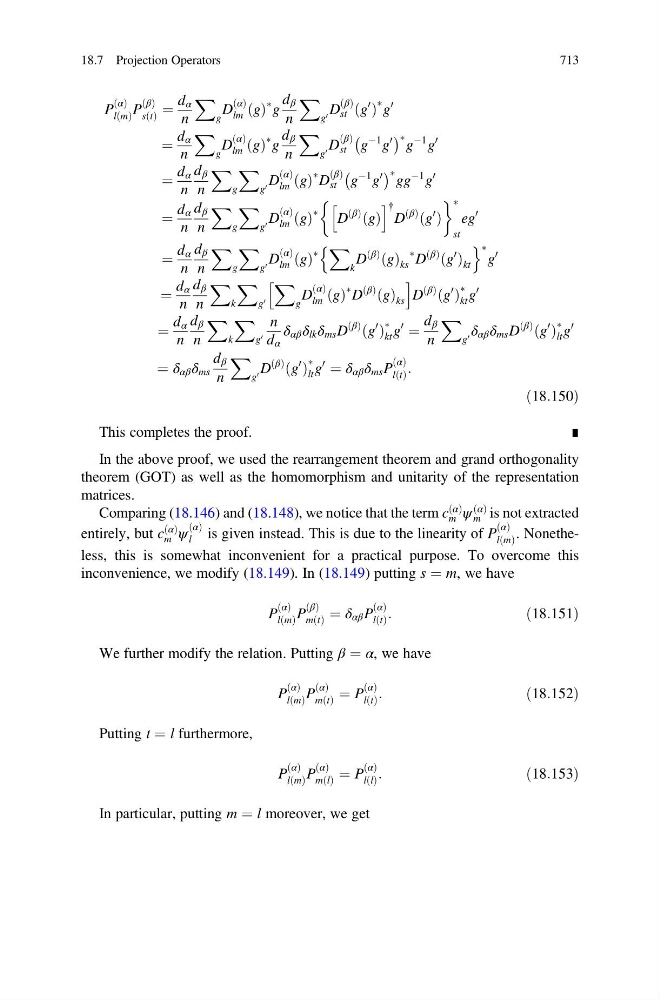
This completes the proof.
∎
In the above proof, we used the rearrangement theorem and grand orthogonality
theorem (GOT) as well as the homomorphism and unitarity of the representation
matrices.
Comparing (18.146) and (18.148), we notice that the term c
α
ð Þ
m ψ
α
ð Þ
m is not extracted
entirely, but c
α
ð Þ
m ψ
α
ð Þ
l
is given instead. This is due to the linearity of P
α
ð Þ
l m
ð Þ . Nonetheless, this is somewhat inconvenient for a practical purpose. To overcome this
inconvenience, we modify (18.149). In (18.149) putting s ¼ m, we have
P
α
ð Þ
l m
ð Þ P
β
ð Þ
m t
ð Þ ¼ δ αβ P
α
ð Þ
l t
ð Þ :
ð18:151Þ
We further modify the relation. Putting β ¼ α, we have
P
α
ð Þ
l m
ð Þ P
α
ð Þ
m t
ð Þ ¼ P
α
ð Þ
l t
ð Þ :
ð18:152Þ
Putting t ¼ l furthermore,
P
α
ð Þ
l m
ð Þ P
α
ð Þ
m l
ð Þ ¼ P
α
ð Þ
l l
ð Þ :
ð18:153Þ
In particular, putting m ¼ l moreover, we get
18.7 Projection Operators
713
α
ð Þ
l m
ð Þ P
β
ð Þ
s t
ð Þ ¼
d α
n
X
g
D
α
ð Þ
lm g
ð Þ
à g
d β
n
X
g 0 D
β
ð Þ
st g
0
ð Þ
à g
0
¼
d α
n
X
g
D
α
ð Þ
lm g
ð Þ
à g
d β
n
X
g 0 D
β
ð Þ
st g
À1 g
0
À
Á Ã g
À1 g
0
¼
d α
n
d β
n
X
g
X
g 0 D
α
ð Þ
lm g
ð Þ
à D
β
ð Þ
st g
À1 g
0
À
Á Ã gg
À1 g
0
¼
d α
n
d β
n
X
g
X
g 0 D
α
ð Þ
lm g
ð Þ
Ã
D
β
ð Þ g
ð Þ
h
i {
D
β
ð Þ g
0
ð Þ
&
' Ã
st
eg
0
¼
d α
n
d β
n
X
g
X
g 0 D
α
ð Þ
lm g
ð Þ
Ã
X
k
D
β
ð Þ g
ð Þ ks
à D
β
ð Þ g
0
ð Þ kt
n
o Ã
g
0
¼
d α
n
d β
n
X
k
X
g 0
X
g
D
α
ð Þ
lm g
ð Þ
à D
β
ð Þ g
ð Þ ks
h
i
D
β
ð Þ g
0
ð Þ
Ã
kt g
0
¼
d α
n
d β
n
X
k
X
g 0
n
d α
δ αβ δ lk δ ms D
β
ð Þ g
0
ð Þ
Ã
kt g
0
¼
d β
n
X
g 0 δ αβ δ ms D
β
ð Þ g
0
ð Þ
Ã
lt g
0
¼ δ αβ δ ms
d β
n
X
g 0 D
β
ð Þ g
0
ð Þ
Ã
lt g
0
¼ δ αβ δ ms P
α
ð Þ
l t
ð Þ :
ð18:150Þ
This completes the proof.
∎
In the above proof, we used the rearrangement theorem and grand orthogonality
theorem (GOT) as well as the homomorphism and unitarity of the representation
matrices.
Comparing (18.146) and (18.148), we notice that the term c
α
ð Þ
m ψ
α
ð Þ
m is not extracted
entirely, but c
α
ð Þ
m ψ
α
ð Þ
l
is given instead. This is due to the linearity of P
α
ð Þ
l m
ð Þ . Nonetheless, this is somewhat inconvenient for a practical purpose. To overcome this
inconvenience, we modify (18.149). In (18.149) putting s ¼ m, we have
P
α
ð Þ
l m
ð Þ P
β
ð Þ
m t
ð Þ ¼ δ αβ P
α
ð Þ
l t
ð Þ :
ð18:151Þ
We further modify the relation. Putting β ¼ α, we have
P
α
ð Þ
l m
ð Þ P
α
ð Þ
m t
ð Þ ¼ P
α
ð Þ
l t
ð Þ :
ð18:152Þ
Putting t ¼ l furthermore,
P
α
ð Þ
l m
ð Þ P
α
ð Þ
m l
ð Þ ¼ P
α
ð Þ
l l
ð Þ :
ð18:153Þ
In particular, putting m ¼ l moreover, we get
18.7 Projection Operators
713