

P
α
ð Þ
l m
ð Þ f ¼
d α
n
X
g
D
α
ð Þ
lm g
ð Þ
à gf ¼
d α
n
X
g
D
α
ð Þ
lm g
ð Þ
à g
X
ν
X
k
c
ν
ð Þ
k ψ
ν
ð Þ
k
¼
d α
n
X
g
D
α
ð Þ
lm g
ð Þ
Ã
X
ν
X
k
c
ν
ð Þ
k gψ
ν
ð Þ
k
¼
d α
n
X
g
D
α
ð Þ
lm g
ð Þ
Ã
X
ν
X
k
c
ν
ð Þ
k
X d ν
j¼1
ψ
ν
ð Þ
j D
ν
ð Þ
jk g
ð Þ
¼
d α
n
X
ν
X
k
c
ν
ð Þ
k
X d ν
j¼1
ψ
ν
ð Þ
j
X
g
D
α
ð Þ
lm g
ð Þ
à D
ν
ð Þ
jk g
ð Þ
h
i
¼
d α
n
X
ν
X
k
c
ν
ð Þ
k
X d ν
j¼1
ψ
ν
ð Þ
j
n
d α
δ αν δ lj δ mk ¼ c
α
ð Þ
m ψ
α
ð Þ
l ,
ð18:148Þ
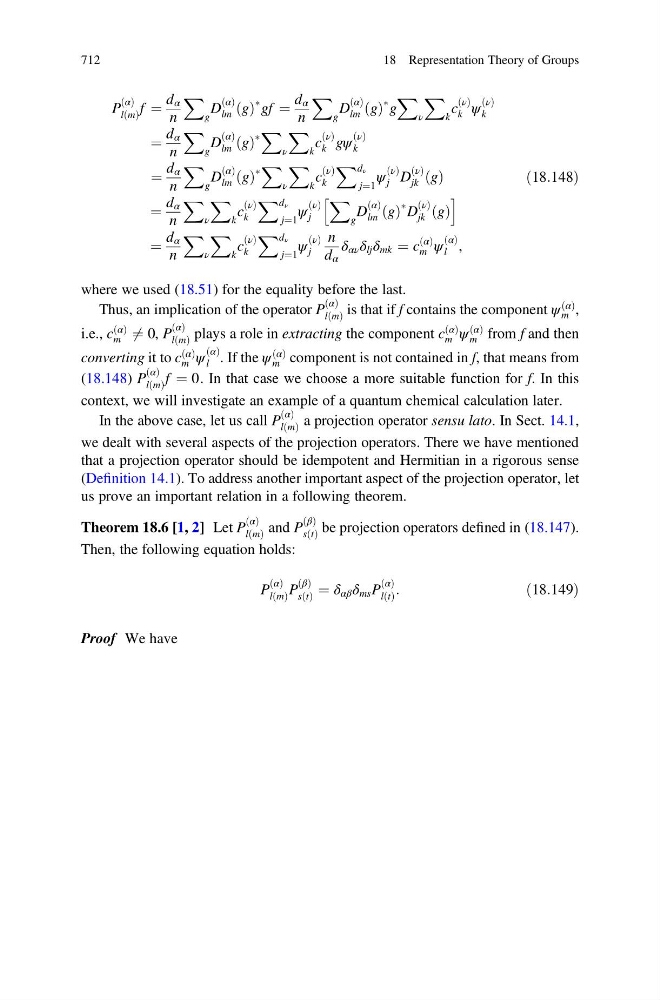
where we used (18.51) for the equality before the last.
Thus, an implication of the operator P
α
ð Þ
l m
ð Þ is that if f contains the component ψ
α
ð Þ
m ,
i.e., c
α
ð Þ
m 6 ¼ 0, P
α
ð Þ
l m
ð Þ plays a role in extracting the component c
α
ð Þ
m ψ
α
ð Þ
m from f and then
converting it to c
α
ð Þ
m ψ
α
ð Þ
l . If the ψ
α
ð Þ
m component is not contained in f, that means from
(18.148) P
α
ð Þ
l m
ð Þ f ¼ 0. In that case we choose a more suitable function for f. In this
context, we will investigate an example of a quantum chemical calculation later.
In the above case, let us call P
α
ð Þ
l m
ð Þ a projection operator sensu lato. In Sect. 14.1,
we dealt with several aspects of the projection operators. There we have mentioned
that a projection operator should be idempotent and Hermitian in a rigorous sense
(Definition 14.1). To address another important aspect of the projection operator, let
us prove an important relation in a following theorem.
Theorem 18.6 [1, 2] Let P
α
ð Þ
l m
ð Þ and P
β
ð Þ
s t
ð Þ be projection operators defined in (18.147).
Then, the following equation holds:
P
α
ð Þ
l m
ð Þ P
β
ð Þ
s t
ð Þ ¼ δ αβ δ ms P
α
ð Þ
l t
ð Þ :
ð18:149Þ
Proof We have
712
18 Representation Theory of Groups
α
ð Þ
l m
ð Þ f ¼
d α
n
X
g
D
α
ð Þ
lm g
ð Þ
à gf ¼
d α
n
X
g
D
α
ð Þ
lm g
ð Þ
à g
X
ν
X
k
c
ν
ð Þ
k ψ
ν
ð Þ
k
¼
d α
n
X
g
D
α
ð Þ
lm g
ð Þ
Ã
X
ν
X
k
c
ν
ð Þ
k gψ
ν
ð Þ
k
¼
d α
n
X
g
D
α
ð Þ
lm g
ð Þ
Ã
X
ν
X
k
c
ν
ð Þ
k
X d ν
j¼1
ψ
ν
ð Þ
j D
ν
ð Þ
jk g
ð Þ
¼
d α
n
X
ν
X
k
c
ν
ð Þ
k
X d ν
j¼1
ψ
ν
ð Þ
j
X
g
D
α
ð Þ
lm g
ð Þ
à D
ν
ð Þ
jk g
ð Þ
h
i
¼
d α
n
X
ν
X
k
c
ν
ð Þ
k
X d ν
j¼1
ψ
ν
ð Þ
j
n
d α
δ αν δ lj δ mk ¼ c
α
ð Þ
m ψ
α
ð Þ
l ,
ð18:148Þ
where we used (18.51) for the equality before the last.
Thus, an implication of the operator P
α
ð Þ
l m
ð Þ is that if f contains the component ψ
α
ð Þ
m ,
i.e., c
α
ð Þ
m 6 ¼ 0, P
α
ð Þ
l m
ð Þ plays a role in extracting the component c
α
ð Þ
m ψ
α
ð Þ
m from f and then
converting it to c
α
ð Þ
m ψ
α
ð Þ
l . If the ψ
α
ð Þ
m component is not contained in f, that means from
(18.148) P
α
ð Þ
l m
ð Þ f ¼ 0. In that case we choose a more suitable function for f. In this
context, we will investigate an example of a quantum chemical calculation later.
In the above case, let us call P
α
ð Þ
l m
ð Þ a projection operator sensu lato. In Sect. 14.1,
we dealt with several aspects of the projection operators. There we have mentioned
that a projection operator should be idempotent and Hermitian in a rigorous sense
(Definition 14.1). To address another important aspect of the projection operator, let
us prove an important relation in a following theorem.
Theorem 18.6 [1, 2] Let P
α
ð Þ
l m
ð Þ and P
β
ð Þ
s t
ð Þ be projection operators defined in (18.147).
Then, the following equation holds:
P
α
ð Þ
l m
ð Þ P
β
ð Þ
s t
ð Þ ¼ δ αβ δ ms P
α
ð Þ
l t
ð Þ :
ð18:149Þ
Proof We have
712
18 Representation Theory of Groups