

Àλ À 1 0
0
0
Àλ À1
À1 Àλ
¼ 0:
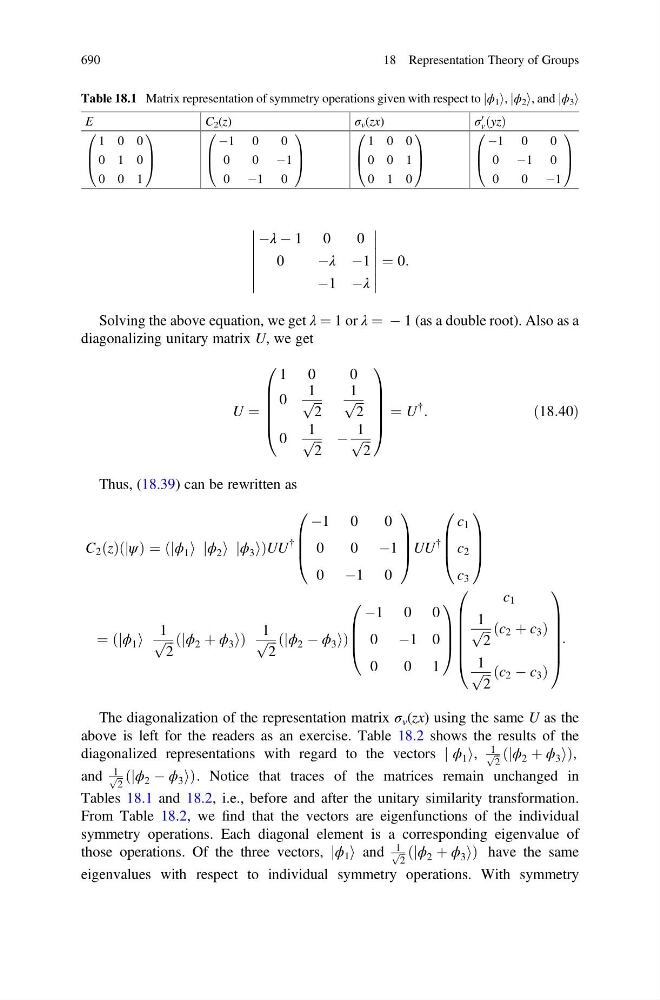
Solving the above equation, we get λ ¼ 1 or λ ¼ À 1 (as a double root). Also as a
diagonalizing unitary matrix U, we get
U ¼
1 0
0
0
1
ffiffi ffi
2
p
1
ffiffi ffi
2
p
0
1
ffiffi ffi
2
p À
1
ffiffi ffi
2
p
0
B
B
B
B
@
1
C
C
C
C
A
¼ U
{
:
ð18:40Þ
Thus, (18.39) can be rewritten as
C 2 z
ð Þ jψ
ð Þ ¼ ð ϕ 1 i
j
jϕ 2 i ϕ 3
j iÞUU
{
À1 0
0
0
0 À1
0 À1 0
0
B
B
@
1
C
C
A UU
{
c 1
c 2
c 3
0
B
B
@
1
C
C
A
¼ ðjϕ 1 i
1
ffiffi ffi
2
p jϕ 2 þ ϕ 3 i
ð
Þ
1
ffiffi ffi
2
p ϕ 2
j À ϕ 3 i
ð
Þ
À1 0 0
0 À1 0
0
0 1
0
B
B
@
1
C
C
A
c 1
1
ffiffi ffi
2
p c 2 þ c 3
ð
Þ
1
ffiffi ffi
2
p c 2 À c 3
ð
Þ
0
B
B
B
B
B
@
1
C
C
C
C
C
A
:
The diagonalization of the representation matrix σ v (zx) using the same U as the
above is left for the readers as an exercise. Table 18.2 shows the results of the
diagonalized representations with regard to the vectors j ϕ 1 i,
1 ffiffi
2
p jϕ 2 þ ϕ 3 i
ð
Þ ,
and
1 ffiffi
2
p jϕ 2 À ϕ 3 i
ð
Þ . Notice that traces of the matrices remain unchanged in
Tables 18.1 and 18.2, i.e., before and after the unitary similarity transformation.
From Table 18.2, we find that the vectors are eigenfunctions of the individual
symmetry operations. Each diagonal element is a corresponding eigenvalue of
those operations. Of the three vectors, jϕ 1 i and
1 ffiffi
2
p jϕ 2 þ ϕ 3 i
ð
Þ have the same
eigenvalues with respect to individual symmetry operations. With symmetry
Table 18.1 Matrix representation of symmetry operations given with respect to jϕ 1 i, jϕ 2 i, and jϕ 3 i
E
C 2 (z)
σ v (zx)
σ
0
v yz
ð Þ
1 0 0
0 1 0
0 0 1
0
B
@
1
C
A
À1 0
0
0
0 À1
0 À1 0
0
B
@
1
C
A
1 0 0
0 0 1
0 1 0
0
B
@
1
C
A
À1 0
0
0 À1 0
0
0 À1
0
B
@
1
C
A
690
18 Representation Theory of Groups
0
0
Àλ À1
À1 Àλ
¼ 0:
Solving the above equation, we get λ ¼ 1 or λ ¼ À 1 (as a double root). Also as a
diagonalizing unitary matrix U, we get
U ¼
1 0
0
0
1
ffiffi ffi
2
p
1
ffiffi ffi
2
p
0
1
ffiffi ffi
2
p À
1
ffiffi ffi
2
p
0
B
B
B
B
@
1
C
C
C
C
A
¼ U
{
:
ð18:40Þ
Thus, (18.39) can be rewritten as
C 2 z
ð Þ jψ
ð Þ ¼ ð ϕ 1 i
j
jϕ 2 i ϕ 3
j iÞUU
{
À1 0
0
0
0 À1
0 À1 0
0
B
B
@
1
C
C
A UU
{
c 1
c 2
c 3
0
B
B
@
1
C
C
A
¼ ðjϕ 1 i
1
ffiffi ffi
2
p jϕ 2 þ ϕ 3 i
ð
Þ
1
ffiffi ffi
2
p ϕ 2
j À ϕ 3 i
ð
Þ
À1 0 0
0 À1 0
0
0 1
0
B
B
@
1
C
C
A
c 1
1
ffiffi ffi
2
p c 2 þ c 3
ð
Þ
1
ffiffi ffi
2
p c 2 À c 3
ð
Þ
0
B
B
B
B
B
@
1
C
C
C
C
C
A
:
The diagonalization of the representation matrix σ v (zx) using the same U as the
above is left for the readers as an exercise. Table 18.2 shows the results of the
diagonalized representations with regard to the vectors j ϕ 1 i,
1 ffiffi
2
p jϕ 2 þ ϕ 3 i
ð
Þ ,
and
1 ffiffi
2
p jϕ 2 À ϕ 3 i
ð
Þ . Notice that traces of the matrices remain unchanged in
Tables 18.1 and 18.2, i.e., before and after the unitary similarity transformation.
From Table 18.2, we find that the vectors are eigenfunctions of the individual
symmetry operations. Each diagonal element is a corresponding eigenvalue of
those operations. Of the three vectors, jϕ 1 i and
1 ffiffi
2
p jϕ 2 þ ϕ 3 i
ð
Þ have the same
eigenvalues with respect to individual symmetry operations. With symmetry
Table 18.1 Matrix representation of symmetry operations given with respect to jϕ 1 i, jϕ 2 i, and jϕ 3 i
E
C 2 (z)
σ v (zx)
σ
0
v yz
ð Þ
1 0 0
0 1 0
0 0 1
0
B
@
1
C
A
À1 0
0
0
0 À1
0 À1 0
0
B
@
1
C
A
1 0 0
0 0 1
0 1 0
0
B
@
1
C
A
À1 0
0
0 À1 0
0
0 À1
0
B
@
1
C
A
690
18 Representation Theory of Groups