

ψi ¼ c 1
j
j ϕ 1 i þ c 2 ϕ 2 i þ c 3
j
j ϕ 3 i ¼ c 1 ϕ 1 þ c 2 ϕ 2 þ c 3 ϕ 3
j
i
¼ ϕ 1 i
j
jϕ 2 i jϕ 3 i
ð
Þ
c 1
c 2
c 3
0
B
B
@
1
C
C
A :
Let us now operate a group element of C 2v . For example, choosing C 2 (z), we have
C 2 z
ð Þ jψ
ð Þ ¼ ϕ 1
j i ϕ 2
j i ϕ 3
j i
ð
Þ
À1 0
0
0
0 À1
0 À1 0
0
B
@
1
C
A
c 1
c 2
c 3
0
B
@
1
C
A:
ð18:39Þ
Thus, C 2 (z) is represented by a (3, 3) matrix. Other group elements are
represented similarly. These results are collected in Table 18.1, where each matrix
is given with respect to jϕ 1 i, jϕ 2 i, and jϕ 3 i as basis vectors. Notice that the matrix
representations differ from those of Table 17.2, where we chose jxi, j yi, and j zi for
the basis vectors. From Table 18.1, we immediately see that the representation
matrices are reduced to an upper (1, 1) diagonal matrix (i.e., just a number) and a
lower (2, 2) diagonal matrix.
In Table 18.1, we find that all the matrices are Hermitian (as well as unitary).
Since C 2v is an Abelian group (i.e., commutative), in light of Theorem 14.13, we
should be able to diagonalize these matrices by a single unitary similarity transformation all at once. In fact, E and σ
0
v yz
ð Þare invariant with respect to unitary similarity
transformation, and so we only have to diagonalize C 2 (z) and σ v (zx) at once. As a
characteristic equation of the above (3, 3) matrix of (18.39), we have
C 1
C 2
C 3
H
H
H
H
H
C 1
C 2
C 3
H
H
H
H
H
x
z
y
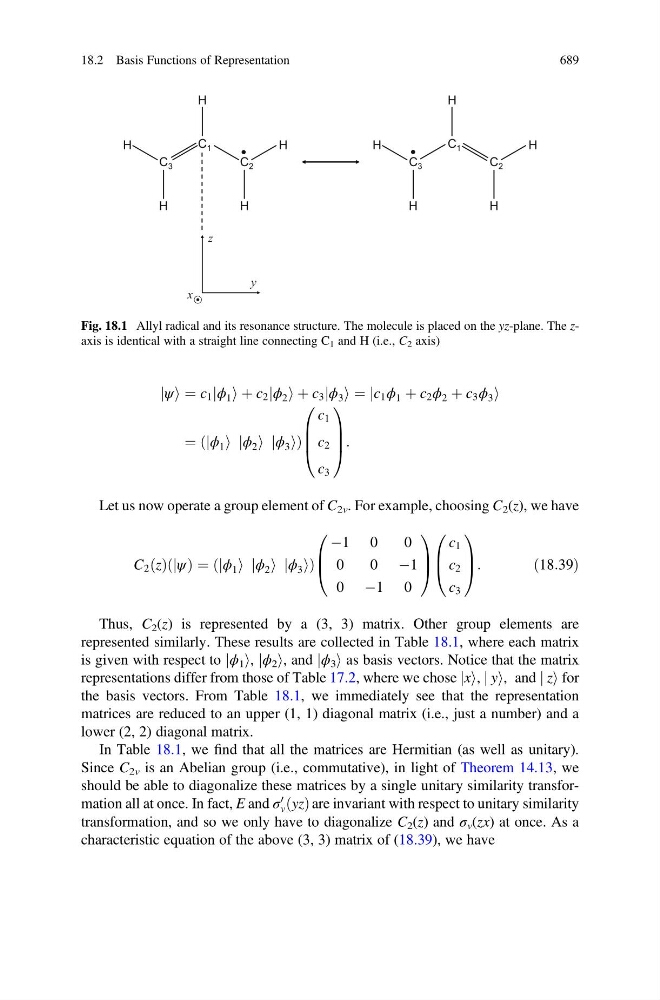
Fig. 18.1 Allyl radical and its resonance structure. The molecule is placed on the yz-plane. The zaxis is identical with a straight line connecting C 1 and H (i.e., C 2 axis)
18.2 Basis Functions of Representation
689
j
j ϕ 1 i þ c 2 ϕ 2 i þ c 3
j
j ϕ 3 i ¼ c 1 ϕ 1 þ c 2 ϕ 2 þ c 3 ϕ 3
j
i
¼ ϕ 1 i
j
jϕ 2 i jϕ 3 i
ð
Þ
c 1
c 2
c 3
0
B
B
@
1
C
C
A :
Let us now operate a group element of C 2v . For example, choosing C 2 (z), we have
C 2 z
ð Þ jψ
ð Þ ¼ ϕ 1
j i ϕ 2
j i ϕ 3
j i
ð
Þ
À1 0
0
0
0 À1
0 À1 0
0
B
@
1
C
A
c 1
c 2
c 3
0
B
@
1
C
A:
ð18:39Þ
Thus, C 2 (z) is represented by a (3, 3) matrix. Other group elements are
represented similarly. These results are collected in Table 18.1, where each matrix
is given with respect to jϕ 1 i, jϕ 2 i, and jϕ 3 i as basis vectors. Notice that the matrix
representations differ from those of Table 17.2, where we chose jxi, j yi, and j zi for
the basis vectors. From Table 18.1, we immediately see that the representation
matrices are reduced to an upper (1, 1) diagonal matrix (i.e., just a number) and a
lower (2, 2) diagonal matrix.
In Table 18.1, we find that all the matrices are Hermitian (as well as unitary).
Since C 2v is an Abelian group (i.e., commutative), in light of Theorem 14.13, we
should be able to diagonalize these matrices by a single unitary similarity transformation all at once. In fact, E and σ
0
v yz
ð Þare invariant with respect to unitary similarity
transformation, and so we only have to diagonalize C 2 (z) and σ v (zx) at once. As a
characteristic equation of the above (3, 3) matrix of (18.39), we have
C 1
C 2
C 3
H
H
H
H
H
C 1
C 2
C 3
H
H
H
H
H
x
z
y
Fig. 18.1 Allyl radical and its resonance structure. The molecule is placed on the yz-plane. The zaxis is identical with a straight line connecting C 1 and H (i.e., C 2 axis)
18.2 Basis Functions of Representation
689