

U ¼
1
ffiffi ffi
2
p
1
ffiffi ffi
2
p 0
À
i ffiffi ffi
2
p
i ffiffi ffi
2
p 0
0
0 1
0
B
B
B
B
@
1
C
C
C
C
A
, U
{
¼
1
ffiffi ffi
2
p
i ffiffi ffi
2
p
0
1
ffiffi ffi
2
p
À
i ffiffi ffi
2
p
0
0
0
1
0
B
B
B
B
@
1
C
C
C
C
A
:
ð17:76Þ
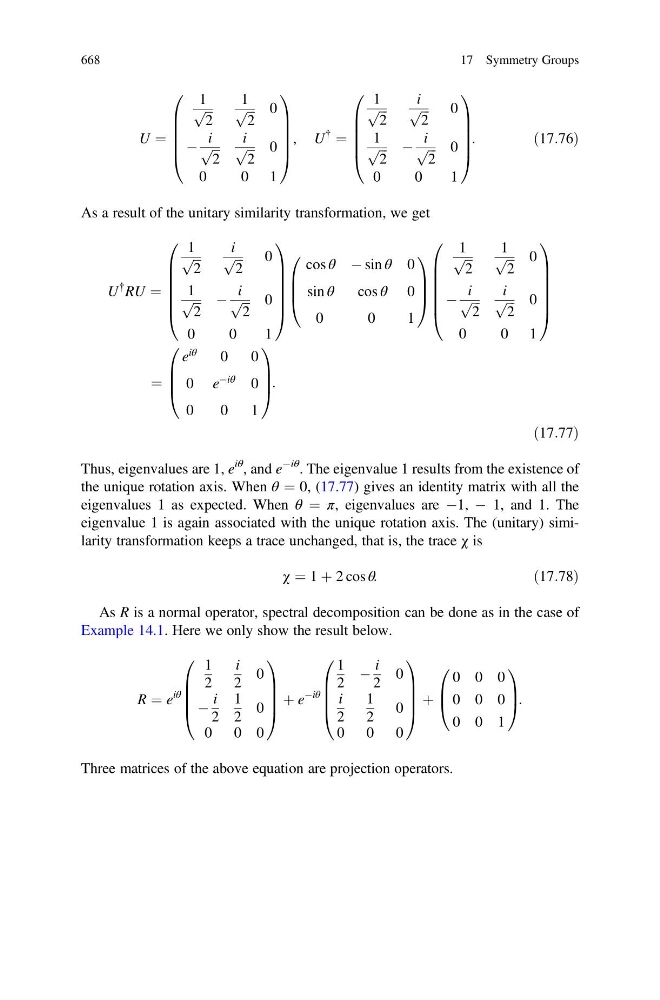
As a result of the unitary similarity transformation, we get
U
{ RU ¼
1
ffiffi ffi
2
p
i ffiffi ffi
2
p
0
1
ffiffi ffi
2
p
À
i ffiffi ffi
2
p 0
0
0
1
0
B
B
B
B
B
@
1
C
C
C
C
C
A
cos θ À sin θ 0
sin θ
cos θ 0
0
0
1
0
B
B
@
1
C
C
A
1
ffiffi ffi
2
p
1
ffiffi ffi
2
p
0
À
i ffiffi ffi
2
p
i ffiffi ffi
2
p
0
0
0 1
0
B
B
B
B
B
@
1
C
C
C
C
C
A
¼
e
iθ
0
0
0 e
Àiθ
0
0
0
1
0
B
B
@
1
C
C
A :
ð17:77Þ
Thus, eigenvalues are 1, e
iθ , and e
Àiθ . The eigenvalue 1 results from the existence of
the unique rotation axis. When θ ¼ 0, (17.77) gives an identity matrix with all the
eigenvalues 1 as expected. When θ ¼ π, eigenvalues are À1, À 1, and 1. The
eigenvalue 1 is again associated with the unique rotation axis. The (unitary) similarity transformation keeps a trace unchanged, that is, the trace χ is
χ ¼ 1 þ 2 cos θ:
ð17:78Þ
As R is a normal operator, spectral decomposition can be done as in the case of
Example 14.1. Here we only show the result below.
R ¼ e
iθ
1
2
i
2
0
À
i
2
1
2
0
0 0 0
0
B
B
B
@
1
C
C
C
A
þ e
Àiθ
1
2
À
i
2
0
i
2
1
2
0
0 0 0
0
B
B
B
@
1
C
C
C
A
þ
0 0 0
0 0 0
0 0 1
0
B
@
1
C
A:
Three matrices of the above equation are projection operators.
668
17 Symmetry Groups
1
ffiffi ffi
2
p
1
ffiffi ffi
2
p 0
À
i ffiffi ffi
2
p
i ffiffi ffi
2
p 0
0
0 1
0
B
B
B
B
@
1
C
C
C
C
A
, U
{
¼
1
ffiffi ffi
2
p
i ffiffi ffi
2
p
0
1
ffiffi ffi
2
p
À
i ffiffi ffi
2
p
0
0
0
1
0
B
B
B
B
@
1
C
C
C
C
A
:
ð17:76Þ
As a result of the unitary similarity transformation, we get
U
{ RU ¼
1
ffiffi ffi
2
p
i ffiffi ffi
2
p
0
1
ffiffi ffi
2
p
À
i ffiffi ffi
2
p 0
0
0
1
0
B
B
B
B
B
@
1
C
C
C
C
C
A
cos θ À sin θ 0
sin θ
cos θ 0
0
0
1
0
B
B
@
1
C
C
A
1
ffiffi ffi
2
p
1
ffiffi ffi
2
p
0
À
i ffiffi ffi
2
p
i ffiffi ffi
2
p
0
0
0 1
0
B
B
B
B
B
@
1
C
C
C
C
C
A
¼
e
iθ
0
0
0 e
Àiθ
0
0
0
1
0
B
B
@
1
C
C
A :
ð17:77Þ
Thus, eigenvalues are 1, e
iθ , and e
Àiθ . The eigenvalue 1 results from the existence of
the unique rotation axis. When θ ¼ 0, (17.77) gives an identity matrix with all the
eigenvalues 1 as expected. When θ ¼ π, eigenvalues are À1, À 1, and 1. The
eigenvalue 1 is again associated with the unique rotation axis. The (unitary) similarity transformation keeps a trace unchanged, that is, the trace χ is
χ ¼ 1 þ 2 cos θ:
ð17:78Þ
As R is a normal operator, spectral decomposition can be done as in the case of
Example 14.1. Here we only show the result below.
R ¼ e
iθ
1
2
i
2
0
À
i
2
1
2
0
0 0 0
0
B
B
B
@
1
C
C
C
A
þ e
Àiθ
1
2
À
i
2
0
i
2
1
2
0
0 0 0
0
B
B
B
@
1
C
C
C
A
þ
0 0 0
0 0 0
0 0 1
0
B
@
1
C
A:
Three matrices of the above equation are projection operators.
668
17 Symmetry Groups