

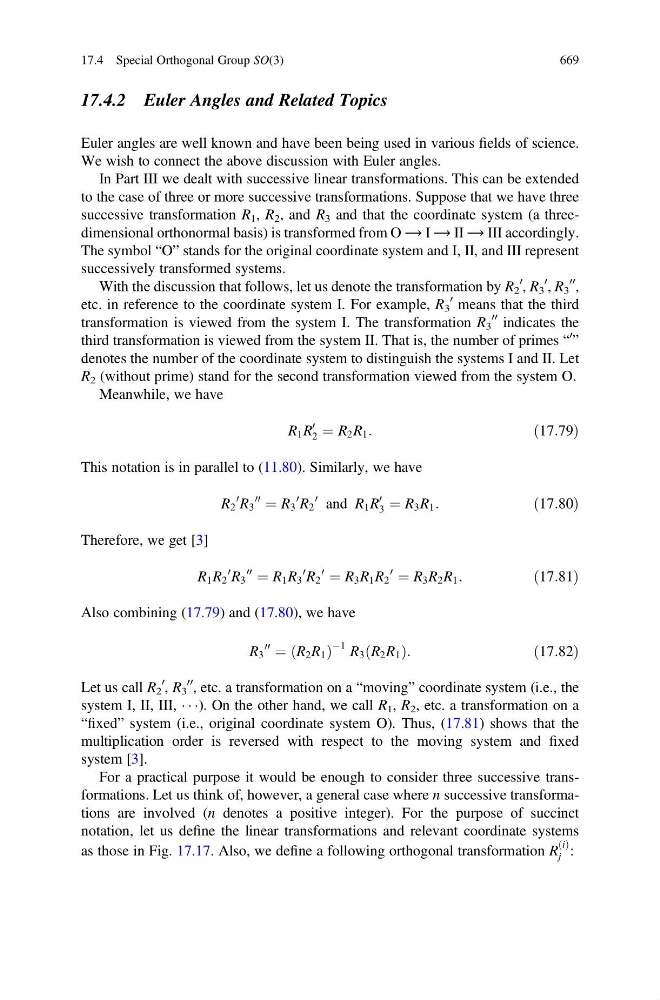
17.4.2 Euler Angles and Related Topics
Euler angles are well known and have been being used in various fields of science.
We wish to connect the above discussion with Euler angles.
In Part III we dealt with successive linear transformations. This can be extended
to the case of three or more successive transformations. Suppose that we have three
successive transformation R 1 , R 2 , and R 3 and that the coordinate system (a threedimensional orthonormal basis) is transformed from O ⟶ I ⟶ II ⟶ III accordingly.
The symbol “O” stands for the original coordinate system and I, II, and III represent
successively transformed systems.
With the discussion that follows, let us denote the transformation by R 2
0
, R 3
0 , R 3
00
,
etc. in reference to the coordinate system I. For example, R 3
0 means that the third
transformation is viewed from the system I. The transformation R 3
00 indicates the
third transformation is viewed from the system II. That is, the number of primes “
0
”
denotes the number of the coordinate system to distinguish the systems I and II. Let
R 2 (without prime) stand for the second transformation viewed from the system O.
Meanwhile, we have
R 1 R
0
2 ¼ R 2 R 1 :
ð17:79Þ
This notation is in parallel to (11.80). Similarly, we have
R 2
0 R 3
00
¼ R 3
0 R 2
0 and R 1 R
0
3 ¼ R 3 R 1 :
ð17:80Þ
Therefore, we get [3]
R 1 R 2
0 R 3
00
¼ R 1 R 3
0 R 2
0
¼ R 3 R 1 R 2
0
¼ R 3 R 2 R 1 :
ð17:81Þ
Also combining (17.79) and (17.80), we have
R 3
00
¼ R 2 R 1
ð
Þ
À1 R 3 R 2 R 1
ð
Þ:
ð17:82Þ
Let us call R 2
0
, R 3
00 , etc. a transformation on a “moving” coordinate system (i.e., the
system I, II, III, Á Á Á). On the other hand, we call R 1 , R 2 , etc. a transformation on a
“fixed” system (i.e., original coordinate system O). Thus, (17.81) shows that the
multiplication order is reversed with respect to the moving system and fixed
system [3].
For a practical purpose it would be enough to consider three successive transformations. Let us think of, however, a general case where n successive transformations are involved (n denotes a positive integer). For the purpose of succinct
notation, let us define the linear transformations and relevant coordinate systems
as those in Fig. 17.17. Also, we define a following orthogonal transformation R
i
ð Þ
j :
17.4 Special Orthogonal Group SO(3)
669