

hvjR
T
¼ hvj :
ð17:67Þ
Therefore, using the relation (17.64), we get
hyjR
T
¼ hyj :
ð17:68Þ
Here we are dealing with real numbers and, hence, we have
R
{
¼ R
T
:
ð17:69Þ
Now we have
yjRw
h
i¼ yR
T
jRw
¼ yjR
T Rw
¼ yjEw
h
i¼ yjw
h i ¼ 0:
ð17:70Þ
In (17.70) the second equality comes from the associative law; the third is due to
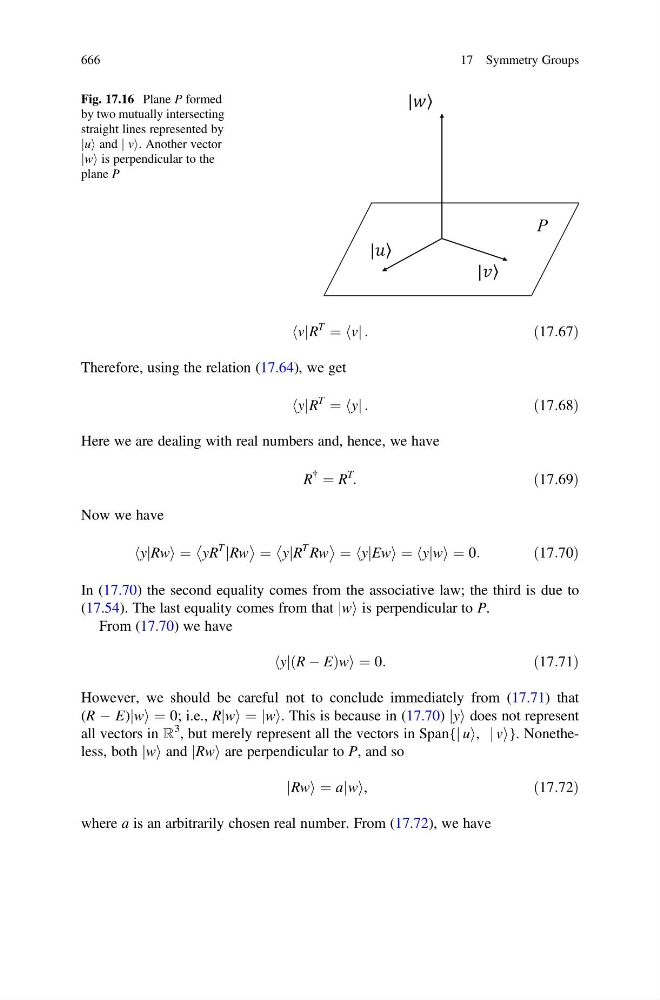
(17.54). The last equality comes from that jwi is perpendicular to P.
From (17.70) we have
yj R À E
ð
Þw
h
i¼ 0:
ð17:71Þ
However, we should be careful not to conclude immediately from (17.71) that
(R À E)jwi ¼ 0; i.e., Rjwi ¼ jwi. This is because in (17.70) jyi does not represent
all vectors in ℝ
3 , but merely represent all the vectors in Span{j ui, j vi}. Nonetheless, both jwi and jRwi are perpendicular to P, and so
jRwi ¼ ajwi,
ð17:72Þ
where a is an arbitrarily chosen real number. From (17.72), we have
⟩
|
⟩
|
⟩
|
P
Fig. 17.16 Plane P formed
by two mutually intersecting
straight lines represented by
jui and j vi. Another vector
jwi is perpendicular to the
plane P
666
17 Symmetry Groups
T
¼ hvj :
ð17:67Þ
Therefore, using the relation (17.64), we get
hyjR
T
¼ hyj :
ð17:68Þ
Here we are dealing with real numbers and, hence, we have
R
{
¼ R
T
:
ð17:69Þ
Now we have
yjRw
h
i¼ yR
T
jRw
¼ yjR
T Rw
¼ yjEw
h
i¼ yjw
h i ¼ 0:
ð17:70Þ
In (17.70) the second equality comes from the associative law; the third is due to
(17.54). The last equality comes from that jwi is perpendicular to P.
From (17.70) we have
yj R À E
ð
Þw
h
i¼ 0:
ð17:71Þ
However, we should be careful not to conclude immediately from (17.71) that
(R À E)jwi ¼ 0; i.e., Rjwi ¼ jwi. This is because in (17.70) jyi does not represent
all vectors in ℝ
3 , but merely represent all the vectors in Span{j ui, j vi}. Nonetheless, both jwi and jRwi are perpendicular to P, and so
jRwi ¼ ajwi,
ð17:72Þ
where a is an arbitrarily chosen real number. From (17.72), we have
⟩
|
⟩
|
⟩
|
P
Fig. 17.16 Plane P formed
by two mutually intersecting
straight lines represented by
jui and j vi. Another vector
jwi is perpendicular to the
plane P
666
17 Symmetry Groups