

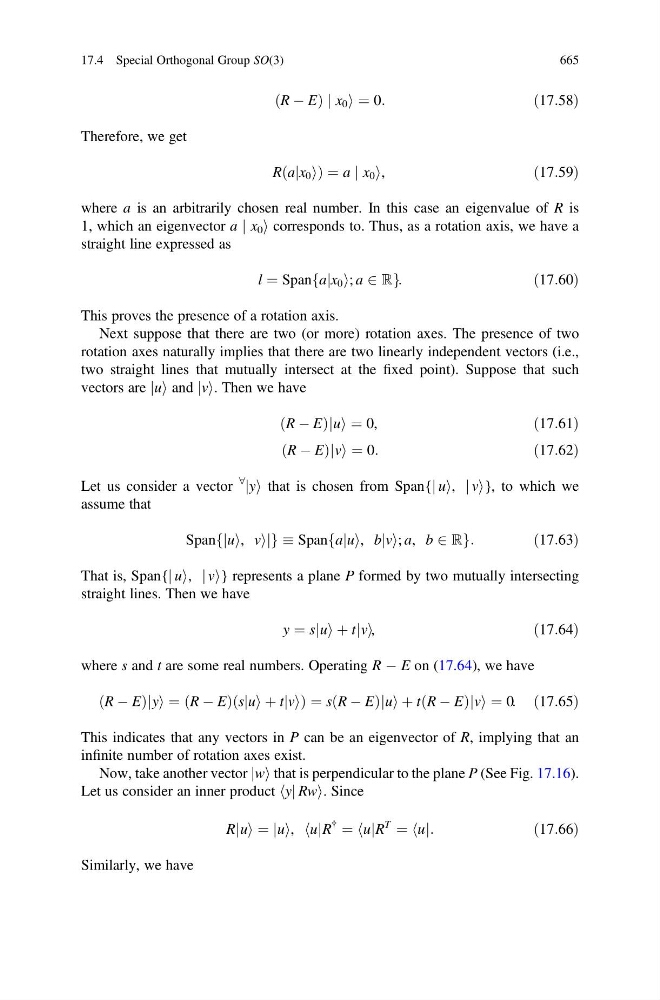
R À E
ð
Þjx 0 i ¼ 0:
ð17:58Þ
Therefore, we get
R ajx 0 i
ð
Þ¼a j x 0 i,
ð17:59Þ
where a is an arbitrarily chosen real number. In this case an eigenvalue of R is
1, which an eigenvector a j x 0 i corresponds to. Thus, as a rotation axis, we have a
straight line expressed as
l ¼ Span ajx 0 i; a 2 ℝ
f
g :
ð17:60Þ
This proves the presence of a rotation axis.
Next suppose that there are two (or more) rotation axes. The presence of two
rotation axes naturally implies that there are two linearly independent vectors (i.e.,
two straight lines that mutually intersect at the fixed point). Suppose that such
vectors are jui and jvi. Then we have
R À E
ð
Þjui ¼ 0,
ð17:61Þ
R À E
ð
Þjvi ¼ 0:
ð17:62Þ
Let us consider a vector
8
jyi that is chosen from Span{j ui, j vi}, to which we
assume that
Span jui, vij
f
g Span ajui, bjvi; a, b 2 ℝ
f
g :
ð17:63Þ
That is, Span{j ui, j vi} represents a plane P formed by two mutually intersecting
straight lines. Then we have
y ¼ sjui þ tjvi,
ð17:64Þ
where s and t are some real numbers. Operating R À E on (17.64), we have
R À E
ð
Þjyi ¼ R À E
ð
Þ sjui þ tjvi
ð
Þ¼s R À E
ð
Þjui þ t R À E
ð
Þjvi ¼ 0: ð17:65Þ
This indicates that any vectors in P can be an eigenvector of R, implying that an
infinite number of rotation axes exist.
Now, take another vector jwi that is perpendicular to the plane P (See Fig. 17.16).
Let us consider an inner product hyj Rwi. Since
Rjui ¼ jui, hujR
{
¼ hujR
T
¼ huj:
ð17:66Þ
Similarly, we have
17.4 Special Orthogonal Group SO(3)
665
ð
Þjx 0 i ¼ 0:
ð17:58Þ
Therefore, we get
R ajx 0 i
ð
Þ¼a j x 0 i,
ð17:59Þ
where a is an arbitrarily chosen real number. In this case an eigenvalue of R is
1, which an eigenvector a j x 0 i corresponds to. Thus, as a rotation axis, we have a
straight line expressed as
l ¼ Span ajx 0 i; a 2 ℝ
f
g :
ð17:60Þ
This proves the presence of a rotation axis.
Next suppose that there are two (or more) rotation axes. The presence of two
rotation axes naturally implies that there are two linearly independent vectors (i.e.,
two straight lines that mutually intersect at the fixed point). Suppose that such
vectors are jui and jvi. Then we have
R À E
ð
Þjui ¼ 0,
ð17:61Þ
R À E
ð
Þjvi ¼ 0:
ð17:62Þ
Let us consider a vector
8
jyi that is chosen from Span{j ui, j vi}, to which we
assume that
Span jui, vij
f
g Span ajui, bjvi; a, b 2 ℝ
f
g :
ð17:63Þ
That is, Span{j ui, j vi} represents a plane P formed by two mutually intersecting
straight lines. Then we have
y ¼ sjui þ tjvi,
ð17:64Þ
where s and t are some real numbers. Operating R À E on (17.64), we have
R À E
ð
Þjyi ¼ R À E
ð
Þ sjui þ tjvi
ð
Þ¼s R À E
ð
Þjui þ t R À E
ð
Þjvi ¼ 0: ð17:65Þ
This indicates that any vectors in P can be an eigenvector of R, implying that an
infinite number of rotation axes exist.
Now, take another vector jwi that is perpendicular to the plane P (See Fig. 17.16).
Let us consider an inner product hyj Rwi. Since
Rjui ¼ jui, hujR
{
¼ hujR
T
¼ huj:
ð17:66Þ
Similarly, we have
17.4 Special Orthogonal Group SO(3)
665