

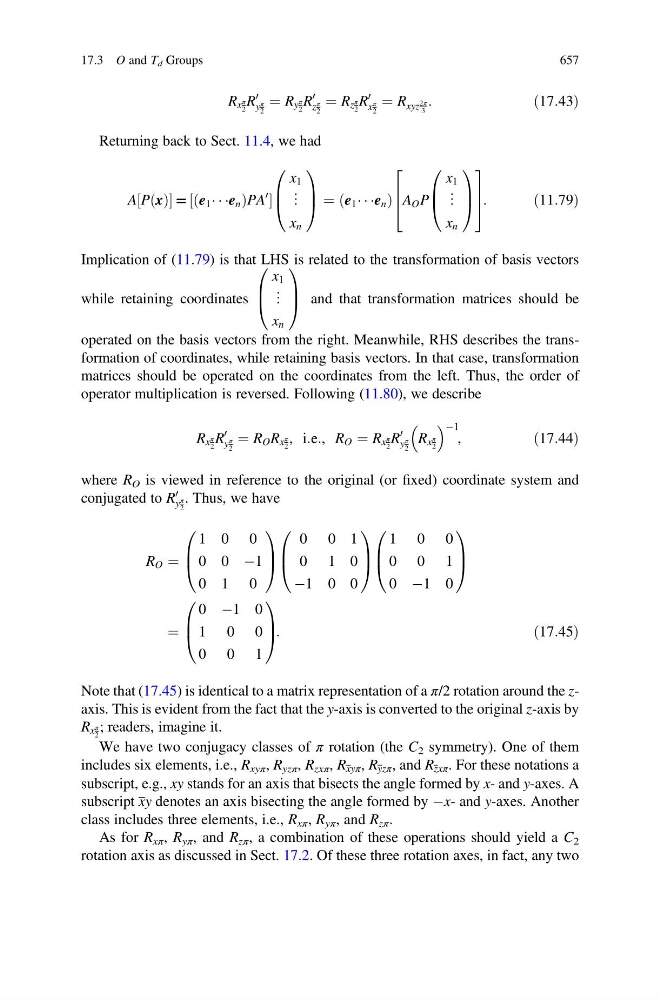
R x
π
2
R
0
y
π
2
¼ R y
π
2
R
0
z
π
2
¼ R z
π
2
R
0
x
π
2
¼ R xyz
2π
3
:
ð17:43Þ
Returning back to Sect. 11.4, we had
A P x
ð Þ
½
= e 1 Á Á Áe n
ð
ÞPA
0
½
x 1
⋮
x n
0
B
@
1
C
A ¼ e 1 Á Á Áe n
ð
Þ A O P
x 1
⋮
x n
0
B
@
1
C
A
2
6
4
3
7
5:
ð11:79Þ
Implication of (11.79) is that LHS is related to the transformation of basis vectors
while retaining coordinates
x 1
⋮
x n
0
B
@
1
C
A and that transformation matrices should be
operated on the basis vectors from the right. Meanwhile, RHS describes the transformation of coordinates, while retaining basis vectors. In that case, transformation
matrices should be operated on the coordinates from the left. Thus, the order of
operator multiplication is reversed. Following (11.80), we describe
R x
π
2
R
0
y
π
2
¼ R O R x
π
2
, i:e:, R O ¼ R x
π
2
R
0
y
π
2
R x
π
2
À1
,
ð17:44Þ
where R O is viewed in reference to the original (or fixed) coordinate system and
conjugated to R
0
y
π
2
. Thus, we have
R O ¼
1 0 0
0 0 À1
0 1 0
0
B
@
1
C
A
0 0 1
0 1 0
À1 0 0
0
B
@
1
C
A
1 0 0
0 0 1
0 À1 0
0
B
@
1
C
A
¼
0 À1 0
1 0 0
0 0 1
0
B
@
1
C
A:
ð17:45Þ
Note that (17.45) is identical to a matrix representation of a π/2 rotation around the zaxis. This is evident from the fact that the y-axis is converted to the original z-axis by
R x
π
2
; readers, imagine it.
We have two conjugacy classes of π rotation (the C 2 symmetry). One of them
includes six elements, i.e., R xyπ , R yzπ , R zxπ , R xyπ , R yzπ , and R zxπ . For these notations a
subscript, e.g., xy stands for an axis that bisects the angle formed by x- and y-axes. A
subscript xy denotes an axis bisecting the angle formed by Àx- and y-axes. Another
class includes three elements, i.e., R xπ , R yπ , and R zπ .
As for R xπ , R yπ , and R zπ , a combination of these operations should yield a C 2
rotation axis as discussed in Sect. 17.2. Of these three rotation axes, in fact, any two
17.3 O and T d Groups
657
π
2
R
0
y
π
2
¼ R y
π
2
R
0
z
π
2
¼ R z
π
2
R
0
x
π
2
¼ R xyz
2π
3
:
ð17:43Þ
Returning back to Sect. 11.4, we had
A P x
ð Þ
½
= e 1 Á Á Áe n
ð
ÞPA
0
½
x 1
⋮
x n
0
B
@
1
C
A ¼ e 1 Á Á Áe n
ð
Þ A O P
x 1
⋮
x n
0
B
@
1
C
A
2
6
4
3
7
5:
ð11:79Þ
Implication of (11.79) is that LHS is related to the transformation of basis vectors
while retaining coordinates
x 1
⋮
x n
0
B
@
1
C
A and that transformation matrices should be
operated on the basis vectors from the right. Meanwhile, RHS describes the transformation of coordinates, while retaining basis vectors. In that case, transformation
matrices should be operated on the coordinates from the left. Thus, the order of
operator multiplication is reversed. Following (11.80), we describe
R x
π
2
R
0
y
π
2
¼ R O R x
π
2
, i:e:, R O ¼ R x
π
2
R
0
y
π
2
R x
π
2
À1
,
ð17:44Þ
where R O is viewed in reference to the original (or fixed) coordinate system and
conjugated to R
0
y
π
2
. Thus, we have
R O ¼
1 0 0
0 0 À1
0 1 0
0
B
@
1
C
A
0 0 1
0 1 0
À1 0 0
0
B
@
1
C
A
1 0 0
0 0 1
0 À1 0
0
B
@
1
C
A
¼
0 À1 0
1 0 0
0 0 1
0
B
@
1
C
A:
ð17:45Þ
Note that (17.45) is identical to a matrix representation of a π/2 rotation around the zaxis. This is evident from the fact that the y-axis is converted to the original z-axis by
R x
π
2
; readers, imagine it.
We have two conjugacy classes of π rotation (the C 2 symmetry). One of them
includes six elements, i.e., R xyπ , R yzπ , R zxπ , R xyπ , R yzπ , and R zxπ . For these notations a
subscript, e.g., xy stands for an axis that bisects the angle formed by x- and y-axes. A
subscript xy denotes an axis bisecting the angle formed by Àx- and y-axes. Another
class includes three elements, i.e., R xπ , R yπ , and R zπ .
As for R xπ , R yπ , and R zπ , a combination of these operations should yield a C 2
rotation axis as discussed in Sect. 17.2. Of these three rotation axes, in fact, any two
17.3 O and T d Groups
657