

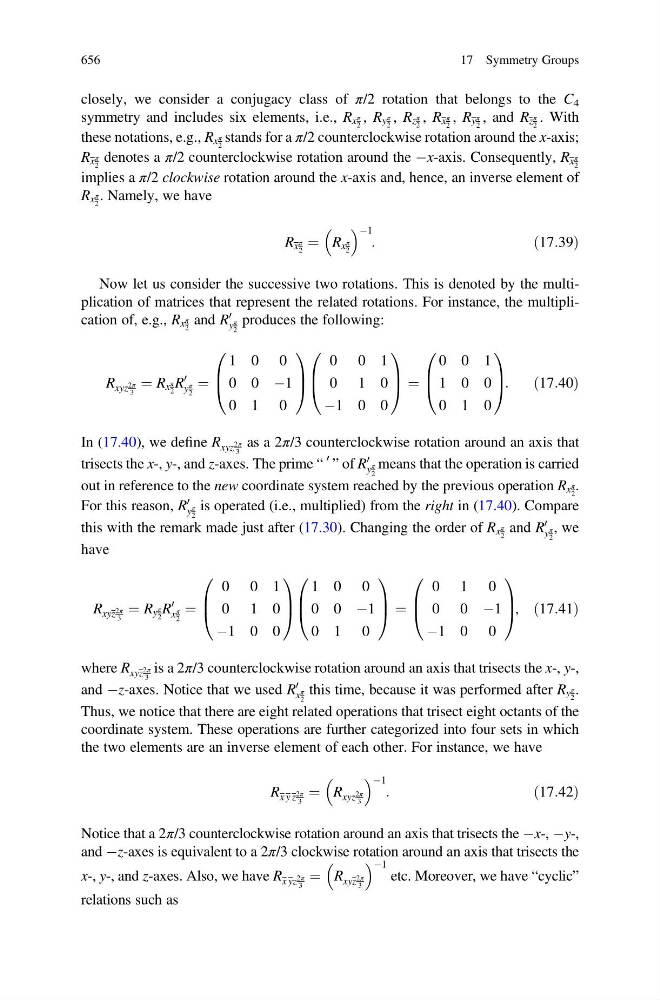
closely, we consider a conjugacy class of π/2 rotation that belongs to the C 4
symmetry and includes six elements, i.e., R x
π
2
, R y
π
2
, R z
π
2
, R x
π
2
, R y
π
2
, and R z
π
2
. With
these notations, e.g., R x
π
2
stands for a π/2 counterclockwise rotation around the x-axis;
R x
π
2
denotes a π/2 counterclockwise rotation around the Àx-axis. Consequently, R x
π
2
implies a π/2 clockwise rotation around the x-axis and, hence, an inverse element of
R x
π
2
. Namely, we have
R x
π
2
¼ R x
π
2
À1
:
ð17:39Þ
Now let us consider the successive two rotations. This is denoted by the multiplication of matrices that represent the related rotations. For instance, the multiplication of, e.g., R x
π
2
and R
0
y
π
2
produces the following:
R xyz
2π
3
¼ R x
π
2
R
0
y
π
2
¼
1 0 0
0 0 À1
0 1 0
0
B
@
1
C
A
0 0 1
0 1 0
À1 0 0
0
B
@
1
C
A ¼
0 0 1
1 0 0
0 1 0
0
B
@
1
C
A:
ð17:40Þ
In (17.40), we define R xyz
2π
3
as a 2π/3 counterclockwise rotation around an axis that
trisects the x-, y-, and z-axes. The prime “
0 ” of R
0
y
π
2
means that the operation is carried
out in reference to the new coordinate system reached by the previous operation R x
π
2
.
For this reason, R
0
y
π
2
is operated (i.e., multiplied) from the right in (17.40). Compare
this with the remark made just after (17.30). Changing the order of R x
π
2
and R
0
y
π
2
, we
have
R xyz
2π
3
¼ R y
π
2
R
0
x
π
2
¼
0 0 1
0 1 0
À1 0 0
0
B
@
1
C
A
1 0 0
0 0 À1
0 1 0
0
B
@
1
C
A ¼
0 1 0
0 0 À1
À1 0 0
0
B
@
1
C
A, ð17:41Þ
where R xyz
2π
3
is a 2π/3 counterclockwise rotation around an axis that trisects the x-, y-,
and Àz-axes. Notice that we used R
0
x
π
2
this time, because it was performed after R y
π
2
.
Thus, we notice that there are eight related operations that trisect eight octants of the
coordinate system. These operations are further categorized into four sets in which
the two elements are an inverse element of each other. For instance, we have
R x y z
2π
3
¼ R xyz
2π
3
À1
:
ð17:42Þ
Notice that a 2π/3 counterclockwise rotation around an axis that trisects the Àx-, Ày-,
and Àz-axes is equivalent to a 2π/3 clockwise rotation around an axis that trisects the
x-, y-, and z-axes. Also, we have R x yz
2π
3
¼ R xyz
2π
3
À1
etc. Moreover, we have “cyclic”
relations such as
656
17 Symmetry Groups