

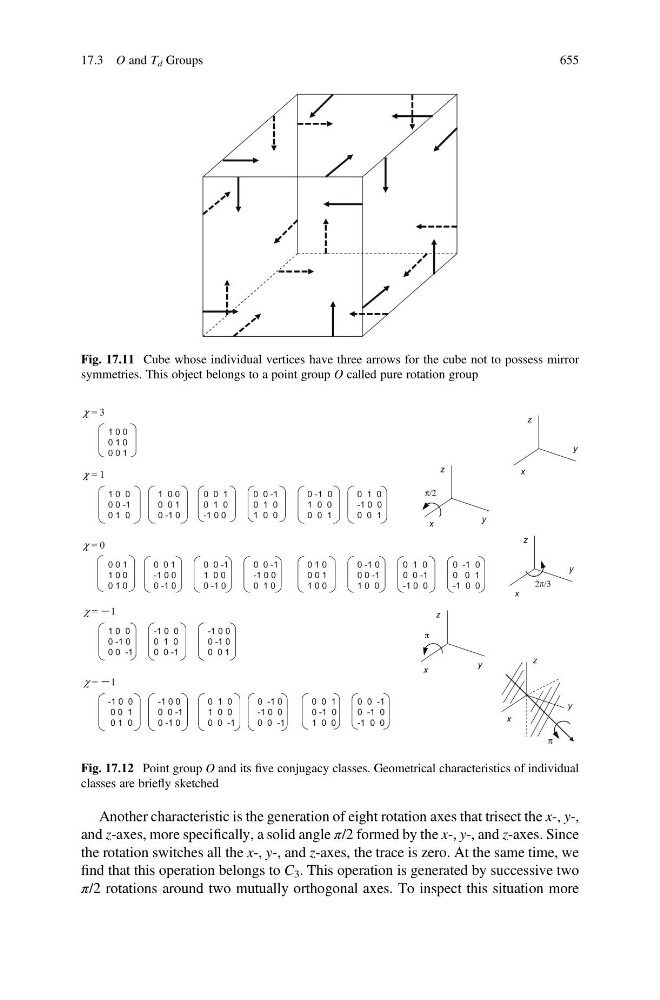
Another characteristic is the generation of eight rotation axes that trisect the x-, y-,
and z-axes, more specifically, a solid angle π/2 formed by the x-, y-, and z-axes. Since
the rotation switches all the x-, y-, and z-axes, the trace is zero. At the same time, we
find that this operation belongs to C 3 . This operation is generated by successive two
π/2 rotations around two mutually orthogonal axes. To inspect this situation more
Fig. 17.11 Cube whose individual vertices have three arrows for the cube not to possess mirror
symmetries. This object belongs to a point group O called pure rotation group
1 0 0
0 1 0
0 0 1
-1 0 0
0 1 0
0 0 -1
0 0 1
1 0 0
0 1 0
0 0 1
-1 0 0
0 -1 0
0 0 -1
1 0 0
0 -1 0
0 0 -1
-1 0 0
0 1 0
x
y
z
0 1 0
0 0 1
1 0 0
0 -1 0
0 0 -1
1 0 0
0 1 0
0 0 -1
-1 0 0
0 -1 0
0 0 1
-1 0 0
x
y
z
1 0 0
0 0 -1
0 1 0
1 0 0
0 0 1
0 -1 0
0 0 1
0 1 0
-1 0 0
0 0 -1
0 1 0
1 0 0
0 -1 0
1 0 0
0 0 1
0 0 1
0 -1 0
1 0 0
0 0 -1
0 -1 0
-1 0 0
0 1 0
-1 0 0
0 0 1
x
y
z
1 0 0
0 -1 0
0 0 -1
-1 0 0
0 -1 0
0 0 1
x
y
z
π
-1 0 0
0 0 1
0 1 0
-1 0 0
0 0 -1
0 -1 0
0 1 0
1 0 0
0 0 -1
0 -1 0
-1 0 0
0 0 -1
χ = 3
χ = 1
χ = 0
χ = 䠉1
χ = 䠉1
2π/3
π/2
x
y
z
π
Fig. 17.12 Point group O and its five conjugacy classes. Geometrical characteristics of individual
classes are briefly sketched
17.3 O and T d Groups
655