

17.3 O and T d Groups
According as a geometric object (or a molecule) has a higher symmetry, we have to
deal with many symmetry operations and relationship between them. As an example,
we consider O and T d groups. Both the groups have 24 symmetry operations and are
isomorphic.
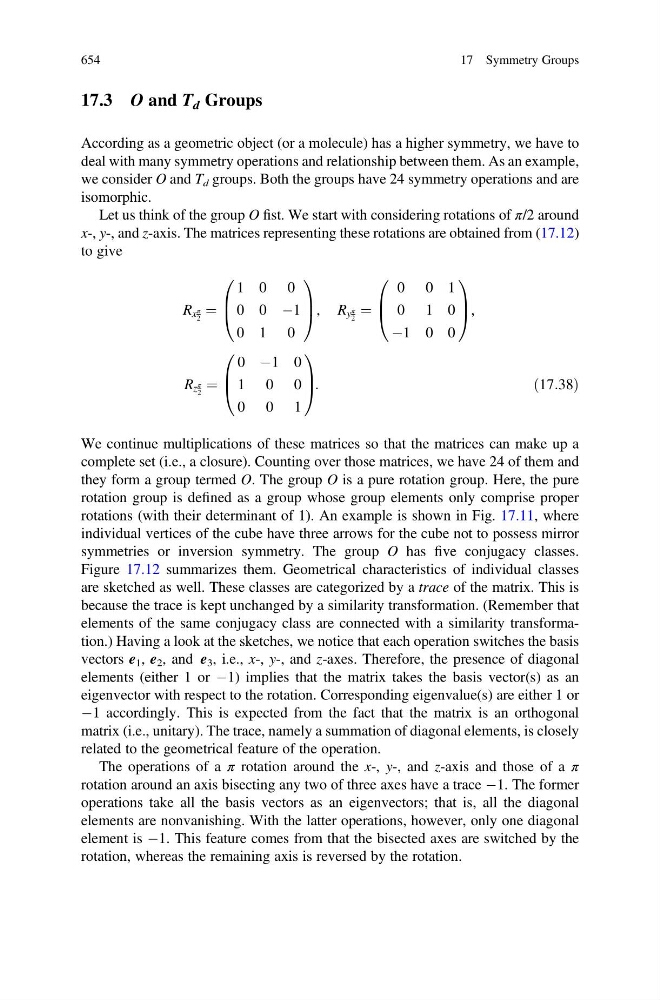
Let us think of the group O fist. We start with considering rotations of π/2 around
x-, y-, and z-axis. The matrices representing these rotations are obtained from (17.12)
to give
R x
π
2
¼
1 0 0
0 0 À1
0 1 0
0
B
@
1
C
A, R y
π
2
¼
0 0 1
0 1 0
À1 0 0
0
B
@
1
C
A,
R z
π
2
¼
0 À1 0
1 0 0
0 0 1
0
B
@
1
C
A:
ð17:38Þ
We continue multiplications of these matrices so that the matrices can make up a
complete set (i.e., a closure). Counting over those matrices, we have 24 of them and
they form a group termed O. The group O is a pure rotation group. Here, the pure
rotation group is defined as a group whose group elements only comprise proper
rotations (with their determinant of 1). An example is shown in Fig. 17.11, where
individual vertices of the cube have three arrows for the cube not to possess mirror
symmetries or inversion symmetry. The group O has five conjugacy classes.
Figure 17.12 summarizes them. Geometrical characteristics of individual classes
are sketched as well. These classes are categorized by a trace of the matrix. This is
because the trace is kept unchanged by a similarity transformation. (Remember that
elements of the same conjugacy class are connected with a similarity transformation.) Having a look at the sketches, we notice that each operation switches the basis
vectors e 1 , e 2 , and e 3 , i.e., x-, y-, and z-axes. Therefore, the presence of diagonal
elements (either 1 or À1) implies that the matrix takes the basis vector(s) as an
eigenvector with respect to the rotation. Corresponding eigenvalue(s) are either 1 or
À1 accordingly. This is expected from the fact that the matrix is an orthogonal
matrix (i.e., unitary). The trace, namely a summation of diagonal elements, is closely
related to the geometrical feature of the operation.
The operations of a π rotation around the x-, y-, and z-axis and those of a π
rotation around an axis bisecting any two of three axes have a trace À1. The former
operations take all the basis vectors as an eigenvectors; that is, all the diagonal
elements are nonvanishing. With the latter operations, however, only one diagonal
element is À1. This feature comes from that the bisected axes are switched by the
rotation, whereas the remaining axis is reversed by the rotation.
654
17 Symmetry Groups