

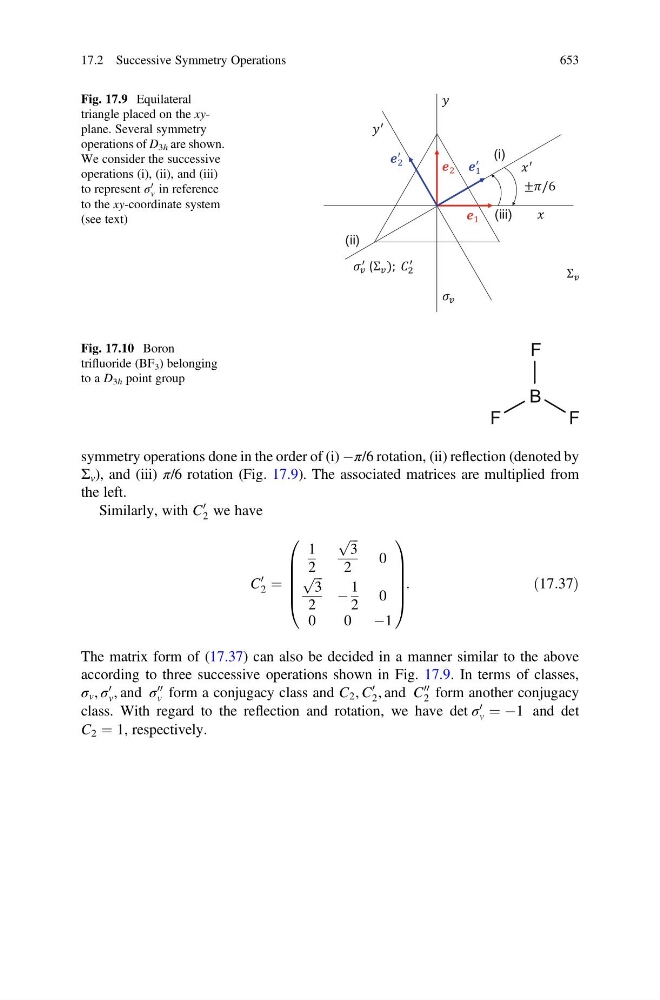
symmetry operations done in the order of (i) Àπ/6 rotation, (ii) reflection (denoted by
Σ v ), and (iii) π/6 rotation (Fig. 17.9). The associated matrices are multiplied from
the left.
Similarly, with C
0
2 we have
C
0
2 ¼
1
2
ffiffi ffi
3
p
2
0
ffiffi ffi
3
p
2
À
1
2
0
0
0 À1
0
B
B
B
B
@
1
C
C
C
C
A
:
ð17:37Þ
The matrix form of (17.37) can also be decided in a manner similar to the above
according to three successive operations shown in Fig. 17.9. In terms of classes,
σ v , σ
0
v , and σ
00
v form a conjugacy class and C 2 , C
0
2 , and C
00
2 form another conjugacy
class. With regard to the reflection and rotation, we have det σ
0
v ¼ À1 and det
C 2 ¼ 1, respectively.
(Σ );
LLL
L
LL
± /6
Σ
Fig. 17.9 Equilateral
triangle placed on the xyplane. Several symmetry
operations of D 3h are shown.
We consider the successive
operations (i), (ii), and (iii)
to represent σ
0
v in reference
to the xy-coordinate system
(see text)
%
Fig. 17.10 Boron
trifluoride (BF 3 ) belonging
to a D 3h point group
17.2 Successive Symmetry Operations
653