

e
0
1 e
0
2 e
0
3
À
Á ¼ e 1 e 2 e 3
ð
Þ R z
π
6
¼ e 1 e 2 e 3
ð
Þ
ffiffi ffi
3
p
2
À
1
2
0
1
2
ffiffi ffi
3
p
2
0
0
0 1
0
B
B
B
B
@
1
C
C
C
C
A
:
ð17:33Þ
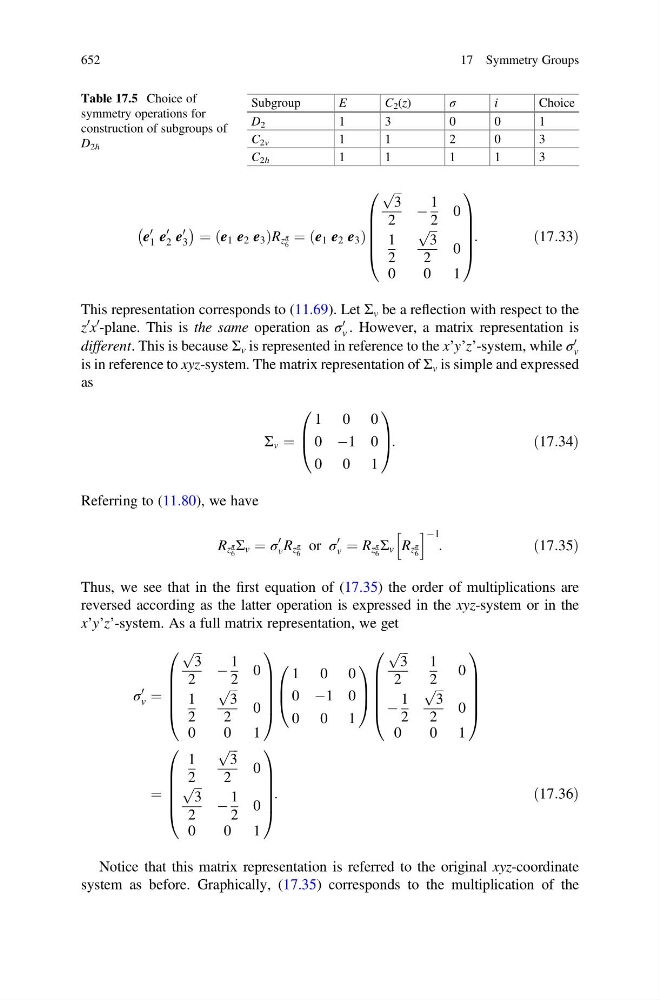
This representation corresponds to (11.69). Let Σ v be a reflection with respect to the
z
0 x
0
-plane. This is the same operation as σ
0
v . However, a matrix representation is
different. This is because Σ v is represented in reference to the x’y’z’-system, while σ
0
v
is in reference to xyz-system. The matrix representation of Σ v is simple and expressed
as
Σ v ¼
1 0 0
0 À1 0
0 0 1
0
B
@
1
C
A:
ð17:34Þ
Referring to (11.80), we have
R z
π
6
Σ v ¼ σ
0
v R z
π
6
or σ
0
v ¼ R z
π
6
Σ v R z
π
6
h i À1
:
ð17:35Þ
Thus, we see that in the first equation of (17.35) the order of multiplications are
reversed according as the latter operation is expressed in the xyz-system or in the
x’y’z’-system. As a full matrix representation, we get
σ
0
v ¼
ffiffi ffi
3
p
2
À
1
2
0
1
2
ffiffi ffi
3
p
2
0
0
0 1
0
B
B
B
B
@
1
C
C
C
C
A
1 0 0
0 À1 0
0 0 1
0
B
@
1
C
A
ffiffi ffi
3
p
2
1
2
0
À
1
2
ffiffi ffi
3
p
2
0
0
0 1
0
B
B
B
B
@
1
C
C
C
C
A
¼
1
2
ffiffi ffi
3
p
2
0
ffiffi ffi
3
p
2
À
1
2
0
0
0 1
0
B
B
B
B
@
1
C
C
C
C
A
:
ð17:36Þ
Notice that this matrix representation is referred to the original xyz-coordinate
system as before. Graphically, (17.35) corresponds to the multiplication of the
Table 17.5 Choice of
symmetry operations for
construction of subgroups of
D 2h
Subgroup
E
C 2 (z)
σ
i
Choice
D 2
1
3
0
0
1
C 2v
1
1
2
0
3
C 2h
1
1
1
1
3
652
17 Symmetry Groups
0
1 e
0
2 e
0
3
À
Á ¼ e 1 e 2 e 3
ð
Þ R z
π
6
¼ e 1 e 2 e 3
ð
Þ
ffiffi ffi
3
p
2
À
1
2
0
1
2
ffiffi ffi
3
p
2
0
0
0 1
0
B
B
B
B
@
1
C
C
C
C
A
:
ð17:33Þ
This representation corresponds to (11.69). Let Σ v be a reflection with respect to the
z
0 x
0
-plane. This is the same operation as σ
0
v . However, a matrix representation is
different. This is because Σ v is represented in reference to the x’y’z’-system, while σ
0
v
is in reference to xyz-system. The matrix representation of Σ v is simple and expressed
as
Σ v ¼
1 0 0
0 À1 0
0 0 1
0
B
@
1
C
A:
ð17:34Þ
Referring to (11.80), we have
R z
π
6
Σ v ¼ σ
0
v R z
π
6
or σ
0
v ¼ R z
π
6
Σ v R z
π
6
h i À1
:
ð17:35Þ
Thus, we see that in the first equation of (17.35) the order of multiplications are
reversed according as the latter operation is expressed in the xyz-system or in the
x’y’z’-system. As a full matrix representation, we get
σ
0
v ¼
ffiffi ffi
3
p
2
À
1
2
0
1
2
ffiffi ffi
3
p
2
0
0
0 1
0
B
B
B
B
@
1
C
C
C
C
A
1 0 0
0 À1 0
0 0 1
0
B
@
1
C
A
ffiffi ffi
3
p
2
1
2
0
À
1
2
ffiffi ffi
3
p
2
0
0
0 1
0
B
B
B
B
@
1
C
C
C
C
A
¼
1
2
ffiffi ffi
3
p
2
0
ffiffi ffi
3
p
2
À
1
2
0
0
0 1
0
B
B
B
B
@
1
C
C
C
C
A
:
ð17:36Þ
Notice that this matrix representation is referred to the original xyz-coordinate
system as before. Graphically, (17.35) corresponds to the multiplication of the
Table 17.5 Choice of
symmetry operations for
construction of subgroups of
D 2h
Subgroup
E
C 2 (z)
σ
i
Choice
D 2
1
3
0
0
1
C 2v
1
1
2
0
3
C 2h
1
1
1
1
3
652
17 Symmetry Groups