

produce a C 2 rotation around the remaining axis, as is the case with naphthalene
belonging to the D 2h symmetry (see Sect. 17.2).
Regarding the class comprising six π rotation elements, a combination of, e.g.,
R xyπ and R xyπ crossing each other at a right angle causes a related effect. For the other
combinations, the two C 2 axes intersect each other at π/3; see Fig. 17.6 and put
θ ¼ π/3 there. In this respect, elementary analytic geometry teaches the positional
relationship among planes and straight lines. The argument is as follows: A plane
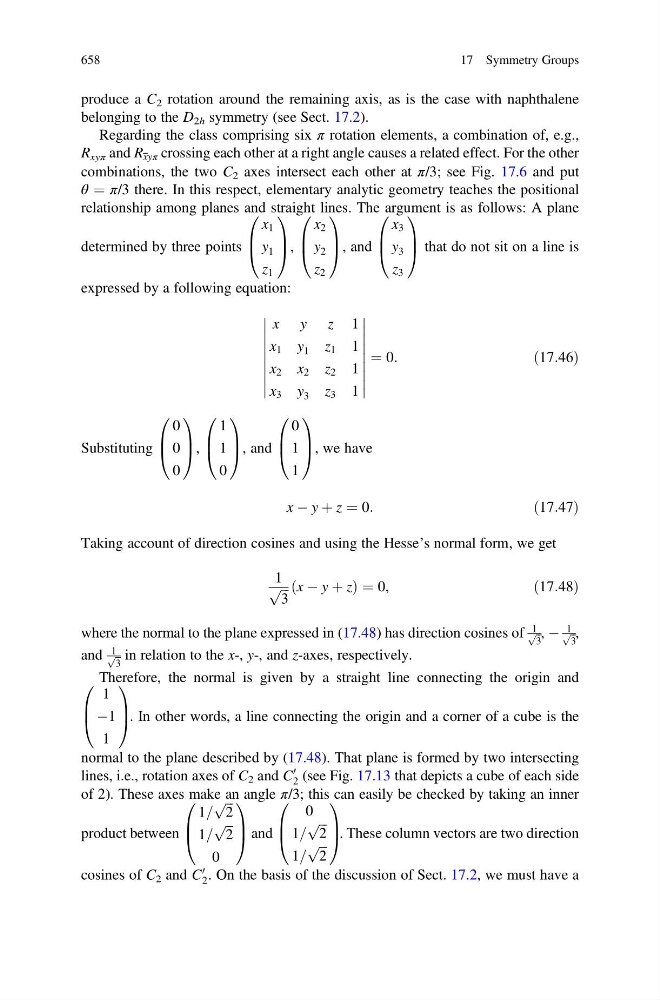
determined by three points
x 1
y 1
z 1
0
B
@
1
C
A,
x 2
y 2
z 2
0
B
@
1
C
A, and
x 3
y 3
z 3
0
B
@
1
C
A that do not sit on a line is
expressed by a following equation:
x y z 1
x 1 y 1 z 1 1
x 2 x 2 z 2 1
x 3 y 3 z 3 1
¼ 0:
ð17:46Þ
Substituting
0
0
0
0
B
@
1
C
A,
1
1
0
0
B
@
1
C
A, and
0
1
1
0
B
@
1
C
A, we have
x À y þ z ¼ 0:
ð17:47Þ
Taking account of direction cosines and using the Hesse’s normal form, we get
1
ffiffi ffi
3
p x À y þ z
ð
Þ¼0,
ð17:48Þ
where the normal to the plane expressed in (17.48) has direction cosines of
1 ffiffi
3
p , À
1 ffiffi
3
p ,
and
1 ffiffi
3
p in relation to the x-, y-, and z-axes, respectively.
Therefore, the normal is given by a straight line connecting the origin and
1
À1
1
0
B
@
1
C
A. In other words, a line connecting the origin and a corner of a cube is the
normal to the plane described by (17.48). That plane is formed by two intersecting
lines, i.e., rotation axes of C 2 and C
0
2 (see Fig. 17.13 that depicts a cube of each side
of 2). These axes make an angle π/3; this can easily be checked by taking an inner
product between
1=
ffiffi ffi
2
p
1=
ffiffi ffi
2
p
0
0
B
@
1
C
A and
0
1=
ffiffi ffi
2
p
1=
ffiffi ffi
2
p
0
B
@
1
C
A. These column vectors are two direction
cosines of C 2 and C
0
2 . On the basis of the discussion of Sect. 17.2, we must have a
658
17 Symmetry Groups