

of forming a group. This is because all the groups must contain identity element, and
so the number allowed is equal to or no greater than 7 C 3 ¼ 35.
(i) In light of the aforementioned discussion, two C 2 axes mutually intersecting at
π/2 yield another C 2 axis around the normal to a plane defined by the intersecting
axes. Thus, three C 2 axes have been chosen and a D 2 symmetry results. In this case,
we have only one choice. (ii) In the case of C 2v , two planes mutually intersecting at
π/2 yield a C 2 axis around their line of intersection. There are three possibilities of
choosing two axes out of three (i.e., 3 C 2 ¼ 3). (iii) If we choose the inversion (i)
along with, e.g., one of the three C 2 axes, a σ necessarily results. This is also the case
when we first combine a σ with i to obtain a C 2 axis. We have three possibilities (i.e.,
3 C 1 ¼ 3) as well. Thus, we have only seven choices to construct subgroups of D 2h
having an order of four. This is summarized in Table 17.5.
An inverse of any element is that element itself. Therefore, if with any above
subgroup one chooses any element out of the remaining four elements and combines
it with the identity, one can construct a subgroup C s , C 2 , or C i of an order of 2. Since
all those subgroups of an order of 4 and 2 are commutative with D 2h , these subgroups are invariant subgroups. Thus in terms of a direct-product group, D 2h can be
expressed as various direct factors. Conversely, we can construct factor groups from
coset decomposition. For instance, we have
6
6
6
(a)
(b)
(c)
(d)
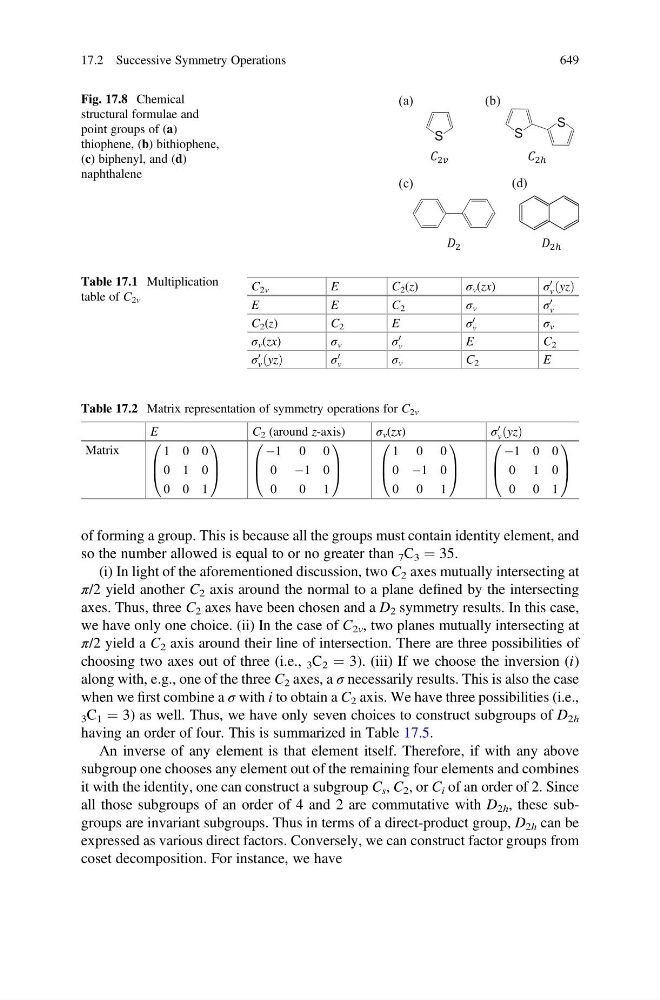
Fig. 17.8 Chemical
structural formulae and
point groups of (a)
thiophene, (b) bithiophene,
(c) biphenyl, and (d)
naphthalene
Table 17.1 Multiplication
table of C 2v
C 2v
E
C 2 (z)
σ v (zx)
σ
0
v yz
ð Þ
E
E
C 2
σ v
σ
0
v
C 2 (z)
C 2
E
σ
0
v
σ v
σ v (zx)
σ v
σ
0
v
E
C 2
σ
0
v yz
ð Þ
σ
0
v
σ v
C 2
E
Table 17.2 Matrix representation of symmetry operations for C 2v
E
C 2 (around z-axis)
σ v (zx)
σ
0
v yz
ð Þ
Matrix
1 0 0
0 1 0
0 0 1
0
B
@
1
C
A
À1 0 0
0 À1 0
0
0 1
0
B
@
1
C
A
1 0 0
0 À1 0
0 0 1
0
B
@
1
C
A
À1 0 0
0 1 0
0 0 1
0
B
@
1
C
A
17.2 Successive Symmetry Operations
649