

This newly generated plane intersects with the original mirror plane and produces a
different C n axis according to the above discussion. Thus, in this situation a mirror
symmetry plane cannot coexist with a sole rotation axis. In a geometric object with
higher symmetry such as O h , however, several mirror symmetry planes can coexist
with several rotation axes in such a way that the axes intersect with the mirror planes
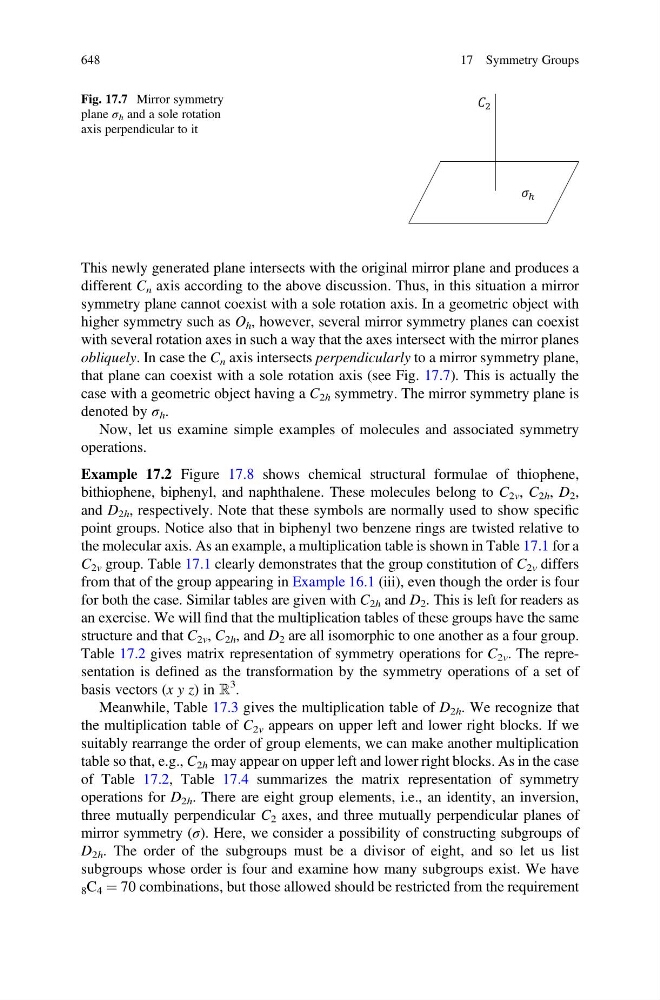
obliquely. In case the C n axis intersects perpendicularly to a mirror symmetry plane,
that plane can coexist with a sole rotation axis (see Fig. 17.7). This is actually the
case with a geometric object having a C 2h symmetry. The mirror symmetry plane is
denoted by σ h .
Now, let us examine simple examples of molecules and associated symmetry
operations.
Example 17.2 Figure 17.8 shows chemical structural formulae of thiophene,
bithiophene, biphenyl, and naphthalene. These molecules belong to C 2v , C 2h , D 2 ,
and D 2h , respectively. Note that these symbols are normally used to show specific
point groups. Notice also that in biphenyl two benzene rings are twisted relative to
the molecular axis. As an example, a multiplication table is shown in Table 17.1 for a
C 2v group. Table 17.1 clearly demonstrates that the group constitution of C 2v differs
from that of the group appearing in Example 16.1 (iii), even though the order is four
for both the case. Similar tables are given with C 2h and D 2 . This is left for readers as
an exercise. We will find that the multiplication tables of these groups have the same
structure and that C 2v , C 2h , and D 2 are all isomorphic to one another as a four group.
Table 17.2 gives matrix representation of symmetry operations for C 2v . The representation is defined as the transformation by the symmetry operations of a set of
basis vectors (x y z) in ℝ
3 .
Meanwhile, Table 17.3 gives the multiplication table of D 2h . We recognize that
the multiplication table of C 2v appears on upper left and lower right blocks. If we
suitably rearrange the order of group elements, we can make another multiplication
table so that, e.g., C 2h may appear on upper left and lower right blocks. As in the case
of Table 17.2, Table 17.4 summarizes the matrix representation of symmetry
operations for D 2h . There are eight group elements, i.e., an identity, an inversion,
three mutually perpendicular C 2 axes, and three mutually perpendicular planes of
mirror symmetry (σ). Here, we consider a possibility of constructing subgroups of
D 2h . The order of the subgroups must be a divisor of eight, and so let us list
subgroups whose order is four and examine how many subgroups exist. We have
8 C 4 ¼ 70 combinations, but those allowed should be restricted from the requirement
Fig. 17.7 Mirror symmetry
plane σ h and a sole rotation
axis perpendicular to it
648
17 Symmetry Groups