

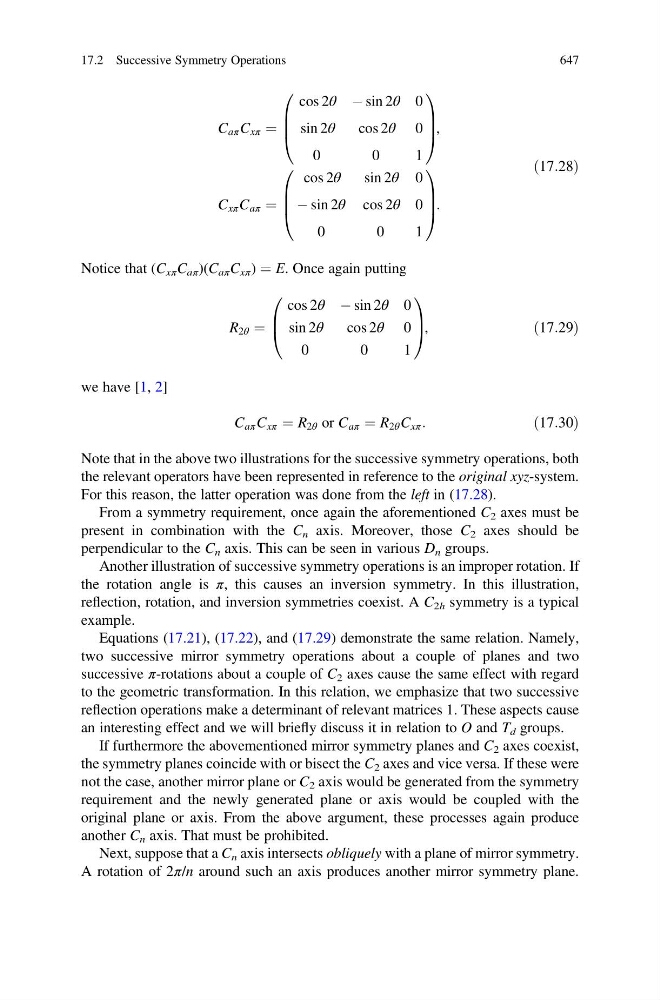
C aπ C xπ ¼
cos 2θ À sin 2θ 0
sin 2θ
cos 2θ 0
0
0
1
0
B
B
@
1
C
C
A ,
C xπ C aπ ¼
cos 2θ
sin 2θ 0
À sin 2θ cos 2θ 0
0
0
1
0
B
B
@
1
C
C
A :
ð17:28Þ
Notice that (C xπ C aπ )(C aπ C xπ ) ¼ E. Once again putting
R 2θ ¼
cos 2θ À sin 2θ 0
sin 2θ
cos 2θ 0
0
0
1
0
B
@
1
C
A,
ð17:29Þ
we have [1, 2]
C aπ C xπ ¼ R 2θ or C aπ ¼ R 2θ C xπ :
ð17:30Þ
Note that in the above two illustrations for the successive symmetry operations, both
the relevant operators have been represented in reference to the original xyz-system.
For this reason, the latter operation was done from the left in (17.28).
From a symmetry requirement, once again the aforementioned C 2 axes must be
present in combination with the C n axis. Moreover, those C 2 axes should be
perpendicular to the C n axis. This can be seen in various D n groups.
Another illustration of successive symmetry operations is an improper rotation. If
the rotation angle is π, this causes an inversion symmetry. In this illustration,
reflection, rotation, and inversion symmetries coexist. A C 2h symmetry is a typical
example.
Equations (17.21), (17.22), and (17.29) demonstrate the same relation. Namely,
two successive mirror symmetry operations about a couple of planes and two
successive π-rotations about a couple of C 2 axes cause the same effect with regard
to the geometric transformation. In this relation, we emphasize that two successive
reflection operations make a determinant of relevant matrices 1. These aspects cause
an interesting effect and we will briefly discuss it in relation to O and T d groups.
If furthermore the abovementioned mirror symmetry planes and C 2 axes coexist,
the symmetry planes coincide with or bisect the C 2 axes and vice versa. If these were
not the case, another mirror plane or C 2 axis would be generated from the symmetry
requirement and the newly generated plane or axis would be coupled with the
original plane or axis. From the above argument, these processes again produce
another C n axis. That must be prohibited.
Next, suppose that a C n axis intersects obliquely with a plane of mirror symmetry.
A rotation of 2π/n around such an axis produces another mirror symmetry plane.
17.2 Successive Symmetry Operations
647
cos 2θ À sin 2θ 0
sin 2θ
cos 2θ 0
0
0
1
0
B
B
@
1
C
C
A ,
C xπ C aπ ¼
cos 2θ
sin 2θ 0
À sin 2θ cos 2θ 0
0
0
1
0
B
B
@
1
C
C
A :
ð17:28Þ
Notice that (C xπ C aπ )(C aπ C xπ ) ¼ E. Once again putting
R 2θ ¼
cos 2θ À sin 2θ 0
sin 2θ
cos 2θ 0
0
0
1
0
B
@
1
C
A,
ð17:29Þ
we have [1, 2]
C aπ C xπ ¼ R 2θ or C aπ ¼ R 2θ C xπ :
ð17:30Þ
Note that in the above two illustrations for the successive symmetry operations, both
the relevant operators have been represented in reference to the original xyz-system.
For this reason, the latter operation was done from the left in (17.28).
From a symmetry requirement, once again the aforementioned C 2 axes must be
present in combination with the C n axis. Moreover, those C 2 axes should be
perpendicular to the C n axis. This can be seen in various D n groups.
Another illustration of successive symmetry operations is an improper rotation. If
the rotation angle is π, this causes an inversion symmetry. In this illustration,
reflection, rotation, and inversion symmetries coexist. A C 2h symmetry is a typical
example.
Equations (17.21), (17.22), and (17.29) demonstrate the same relation. Namely,
two successive mirror symmetry operations about a couple of planes and two
successive π-rotations about a couple of C 2 axes cause the same effect with regard
to the geometric transformation. In this relation, we emphasize that two successive
reflection operations make a determinant of relevant matrices 1. These aspects cause
an interesting effect and we will briefly discuss it in relation to O and T d groups.
If furthermore the abovementioned mirror symmetry planes and C 2 axes coexist,
the symmetry planes coincide with or bisect the C 2 axes and vice versa. If these were
not the case, another mirror plane or C 2 axis would be generated from the symmetry
requirement and the newly generated plane or axis would be coupled with the
original plane or axis. From the above argument, these processes again produce
another C n axis. That must be prohibited.
Next, suppose that a C n axis intersects obliquely with a plane of mirror symmetry.
A rotation of 2π/n around such an axis produces another mirror symmetry plane.
17.2 Successive Symmetry Operations
647