

2θ ¼ 2π=n or n ¼ π=θ:
ð17:26Þ
From a symmetry requirement, there should be n planes of mirror symmetry in
combination with the C n axis. Moreover, an intersection line of these n mirror
symmetry planes should coincide with that C n axis. This can be seen as various
C nv groups.
Next we consider another successive symmetry operations. Suppose that there are
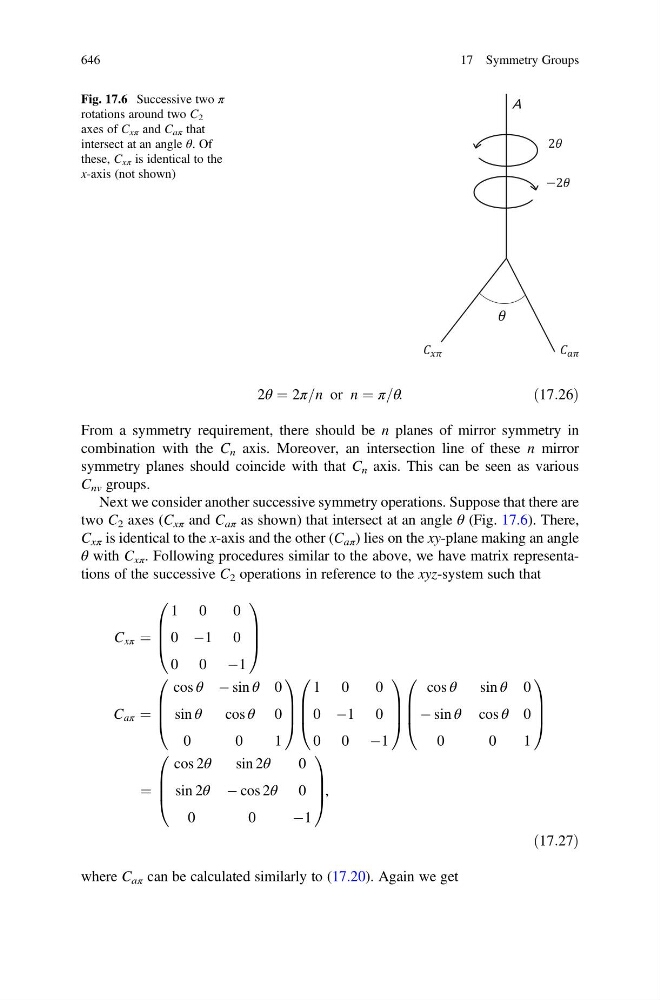
two C 2 axes (C xπ and C aπ as shown) that intersect at an angle θ (Fig. 17.6). There,
C xπ is identical to the x-axis and the other (C aπ ) lies on the xy-plane making an angle
θ with C xπ . Following procedures similar to the above, we have matrix representations of the successive C 2 operations in reference to the xyz-system such that
C xπ ¼
1 0
0
0 À1 0
0 0 À1
0
B
B
@
1
C
C
A
C aπ ¼
cos θ À sin θ 0
sin θ
cos θ 0
0
0
1
0
B
B
@
1
C
C
A
1 0
0
0 À1 0
0 0 À1
0
B
B
@
1
C
C
A
cos θ
sin θ 0
À sin θ cos θ 0
0
0
1
0
B
B
@
1
C
C
A
¼
cos 2θ
sin 2θ
0
sin 2θ À cos 2θ 0
0
0
À1
0
B
B
@
1
C
C
A ,
ð17:27Þ
where C aπ can be calculated similarly to (17.20). Again we get
$
2
−2
Fig. 17.6 Successive two π
rotations around two C 2
axes of C xπ and C aπ that
intersect at an angle θ. Of
these, C xπ is identical to the
x-axis (not shown)
646
17 Symmetry Groups