

e σσ ¼
cos 2θ À sin 2θ 0
sin 2θ
cos 2θ 0
0
0
1
0
B
@
1
C
A:
ð17:21Þ
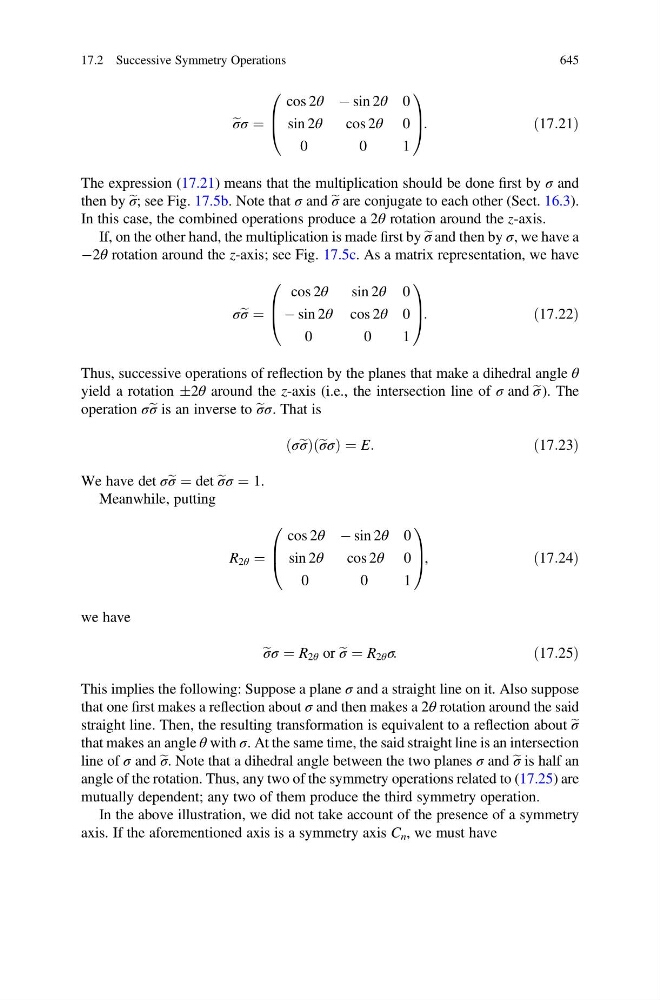
The expression (17.21) means that the multiplication should be done first by σ and
then by e σ; see Fig. 17.5b. Note that σ and e σ are conjugate to each other (Sect. 16.3).
In this case, the combined operations produce a 2θ rotation around the z-axis.
If, on the other hand, the multiplication is made first by e σ and then by σ, we have a
À2θ rotation around the z-axis; see Fig. 17.5c. As a matrix representation, we have
σe σ ¼
cos 2θ
sin 2θ 0
À sin 2θ cos 2θ 0
0
0
1
0
B
@
1
C
A:
ð17:22Þ
Thus, successive operations of reflection by the planes that make a dihedral angle θ
yield a rotation Æ2θ around the z-axis (i.e., the intersection line of σ and e σ ). The
operation σe σ is an inverse to e σσ. That is
σe σ
ð Þ e σσ
ð Þ ¼ E:
ð17:23Þ
We have det σe σ ¼ det e σσ ¼ 1.
Meanwhile, putting
R 2θ ¼
cos 2θ À sin 2θ 0
sin 2θ
cos 2θ 0
0
0
1
0
B
@
1
C
A,
ð17:24Þ
we have
e σσ ¼ R 2θ or e σ ¼ R 2θ σ:
ð17:25Þ
This implies the following: Suppose a plane σ and a straight line on it. Also suppose
that one first makes a reflection about σ and then makes a 2θ rotation around the said
straight line. Then, the resulting transformation is equivalent to a reflection about e σ
that makes an angle θ with σ. At the same time, the said straight line is an intersection
line of σ and e σ. Note that a dihedral angle between the two planes σ and e σ is half an
angle of the rotation. Thus, any two of the symmetry operations related to (17.25) are
mutually dependent; any two of them produce the third symmetry operation.
In the above illustration, we did not take account of the presence of a symmetry
axis. If the aforementioned axis is a symmetry axis C n , we must have
17.2 Successive Symmetry Operations
645
cos 2θ À sin 2θ 0
sin 2θ
cos 2θ 0
0
0
1
0
B
@
1
C
A:
ð17:21Þ
The expression (17.21) means that the multiplication should be done first by σ and
then by e σ; see Fig. 17.5b. Note that σ and e σ are conjugate to each other (Sect. 16.3).
In this case, the combined operations produce a 2θ rotation around the z-axis.
If, on the other hand, the multiplication is made first by e σ and then by σ, we have a
À2θ rotation around the z-axis; see Fig. 17.5c. As a matrix representation, we have
σe σ ¼
cos 2θ
sin 2θ 0
À sin 2θ cos 2θ 0
0
0
1
0
B
@
1
C
A:
ð17:22Þ
Thus, successive operations of reflection by the planes that make a dihedral angle θ
yield a rotation Æ2θ around the z-axis (i.e., the intersection line of σ and e σ ). The
operation σe σ is an inverse to e σσ. That is
σe σ
ð Þ e σσ
ð Þ ¼ E:
ð17:23Þ
We have det σe σ ¼ det e σσ ¼ 1.
Meanwhile, putting
R 2θ ¼
cos 2θ À sin 2θ 0
sin 2θ
cos 2θ 0
0
0
1
0
B
@
1
C
A,
ð17:24Þ
we have
e σσ ¼ R 2θ or e σ ¼ R 2θ σ:
ð17:25Þ
This implies the following: Suppose a plane σ and a straight line on it. Also suppose
that one first makes a reflection about σ and then makes a 2θ rotation around the said
straight line. Then, the resulting transformation is equivalent to a reflection about e σ
that makes an angle θ with σ. At the same time, the said straight line is an intersection
line of σ and e σ. Note that a dihedral angle between the two planes σ and e σ is half an
angle of the rotation. Thus, any two of the symmetry operations related to (17.25) are
mutually dependent; any two of them produce the third symmetry operation.
In the above illustration, we did not take account of the presence of a symmetry
axis. If the aforementioned axis is a symmetry axis C n , we must have
17.2 Successive Symmetry Operations
645